Neutrino Oscillations in Matter. Refractive Index

Introduction to Neutrino Physics

Dmitry V. Naumov

JINR

The Sun as an Optical Medium

Does the Matter of the Sun Affect Neutrino Oscillations?

  • No! Because the Sun is transparent to neutrinos. The scattering probability of a neutrino with an energy of 10 MeV is of the order of \(10^{-7}\).

  • And yet… Light in a transparent medium is hardly absorbed, but it is refracted. Perhaps the neutrino is also refracted in the Sun?

  • Yes! In this lecture we will see that the Sun and the vacuum are, for neutrinos, transparent crystals with two eigenstates and different refractive indices.

    • At the center of the Sun, at \(E=10\) MeV, the matter contributions differ by \(\delta n_e-\delta n_x\approx-8\cdot10^{-19}\).

    • From the center of the Sun to the surface there are about \(6\cdot10^{21}\) wavelengths, and the contribution of matter to the phase difference of the flavor components is about \(4\cdot10^{3}\) rad in absolute value; more than half of it comes from the inner tenth of the radius.

The Sun and the vacuum are, for neutrinos, transparent crystals with two eigenstates and different refractive indices.

Birefringent Crystal

Experiment: a plate between polarizers
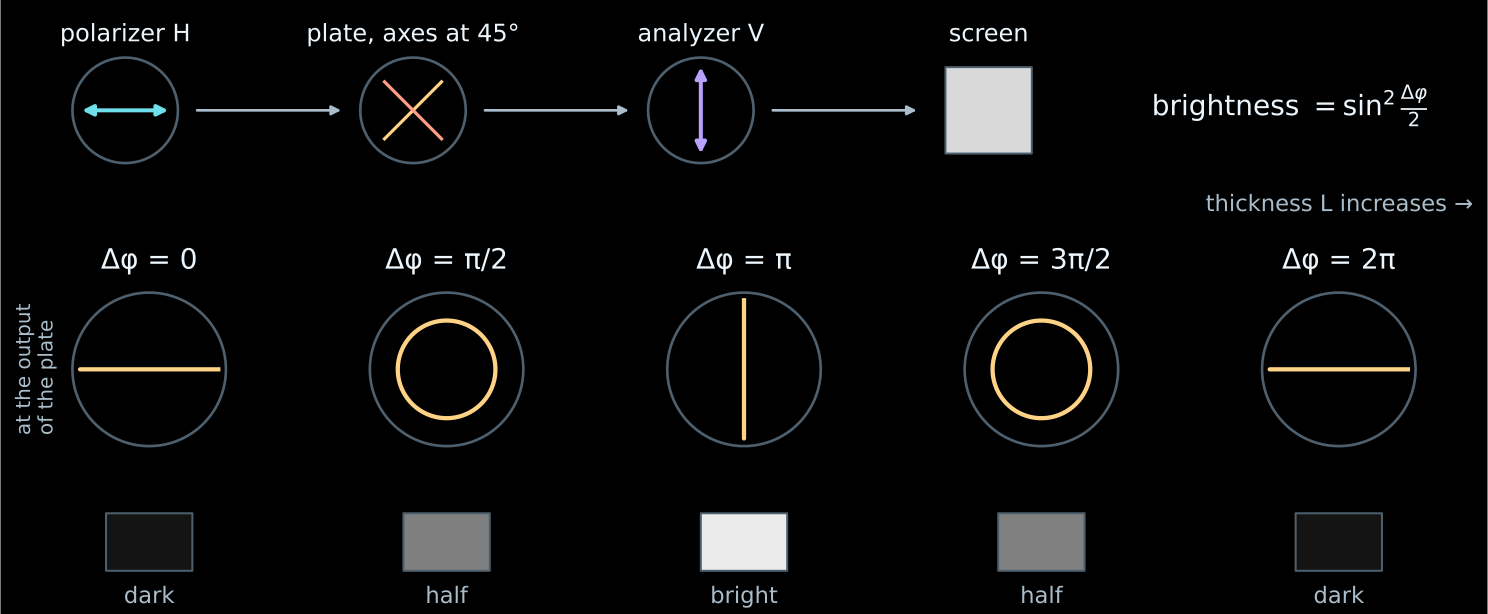
Polarizer H, a birefringent plate with axes at 45 degrees, analyzer V and a screen. Below: the output polarization and screen brightness for phase differences 0, pi/2, pi, 3 pi/2 and 2 pi: dark, half, bright, half, dark.

One frequency, two polarizations. Along the axes of the plate the refractive indices are \(n_1\neq n_2\), and the waves acquire a phase difference \(\Delta\varphi=(n_1-n_2)kL\).

\(P=\sin^2 2\theta\,\sin^2\dfrac{\Delta\varphi}{2}\), where \(\theta\) is the angle between the polarizer and the axis of the plate; here \(\theta=45^\circ\).

Two polarizations in a crystal

Input polarization, rotation of the eigenaxes, and plate thickness. Open separately.

For neutrinos, the vacuum is a birefringent crystal

Neutrino Light in a crystal
mass states \(\nu_1,\nu_2\) — the eigenaxes of the vacuum axes 1 and 2 of the crystal
angle \(\theta\) angle to the polarizer
\(E(n_1-n_2)\simeq\Delta m^2/(2E)\) \((n_1-n_2)k\)

For neutrinos, matter is also a birefringent crystal

Neutrino Light in a crystal
axes \(\nu_{\mathrm{mat},1},\nu_{\mathrm{mat},2}\) axes 1 and 2 of the crystal
angle \(\theta_m\) angle to the polarizer
\(E(n_{\mathrm{mat},1}-n_{\mathrm{mat},2})=\Delta m^2_{\mathrm{mat}}/(2E)\) \((n_1-n_2)k\)

The Nature of the Refractive Index

Light in glass

  • Let us pass monochromatic light through a transparent plate.

  • The incoming wave \(\psi_{\rm in}\) drives the electrons of the atoms, and they radiate a wave \(\psi_{\rm sc}\) at the same frequency.

  • Behind the plate the waves add up: \(\psi_{\rm out}=\psi_{\rm in}+\psi_{\rm sc}\).

  • The refractive index \(n\) arises from this sum: \(\psi_{\rm out}=e^{inkz}\).

  • At the output the light has the same frequency, but its phase changes.

Algorithm: we compute the total wave

  • after a single scatterer

  • after scattering on a thin plane perpendicular to the motion of the incident wave

  • after passing through a medium of finite thickness

One scatterer

For the calculation of the phase, a scalar wave model is sufficient. Far from a small scatterer the wave has the form

\[ \psi(\mathbf r)=e^{ikz}+f(\vartheta)\frac{e^{ikr}}{r}. \]

  • \(e^{ikz}\) is the incident plane wave;
  • \(f(\vartheta)e^{ikr}/r\) is the diverging wave;
  • \(f(\vartheta)\) is the complex scattering amplitude, which has the dimension of length.

The light field is a vector field, but for adding phases in the direction of propagation the scalar model suffices.

Cross section by a plane through the scatterer and the axis \(z\), \(f\) is real.

Fresnel rings

  • A layer of thickness \(dz\) in the plane \(z=0\), scatterer concentration \(\mathcal N\). The observation point \(P\) lies on the axis \(z\) behind the layer.

  • A scatterer at a distance \(b\) from the axis sends to \(P\) the wave \(f(\vartheta)\,e^{ikr}/r\), where \(r=\sqrt{z^2+b^2}\), \(\cos\vartheta=z/r\).

  • The points of the layer with the same \(r\) form a ring: a sphere of radius \(r\) centered at \(P\) intersects the plane of the layer along a circle.

  • Fresnel zones: \(r_m=z+m\lambda/2\). For neighboring rings the path to \(P\) differs by \(\lambda/2\), and the contributions arrive in antiphase.
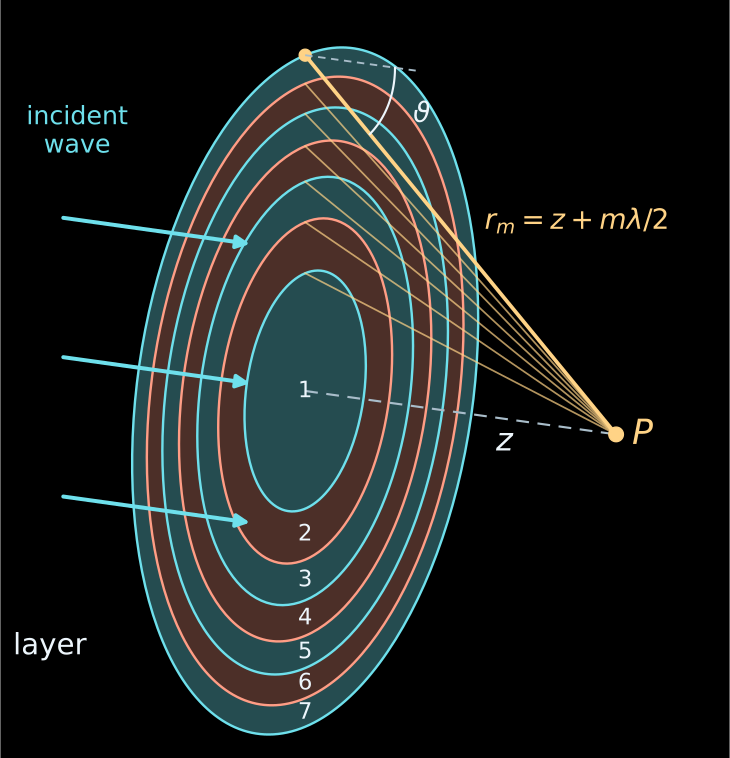
A flat layer with seven Fresnel zones, observation point P on the axis at distance z, rays from the zone boundaries to P, distance r_m and the scattering angle.

Why is the forward amplitude important?

A ring of radius \(b\) has area \(2\pi b\,db\), and \(b\,db=r\,dr\). The factor \(r\) cancels the \(1/r\) of the spherical wave, and the sum over the layer is written exactly:

\[ d\psi_{\rm sc}=\mathcal N\,dz\int\!2\pi b\,db\,f(\vartheta)\frac{e^{ikr}}{r} =2\pi\mathcal N\,dz\int_z^\infty\! f(\vartheta)\,e^{ikr}\,dr . \]

The beam is finite and the wave was switched on at some time: the distant rings are damped by the factor \(e^{-\varepsilon r}\). We integrate by parts, the lower limit \(r=z\) is the center of the layer:

\[ \int_z^\infty f\,e^{ikr}\,dr\;\simeq\;\frac{i}{k}\,f(0)\,e^{ikz} \quad\Longrightarrow\quad d\psi_{\rm sc}=i\,\frac{2\pi\mathcal N}{k}\,f(0)\,dz\,e^{ikz}. \]

The remainder is small as long as \(f(\vartheta)\) hardly changes over the first zone: \(z\gg ka^2\), where \(a\) is the size of the scatterer.

The contribution comes from the region of small angles, which is why \(f(0)\) appears. The factor \(i\) — a rotation by \(90^\circ\) — is given by the geometry of the plane layer. The phase of the layer’s contribution is equal to \(90^\circ+\arg f(0)\). Together with the incident wave behind the layer

\[ \begin{aligned} \psi&=e^{ikz}\,[1+i\,d\varphi],\\ d\varphi&=\frac{2\pi\mathcal N}{k}\,f(0)\,dz . \end{aligned} \]
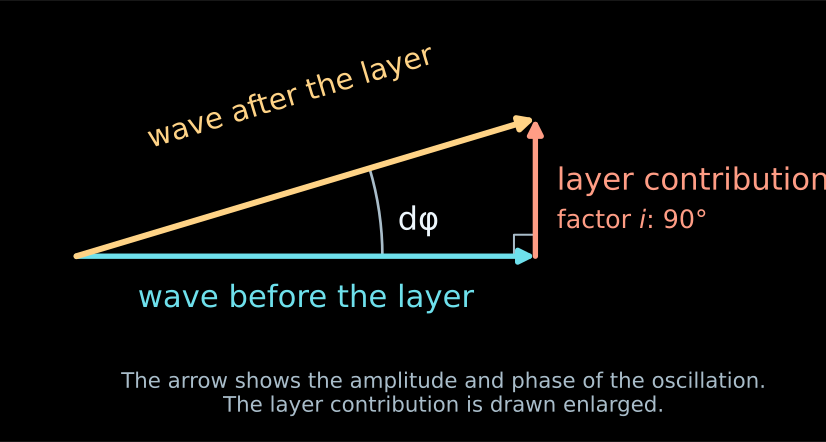
Arrow of the wave before the layer, the perpendicular contribution of the layer, and the arrow of the wave after the layer, rotated by a small angle d phi.

Sum over Fresnel zones

P layer z ≫ λ r = z + m·λ/2 in phase with the incident wave 90° = factor i limit ≈ i dashed: without cutoff

\(f(0)\) is factored out, the moment of time is fixed; the button adds ever more distant rings. The remainder up to the limit is \(e^{-\pi(\varepsilon/k)m}\). Model with a charge response (in Russian).

Many layers: homogeneous matter

Let us add free propagation through \(dz\) to the result for a thin layer (waves \(e^{ikz-i\omega t}\)):

\[ \psi(z+dz)=e^{ikdz} \left[1+i\,\frac{2\pi\mathcal N}{k}f(0)\,dz\right]\psi(z). \]

Let us divide the thickness \(D\) into \(M\) layers of \(dz=D/M\) each:

\[ e^{ikD}\left(1+i\,\frac{2\pi\mathcal N f(0)}{k}\frac{D}{M}\right)^M \xrightarrow[M\to\infty]{} e^{ikD}\exp\!\left(i\,\frac{2\pi\mathcal N f(0)}{k}D\right). \]

\[ \psi(z)=e^{ik_{\rm med}z}\psi(0), \qquad k_{\rm med}=k+\frac{2\pi\mathcal N}{k}f(0), \]

\[ k_{\rm med}=nk:\qquad \boxed{n=1+\frac{2\pi\mathcal N}{k^2}f(0)}. \]
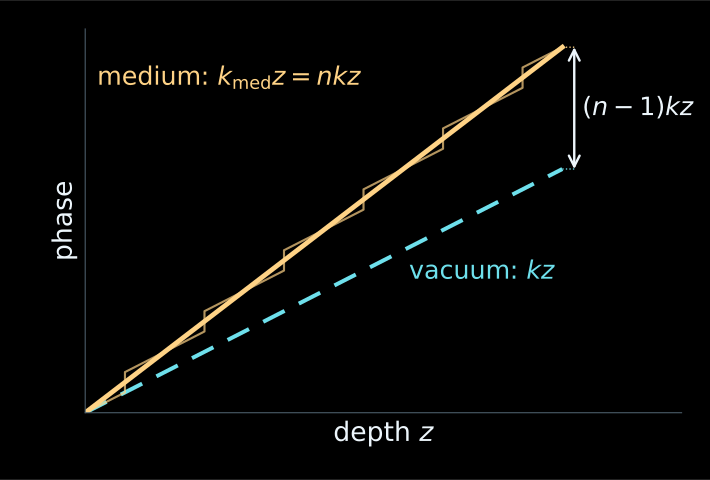
Phase versus depth: in vacuum a straight line kz, in matter steps at each layer and an average slope nk; the phase difference is (n-1)kz.

The exponential has accounted for all orders in \(\mathcal N D\), while \(n-1\) was found in the first order in the concentration of independent scatterers; the backscattered wave is neglected (\(|n-1|\ll1\)). In dense glass an atom is also acted upon by the field of neighboring atoms (the Lorentz–Lorenz formula), but the meaning of \(n\) is the same.

Refractive index and optics

  • In a transparent medium \(n\) can be considered real.

  • For light \(k=\omega/c\) in vacuum, while inside matter \(k_{\rm med}=n\omega/c\). Therefore

\[ \lambda_{\rm med}=\frac{\lambda_0}{n}, \qquad v_{\rm ph}=\frac{c}{n}, \qquad \Delta\varphi=k(n-1)z. \]

  • The frequency of a monochromatic wave is conserved in stationary matter.
  • Over a length \(z\) an additional phase \(\Delta\varphi\) accumulates.
  • At the boundary of media the phase must coincide along the surface. Hence \(n_1\sin\theta_1=n_2\sin\theta_2\).

Thus a single quantity describes both the shift of interference fringes and the refraction of a ray.

If the refractive index is complex

Let \(n=n_R+i n_I\). Then

\[ \psi(z)\propto e^{ikn_Rz}\,e^{-kn_Iz}, \qquad \frac{I(z)}{I(0)}=e^{-2kn_Iz}. \]

The real part of \(f(0)\) determines the phase, the imaginary part — the attenuation of the coherent beam. The optical theorem relates it to the total cross section:

\[ \sigma_{\rm tot}=\frac{4\pi}{k}\operatorname{Im}f(0) \quad\Longrightarrow\quad \frac{I(z)}{I(0)}=e^{-\mathcal N\sigma_{\rm tot}z}. \]

A medium can hardly absorb a wave and at the same time noticeably change its phase. For neutrinos this distinction will turn out to be decisive.

Two Refractive Indices of a Neutrino

The nature of the first refractive index
of a neutrino

  • If a neutrino of any flavor scatters elastically through zero angle in its interaction with the particles of the medium via the exchange of a \(Z\) boson, then:

    • the state of the medium does not change, and

    • the neutrino keeps its direction.

    • The forward-scattered wave adds coherently to the wave that passed through without scattering.

    • A contribution to the refractive index common to the active flavors appears.
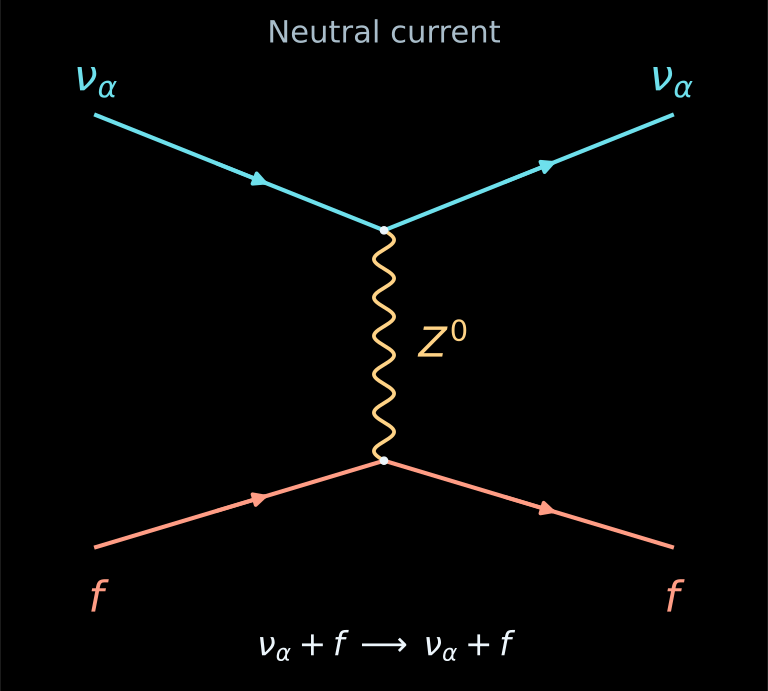
Neutral-current diagram: a neutrino of any active flavor and a fermion of the medium scatter elastically with Z0 exchange. On each fermion line the particle type is conserved.

\(\alpha=e,\mu,\tau\), \(\quad f=e^-,p,n\).

Nature of the second
refractive index of the neutrino

  • An ordinary (normal) medium consists of atomic nuclei and electrons. It contains no \(\mu\), \(\tau\).

  • An electron neutrino \(\nu_e\) can scatter elastically off an electron through the exchange of a \(W^+\) boson, which changes the refractive index \(\nu_e\).

  • Therefore the matter contributions \(\delta n_e\) and \(\delta n_x\) are different.

  • Matter changes both the refractive indices and the eigenstates of the vacuum “crystal”.
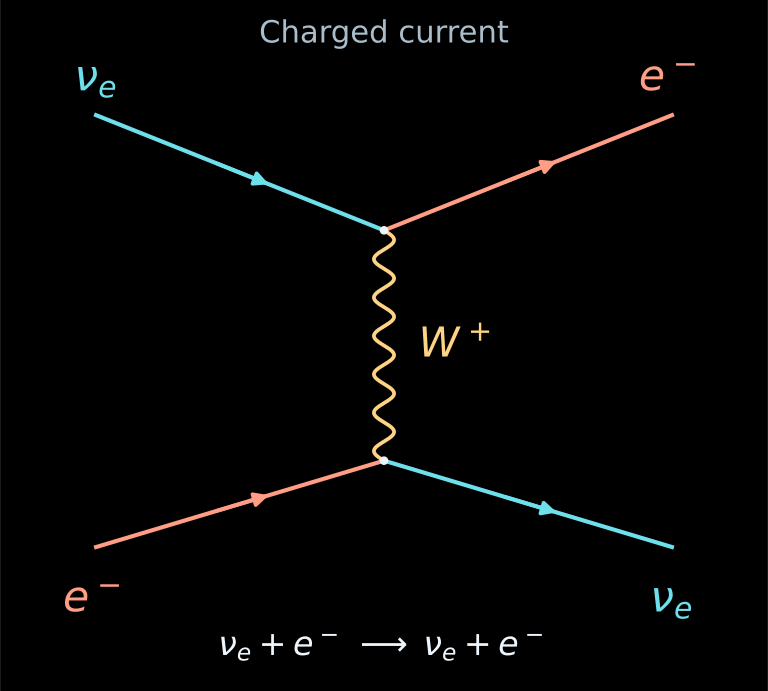
Charged-current diagram for elastic scattering of an electron neutrino on an electron. Incoming lines on the left are nu_e and e-, outgoing lines on the right are e- and nu_e; the vertices are connected by W+.

Neutrino state

  • A neutrino with a given energy \(E\) travels along \(z\). We use \(\hbar=c=1\), and drop the common factor \(e^{-iEt}\).

  • We consider two flavors: \(\nu_e\) and \(\nu_x\) (\(\nu_\mu\) or \(\nu_\tau\) or a combination of them).

  • The state and its flavor amplitudes:

\[ |\psi\rangle=\psi_e|\nu_e\rangle+\psi_x|\nu_x\rangle, \qquad \psi_\alpha=\langle\nu_\alpha|\psi\rangle. \]

  • The same vector can be expanded in the mass states \(|\nu_1\rangle,|\nu_2\rangle\):

\[ |\psi\rangle=a_1|\nu_1\rangle+a_2|\nu_2\rangle, \qquad a_i=\langle\nu_i|\psi\rangle. \]
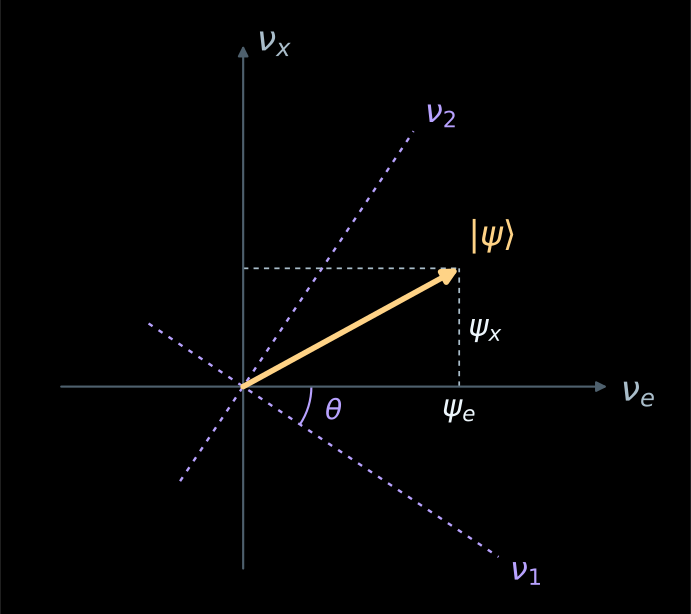
Flavor axes nu_e and nu_x, projections psi_e and psi_x, and the mass axes nu_1 and nu_2 rotated by the angle theta.

Diagram of the bases in the state space. The amplitudes are in general complex.

The vacuum crystal

In vacuum the mass states \(|\nu_i\rangle\) propagate independently. Each wave has its own refractive index:

\[ n_i=\frac{k_{\mathrm{vac},i}}{E} =\sqrt{1-\frac{m_i^2}{E^2}} \simeq1-\frac{m_i^2}{2E^2}. \]

Let us combine them into the refractive-index operator:

\[ \boxed{\hat n_{\mathrm{vac}} =\sum_{i=1,2}n_i\,|\nu_i\rangle\langle\nu_i|.} \]

The factor \(|\nu_i\rangle\langle\nu_i|\) picks out the component along \(|\nu_i\rangle\). Hence

\[ \hat n_{\mathrm{vac}}|\nu_i\rangle=n_i|\nu_i\rangle. \]

This is a definition of the operator through its eigenstates. Its matrix can be written in any basis.

How a state propagates in vacuum

Each eigenstate acquires its own phase:

\[ a_i(z)=a_i(0)e^{iEn_i z}, \qquad |\psi(z)\rangle=\sum_i a_i(0)e^{iEn_i z}|\nu_i\rangle. \]

We differentiate the sum and use the definition \(\hat n_{\mathrm{vac}}\):

\[ \frac{d|\psi\rangle}{dz} =iE\sum_i n_i a_i(z)|\nu_i\rangle =iE\hat n_{\mathrm{vac}}|\psi\rangle. \]

\[ \boxed{\frac{d|\psi\rangle}{dz}=iE\hat n_{\mathrm{vac}}|\psi\rangle.} \]

The oscillations are determined by the phase difference of the two waves:

\[ \Delta\varphi=E(n_1-n_2)z\simeq\frac{\Delta m^2}{2E}z, \qquad \Delta m^2=m_2^2-m_1^2. \]

The matrix in the mass basis

The matrix elements are projections of the operator onto the chosen basis states:

\[ \langle\nu_i|\hat n_{\mathrm{vac}}|\nu_j\rangle=n_i\delta_{ij}. \]

Therefore, in the basis \((\nu_1,\nu_2)\)

\[ \boxed{[\hat n_{\mathrm{vac}}]_{\mathrm{mass}} =\begin{pmatrix}n_1&0\\0&n_2\end{pmatrix},} \qquad \frac{d}{dz}\begin{pmatrix}a_1\\a_2\end{pmatrix} =iE\begin{pmatrix}n_1&0\\0&n_2\end{pmatrix} \begin{pmatrix}a_1\\a_2\end{pmatrix}. \]

The source and the detector distinguish flavors. To go over to their amplitudes we introduce the matrix \(U\):

\[ U_{\alpha i}=\langle\nu_\alpha|\nu_i\rangle, \qquad \begin{pmatrix}\psi_e\\\psi_x\end{pmatrix} =U\begin{pmatrix}a_1\\a_2\end{pmatrix}. \]

The same operator in the flavor basis

\[ U=\begin{pmatrix} \cos\theta&\sin\theta\\ -\sin\theta&\cos\theta \end{pmatrix}, \qquad \boxed{[\hat n_{\mathrm{vac}}]_f =U\begin{pmatrix}n_1&0\\0&n_2\end{pmatrix}U^\dagger.} \]

The rows and columns of this matrix refer to \((\nu_e,\nu_x)\):

\[ \langle\nu_\alpha|\hat n_{\mathrm{vac}}|\nu_\beta\rangle =\sum_i n_i\,U_{\alpha i}U_{\beta i}^*. \]

\[ [\hat n_{\mathrm{vac}}]_f= \begin{pmatrix} n_1\cos^2\theta+n_2\sin^2\theta & (n_2-n_1)\sin\theta\cos\theta\\ (n_2-n_1)\sin\theta\cos\theta & n_1\sin^2\theta+n_2\cos^2\theta \end{pmatrix}. \]

Under the change of basis the matrix became non-diagonal. The eigenstates \(\nu_1,\nu_2\) and the indices \(n_1,n_2\) stayed the same.

From light to neutrinos

Polarizations → mass states \(\nu_{\mathrm{vac},i}\equiv\nu_i\); intensity fractions → probabilities. Open separately · Animation.

Neutrinos in matter

Matter adds its own contribution

Coherent forward scattering in ordinary matter gives different contributions for \(\nu_e\) and \(\nu_x\):

\[ \boxed{\delta\hat n =\delta n_e|\nu_e\rangle\langle\nu_e| +\delta n_x|\nu_x\rangle\langle\nu_x|.} \]

Here \(\delta n_\alpha\) is the contribution to the refractive index:

\[ \delta n_\alpha=\frac{2\pi}{E^2} \sum_{a=e,p,n}\mathcal N_a\operatorname{Re}f_{\alpha a}(0). \]

In a thin layer \(dz\) the phase contributions of vacuum and matter add up. The equation keeps its form:

\[ \boxed{\frac{d|\psi\rangle}{dz}=iE\hat n_{\mathrm{mat}}|\psi\rangle, \qquad \hat n_{\mathrm{mat}}=\hat n_{\mathrm{vac}}+\delta\hat n.} \]

We keep the leading corrections to \(n=1\) from the masses and the weak interaction. We neglect the attenuation of the beam: the operator \(\hat n_{\mathrm{mat}}\) is Hermitian.

Adding the matrices in one basis

In the flavor basis the matter contribution is diagonal:

\[ \boxed{[\hat n_{\mathrm{mat}}]_f =U\begin{pmatrix}n_1&0\\0&n_2\end{pmatrix}U^\dagger +\begin{pmatrix}\delta n_e&0\\0&\delta n_x\end{pmatrix}.} \]

In the mass basis the vacuum contribution is diagonal:

\[ [\hat n_{\mathrm{mat}}]_{\mathrm{mass}} =\begin{pmatrix}n_1&0\\0&n_2\end{pmatrix} +U^\dagger\begin{pmatrix}\delta n_e&0\\0&\delta n_x\end{pmatrix}U. \]

The vacuum and the matter contribution have different eigenaxes. We find the eigenstates of the full medium from their sum.

New axes — new eigenstates

The eigenstates of the full medium satisfy the equation

\[ \hat n_{\mathrm{mat}}|\nu_{\mathrm{mat},i}\rangle =n_{\mathrm{mat},i}|\nu_{\mathrm{mat},i}\rangle. \]

Hence the spectral representation has the familiar form:

\[ \boxed{\hat n_{\mathrm{mat}}=\sum_i n_{\mathrm{mat},i} |\nu_{\mathrm{mat},i}\rangle\langle\nu_{\mathrm{mat},i}|.} \]

  • \(n_1,n_2\) are the vacuum eigen-indices.
  • \(\delta n_e,\delta n_x\) are the flavor contributions of matter.
  • \(n_{\mathrm{mat},1},n_{\mathrm{mat},2}\) are the eigen-indices of the full medium.
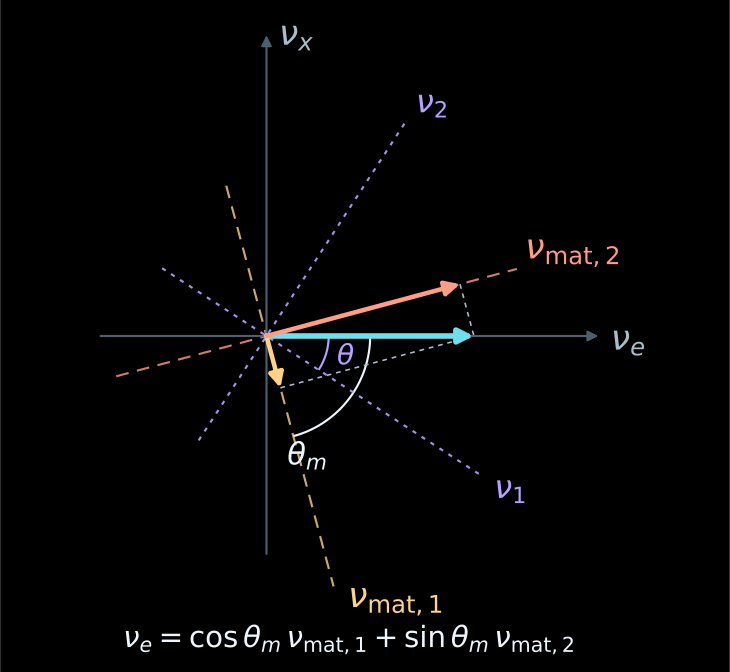
Flavor axes nu_e and nu_x; mass axes nu_1 and nu_2 at angle theta; matter eigenaxes nu_mat,1 and nu_mat,2 at angle theta_m. In dense matter nu_mat,2 is close to nu_e.

Propagation in uniform matter

At constant density the eigenaxes and the indices do not depend on \(z\). We expand the input state along these axes:

\[ |\psi(0)\rangle=\sum_i c_i(0)|\nu_{\mathrm{mat},i}\rangle, \qquad c_i(0)=\langle\nu_{\mathrm{mat},i}|\psi(0)\rangle. \]

Each component acquires its own phase:

\[ c_i(z)=e^{iEn_{\mathrm{mat},i}z}c_i(0). \]

Adding the two eigenstates, we obtain

\[ \boxed{|\psi(z)\rangle =\sum_i e^{iEn_{\mathrm{mat},i}z} |\nu_{\mathrm{mat},i}\rangle \langle\nu_{\mathrm{mat},i}|\psi(0)\rangle.} \]

A contribution proportional to the identity operator gives a common phase. The probabilities are affected by the difference of the eigen-indices and by the orientation of the axes.

The source prepares \(\nu_e\), the detector looks for \(\nu_x\)

  • The mixing angle in matter \(\theta_m\) determines the expansion of the flavors in the eigenstates:

\[ \begin{aligned} |\nu_e\rangle&=\cos\theta_m|\nu_{\mathrm{mat},1}\rangle+\sin\theta_m|\nu_{\mathrm{mat},2}\rangle,\\ |\nu_x\rangle&=-\sin\theta_m|\nu_{\mathrm{mat},1}\rangle+\cos\theta_m|\nu_{\mathrm{mat},2}\rangle. \end{aligned} \]

  • The source excites both waves, they acquire different phases, and the detector takes the projection onto \(\nu_x\):

\[ A_{e\to x}(z)=\sum_{i=1,2} \underbrace{\langle\nu_x|\nu_{\mathrm{mat},i}\rangle}_{\text{detector}}\, \underbrace{e^{iEn_{\mathrm{mat},i}z}}_{\text{path}}\, \underbrace{\langle\nu_{\mathrm{mat},i}|\nu_e\rangle}_{\text{source}} . \]

  • We substitute the projections. For \(z=0\) the contributions cancel: the source prepared a pure \(\nu_e\).

\[ \boxed{A_{e\to x}(z)=\sin\theta_m\cos\theta_m \bigl(e^{iEn_{\mathrm{mat},2}z}-e^{iEn_{\mathrm{mat},1}z}\bigr)}. \]

Two waves: vacuum and solar matter

Same path, \(\nu_e\) at the entrance. The density at the center of the Sun is constant over the whole segment; \(E=10\) MeV. Open separately · Video version.

What already follows from this picture

\[ \boxed{P_{e\to x}=\sin^22\theta_m\,\sin^2\frac{\Delta\varphi}{2}}, \qquad \Delta\varphi=E(n_{\mathrm{mat},1}-n_{\mathrm{mat},2})z. \]

  • In vacuum the result is the same, with \(\theta\) and \(\Delta\varphi\simeq(\Delta m^2/2E)z\): matter changes the eigenaxes and the difference of the refractive indices.
  • This is the same interference of two eigenstates as in a plate between crossed polarizers: \(\theta_m\leftrightarrow\theta\), \(E(n_{\mathrm{mat},1}-n_{\mathrm{mat},2})\leftrightarrow(n_1-n_2)k\).
  • For \(\theta_m=0\) the state \(\nu_e\) is itself an eigenstate, and there are no transitions.
  • The formula holds at constant density. For variable density \(\hat n_{\mathrm{mat}}=\hat n_{\mathrm{mat}}(z)\); in the basis of its local eigenstates one has to account for the rotation of the axes along the path.

How matter changes \(\theta_m\) and \(n_{\mathrm{mat},1}-n_{\mathrm{mat},2}\) we will compute in lecture 12, and we will consider slowly varying density in lecture 13.

Dictionary: neutrino and crystal

Neutrino Light in a birefringent crystal
is born as \(\nu_e\); the detector looks for \(\nu_e\) or \(\nu_x\) polarizer H; analyzer H or V
\(\nu_1,\nu_2\) are the vacuum eigenstates polarizations along the crystal axes
mixing angle \(\theta\) angle between the crystal axis and the polarizer
\(E(n_1-n_2)\simeq\Delta m^2/(2E)\) \((n_1-n_2)k\)
matter: different contributions \(\delta n_e,\delta n_x\) deformation with an additional anisotropy along the H/V axes
\(\nu_{\mathrm{mat},1},\nu_{\mathrm{mat},2}\) and angle \(\theta_m\) new axes of the deformed crystal

For neutrinos, empty space is already a crystal: \(\hat n_{\mathrm{vac}}\) has eigenstates \(\nu_1,\nu_2\) with indices \(n_i\simeq1-m_i^2/(2E^2)\). Matter adds \(\delta\hat n\), which is diagonal in the flavor basis. The eigenstates of the sum \(\hat n_{\mathrm{mat}}\) determine the propagation in matter.

Supplement

Where the \(f(0)\) for Light Comes From

An electron in an atom is an oscillator with natural frequency \(\omega_0\) and damping \(\gamma\). Its forward scattering amplitude in Gaussian units, \(r_e=e^2/(mc^2)\):

\[ f(0)=r_e\,\frac{\omega^2}{\omega_0^2-\omega^2-i\gamma\omega}, \qquad n-1=\frac{2\pi\mathcal N f(0)}{k^2} =\frac{2\pi\mathcal N e^2}{m}\,\frac{1}{\omega_0^2-\omega^2-i\gamma\omega}. \]

  • \(\omega<\omega_0\), visible light in glass: \(n>1\) and grows with frequency — blue light is refracted more strongly than red.
  • \(\omega\gg\omega_0\), X-rays: \(f(0)\to-r_e\) (Thomson scattering), \(n<1\).
  • Near \(\omega_0\) the \(\operatorname{Im}f(0)\) is large: the coherent beam is attenuated (by the optical theorem — due to absorption and scattering).
  • For neutrinos, \(f(0)\) is determined by the weak interaction; we will compute it in Lecture 12.

Exercises for this lecture

  • 11.1. The first Fresnel zone
  • 11.2. Phase and attenuation
  • 11.3. Two refractive indices
  • 11.4. When coherence is lost
  • 11.5. A plate and the accumulated phase
  • 11.6. Two eigenstates
  • 11.7. A half-wave plate and neutrinos
  • 11.8. The refractive index operator
  • 11.9. Vacuum and the Sun: two crystals of the same scale
  • 11.10. A refractive index below one