Neutrino Physics: Fundamentals, Frontiers, and Probes

A short review (2026)

Dmitry V. Naumov

Neutrinos in the Standard Model

  • Three flavors: \(\nu_e\), \(\nu_\mu\), \(\nu_\tau\)
  • Neutral spin-\(1/2\) fermions
  • Produced and detected through the weak interaction
  • In the minimal renormalizable Standard Model, neutrinos are massless

Oscillations show that at least two neutrinos have nonzero mass.
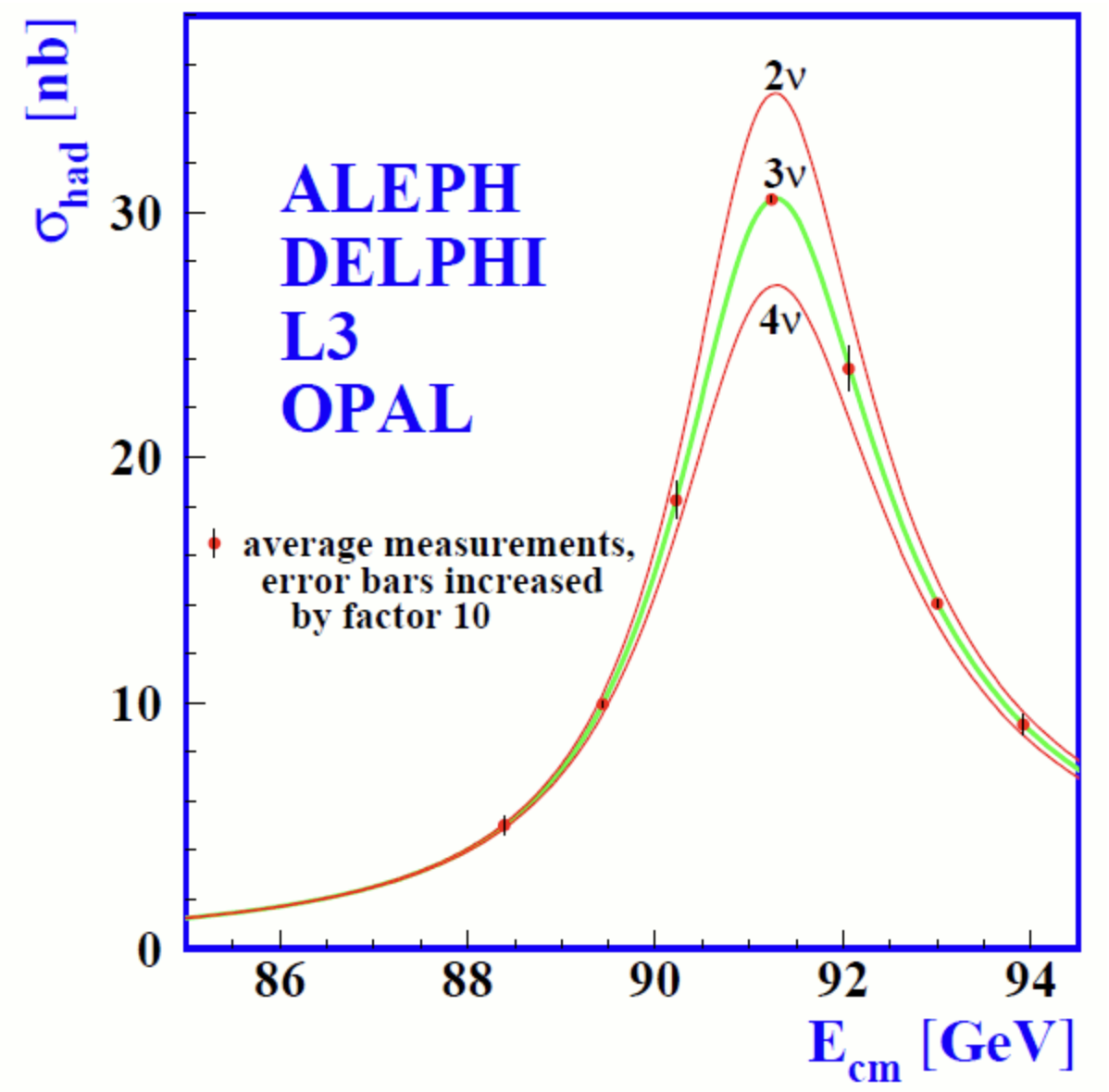
The invisible width of the \(Z\) is consistent with three light active neutrinos.

Why neutrinos are unusual messengers

The mean free path is

\[ \lambda_\nu = \frac{1}{n\sigma}. \]

A 1 MeV solar neutrino

\[ \sigma(\nu_e e)\sim10^{-44}\ \mathrm{cm^2}, \qquad \lambda_\nu\sim10^{20}\ \mathrm{cm} \sim10^9 R_\odot. \]

The Sun is essentially transparent.

A 1 PeV neutrino crossing Earth

\[ \sigma(\nu N)\sim10^{-33}\ \mathrm{cm^2}, \qquad \lambda_\nu\sim3\times10^3\ \mathrm{km}. \]

At extreme energies, even Earth becomes opaque.

Weak interaction makes neutrinos both difficult to detect and uniquely informative.

Flavor states and mass states

\[ \boxed{\displaystyle |\nu_\alpha\rangle=\sum_i U_{\alpha i}^{*}|\nu_i\rangle } \]

Flavor states \(\nu_e,\nu_\mu,\nu_\tau\)

Produced and detected in weak interactions.

Mass states \(\nu_1,\nu_2,\nu_3\)

Propagate with definite masses and accumulate different phases.

The two bases do not coincide. This mismatch and distinct neutrino masses are the origin of oscillations.

Neutrino oscillations

\[ P(\nu_e\!\to\!\nu_\mu)= \sin^2 2\theta\, \sin^2\!\left(\frac{\Delta m^2L}{4E}\right). \]

Different propagation phases convert one detectable flavor mixture into another.

How do we know?

Neutrino source Observed pattern What it establishes
Solar Energy-dependent \(\nu_e\) survival Flavor conversion in matter and vacuum
Atmospheric Zenith- and energy-dependent \(\nu_\mu\) disappearance Oscillations over Earth-scale baselines
Reactors Spectral disappearance of \(\bar\nu_e\) Precise mixing and mass splitting
Accelerators Disappearance and appearance Controlled tests across flavors

One three-neutrino framework describes independent sources, energies, and baselines.

Building the PMNS matrix from observations

Step 0 of 4

Start with the flavor and mass bases

Solar, reactor, and atmospheric measurements supply different entries. Row and column normalization then connect them.

This guided reconstruction assumes \(|U_{e3}|^2=0\) and a real, \(\mu\)–\(\tau\)-symmetric solution. It is not a global oscillation fit.

\(\nu_1\) \(\nu_2\) \(\nu_3\)
\(\nu_e\) ? ? ?
\(\nu_\mu\) ? ? ?
\(\nu_\tau\) ? ? ?

\(\displaystyle\sum_i U_{\alpha i}U_{\beta i}^{*}=\delta_{\alpha\beta},\qquad \sum_{\alpha}U_{\alpha i}^{*}U_{\alpha j}=\delta_{ij}\)

\(\displaystyle U^{\dagger}U=UU^{\dagger}=I_3= \begin{pmatrix}1&0&0\\0&1&0\\0&0&1\end{pmatrix}\)

The three-neutrino picture

Mixing

\[ \theta_{12}\approx34^\circ, \qquad \theta_{13}\approx9^\circ, \qquad \theta_{23}\approx45^\circ. \]

Mass splittings

\[ \Delta m^2_{21}\approx7.4\times10^{-5}\ \mathrm{eV^2}, \]

\[ |\Delta m^2_{31}|\approx2.5\times10^{-3}\ \mathrm{eV^2}. \]

The minimal oscillation picture contains

  • three mixing angles;
  • two independent mass-squared differences;
  • one Dirac CP phase, \(\delta_{\rm CP}\).

If neutrinos are Majorana particles, two additional phases do not affect oscillations.

Neutrino physics has become precision physics

  • Established

    • Three active flavors mix, and at least two masses are nonzero.
  • Cross-checked

    • Solar, atmospheric, reactor, and accelerator data constrain one common framework.
  • Now targeted

    • The remaining unknowns are sharply formulated and experimentally testable.

The field has moved from discovering oscillations to testing the structure behind them.

Mass ordering

Normal ordering

\[m_1<m_2<m_3\]

Inverted ordering

\[m_3<m_1<m_2\]

Solar data fix \(m_2>m_1\). The sign of the atmospheric splitting distinguishes the two spectra.

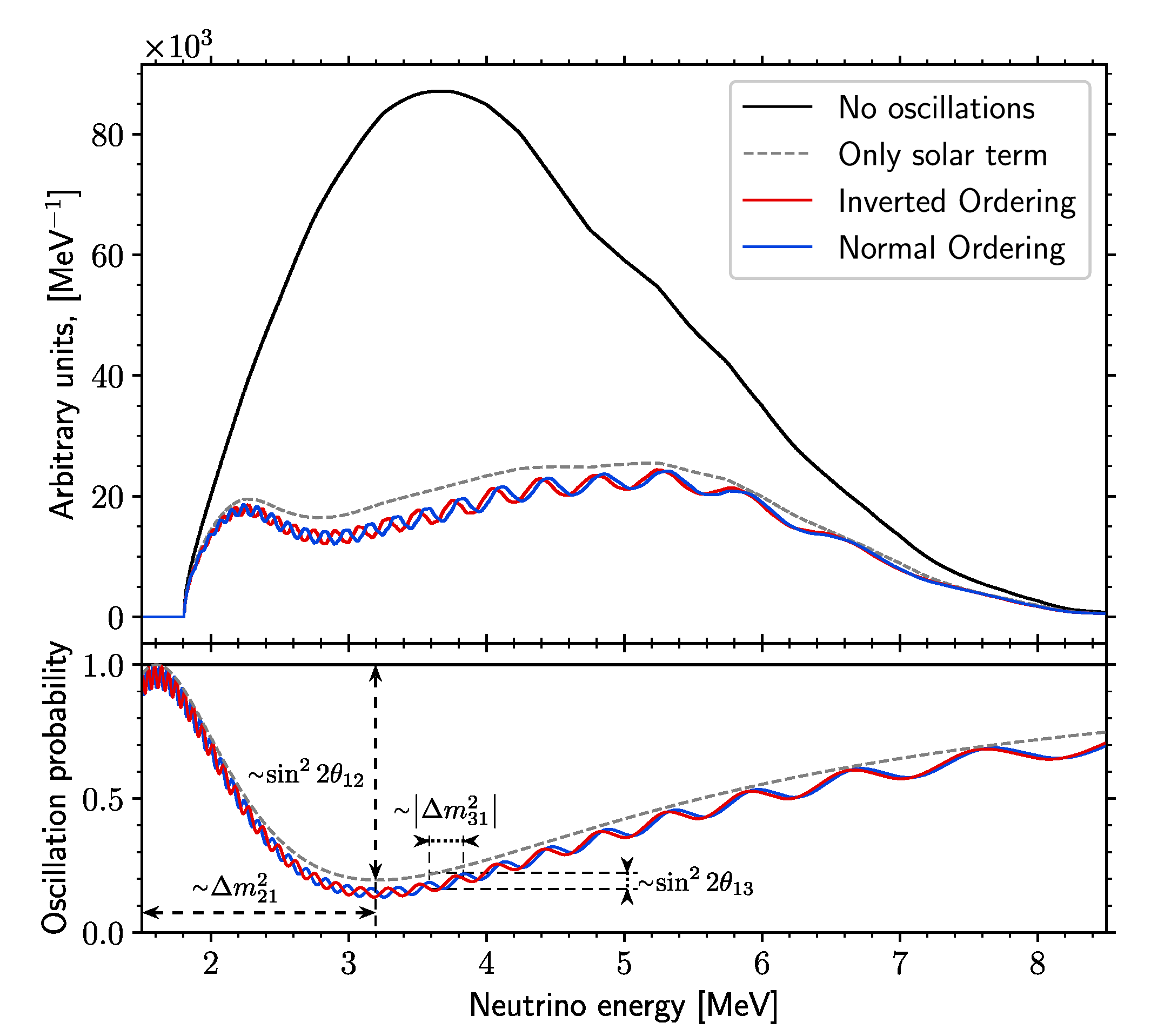
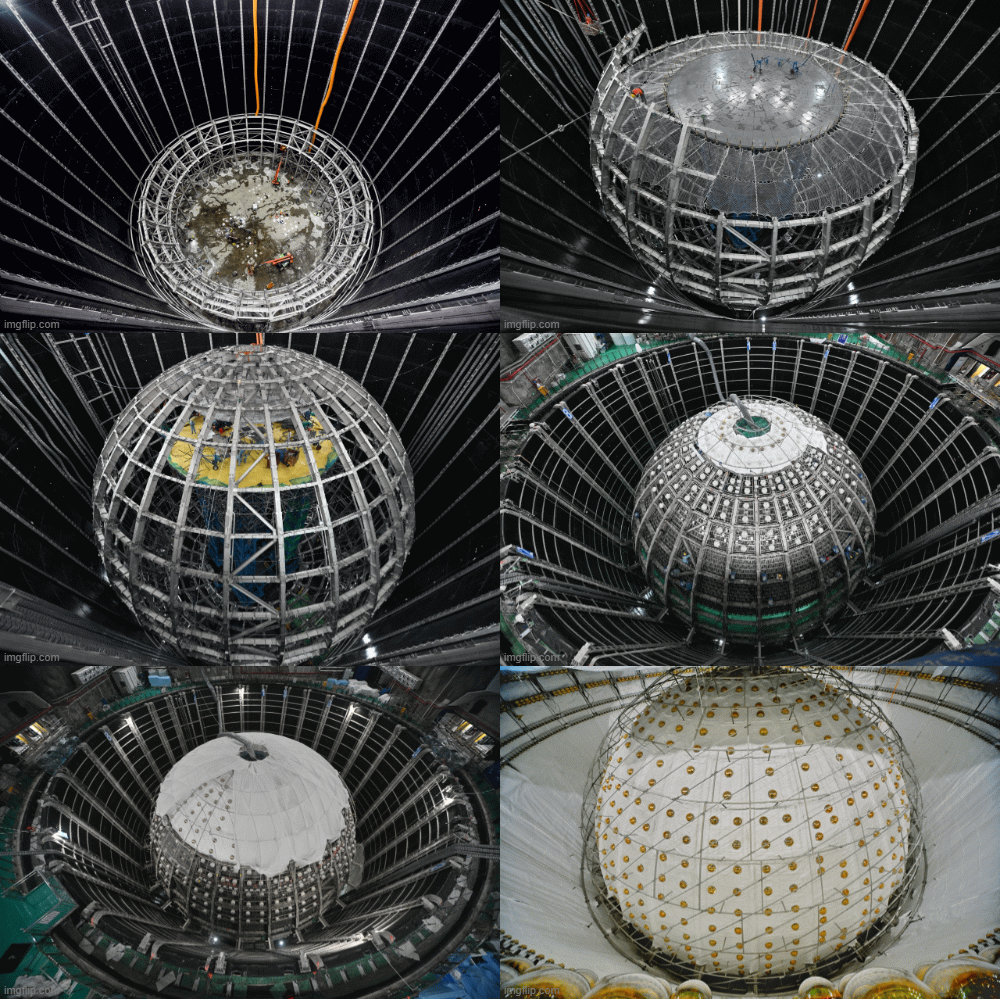
JUNO reads the interference pattern

  • Reactor antineutrinos travel about 52.5 km to the detector.
  • Fine spectral ripples carry information on the ordering in a vacuum-dominated measurement.
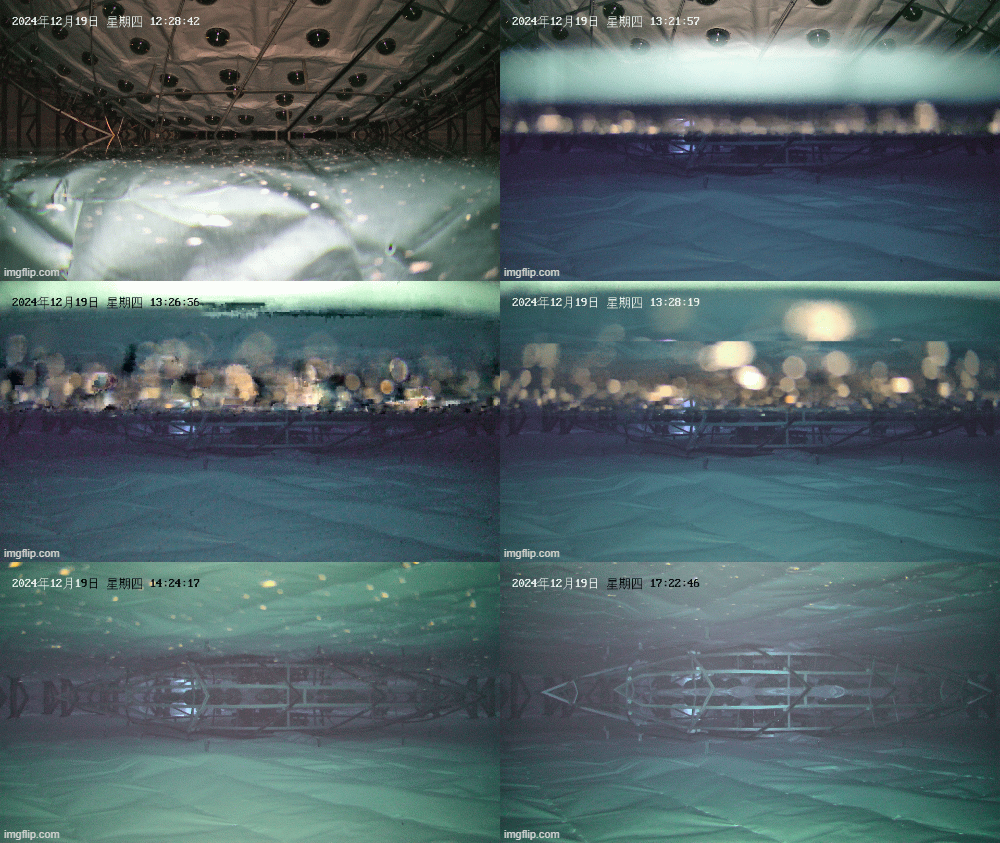
  • A 20 kt liquid-scintillator target and precise energy response make the ripples measurable.
  • TAO and Daya Bay constrain the unoscillated reactor spectrum.

JUNO: larger data set, sharper parameters

JUNO analysis
Live time 207.2 days
IBD candidates 8294
\(\sin^2\theta_{12}\) \(0.3036\pm0.0064\)
\(\Delta m^2_{21}\) \((7.388\pm0.078)\times10^{-5}\ \mathrm{eV^2}\)
\(\Delta m^2_{31}\), NO \(+2.509^{+0.027}_{-0.025}\times10^{-3}\ \mathrm{eV^2}\)
  • Combining JUNO and Daya Bay with long-baseline constraints gives \(\chi^2_{\rm IO}-\chi^2_{\rm NO}=4.86\), corresponding to a one-sided \(2.1\sigma\) indication for normal ordering.

JUNO: one detector, a broad physics program
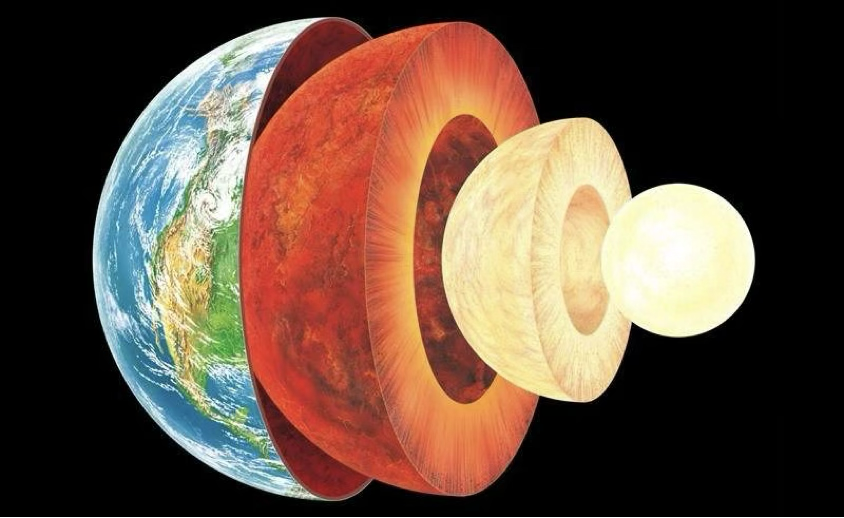
Cutaway view of Earth's crust, mantle, outer core, and inner core

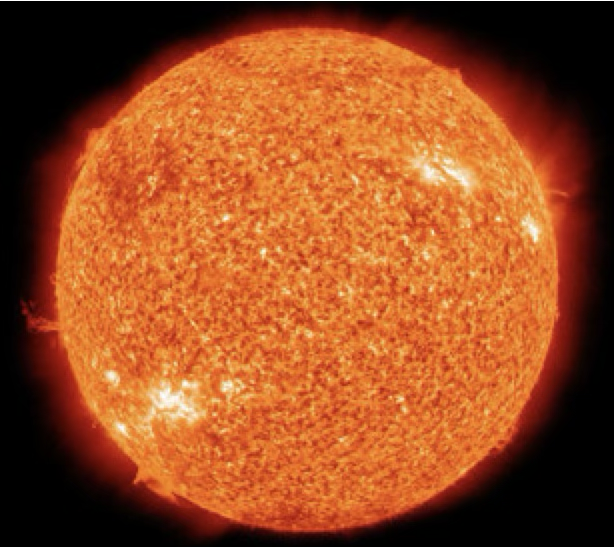
The Sun seen as a bright orange disk

0.0 billion years One sweep compresses the age of the Universe
No proton decay has been observed
\(K^+\)\(\mu^+\)\(e^+\)

Run the cosmic clock: the proton remains. The candidate button then illustrates a possible signal.

Illustration only: the clock is compressed and the candidate is triggered deliberately, not predicted at the Universe's age. JUNO searches for \(p\to\bar\nu K^+\); the kaon, its decay daughter, and a later Michel positron can produce three time-correlated light pulses.

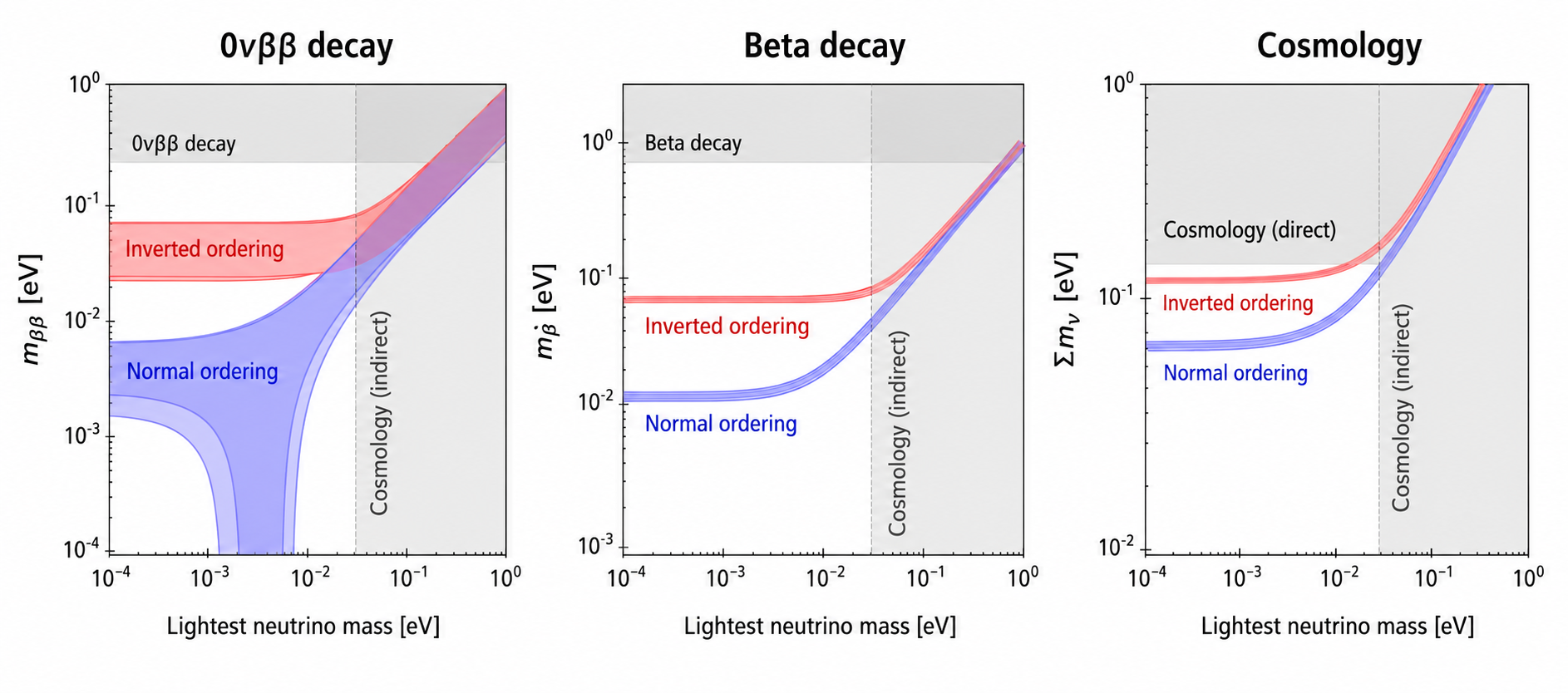
What is the neutrino mass?

Observable Sensitive to
Oscillations Differences \(\Delta m^2_{ij}\)
Beta-decay kinematics \(m_\beta^2=\sum_i|U_{ei}|^2m_i^2\)
Cosmology The mass sum \(\sum_i m_i\)

Oscillations set the spacing of the spectrum, not its absolute position.

KATRIN: electron motion through the MAC-E filter

KATRIN: the endpoint becomes a count rate

Dirac or Majorana?

Dirac neutrino Majorana neutrino
Particle and antiparticle are distinct Particle and antiparticle are identical
Lepton number can remain conserved Lepton-number violation becomes possible

The experimental path is neutrinoless double beta decay:

\[ \boxed{(A,Z)\rightarrow(A,Z+2)+2e^-} \]

No neutrinos appear in the final state. Observation would establish lepton-number violation and the Majorana nature of neutrinos.

CP violation

\[ \boxed{ P(\nu_\alpha\to\nu_\beta) \neq P(\bar\nu_\alpha\to\bar\nu_\beta) } \]

  • The phase \(\delta_{\rm CP}\) controls CP-odd effects in three-flavor oscillations.

  • Long-baseline experiments compare neutrino and antineutrino appearance while controlling matter effects.

The central question is whether lepton mixing violates CP, and by how much.

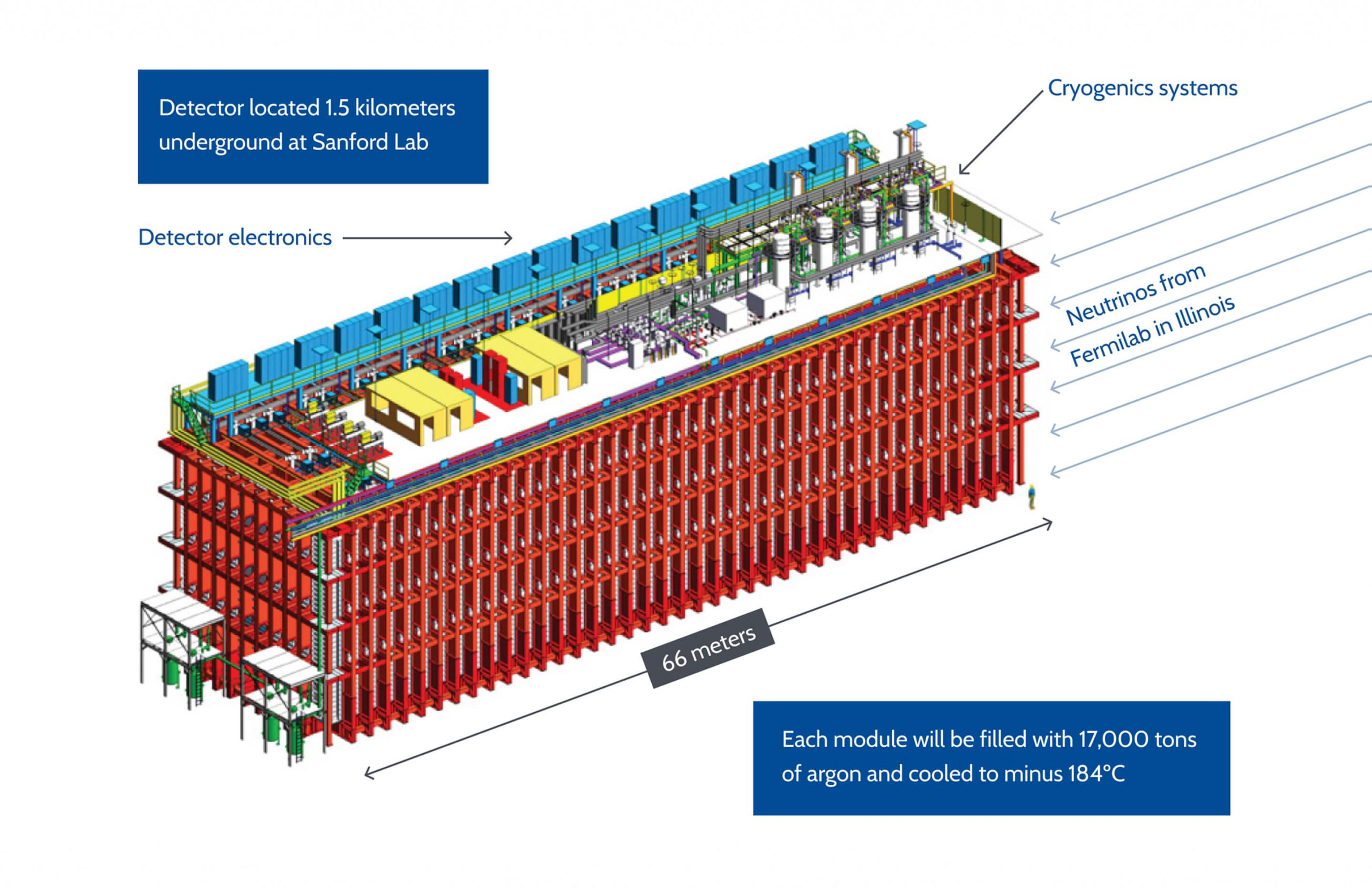
DUNE: a 1300 km matter baseline

  • A beam from Fermilab reaches the far detector in South Dakota.
  • The long baseline strengthens the matter effect, helping separate ordering from CP effects.
  • Near and far measurements constrain the beam and interaction model.
  • Appearance channels compare \(\nu_\mu\to\nu_e\) with \(\bar{\nu}_\mu\to\bar{\nu}_e\).
DUNE: liquid argon as a camera
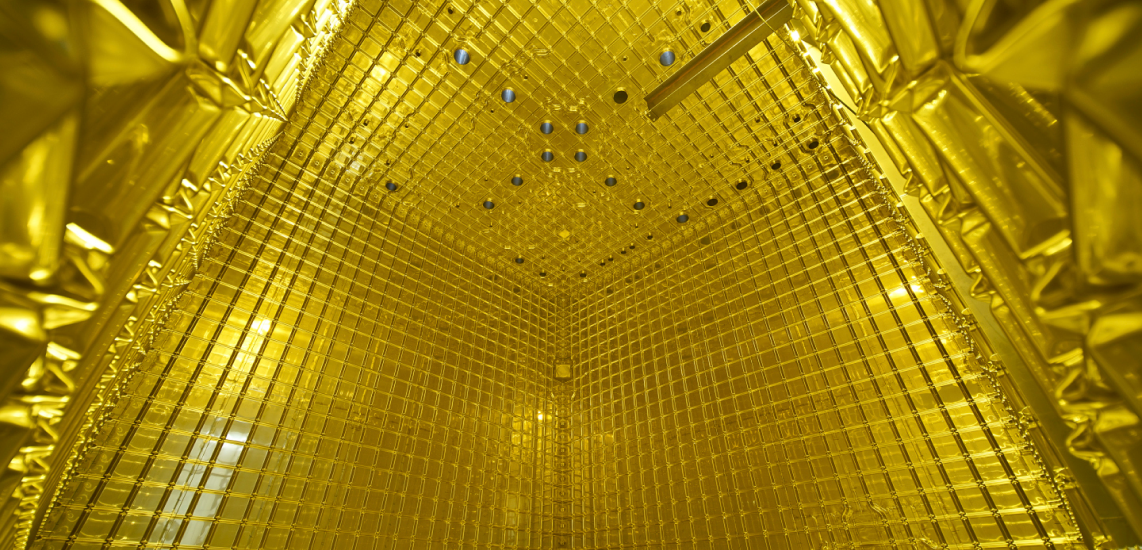
  • A charged track ionizes liquid argon.
  • Electrons drift to a readout plane in an electric field.
  • Scintillation light provides the event time.
  • The combined signals form a detailed three-dimensional event image.

Fine imaging is DUNE’s main technological strength.

Hyper-Kamiokande: a large water target
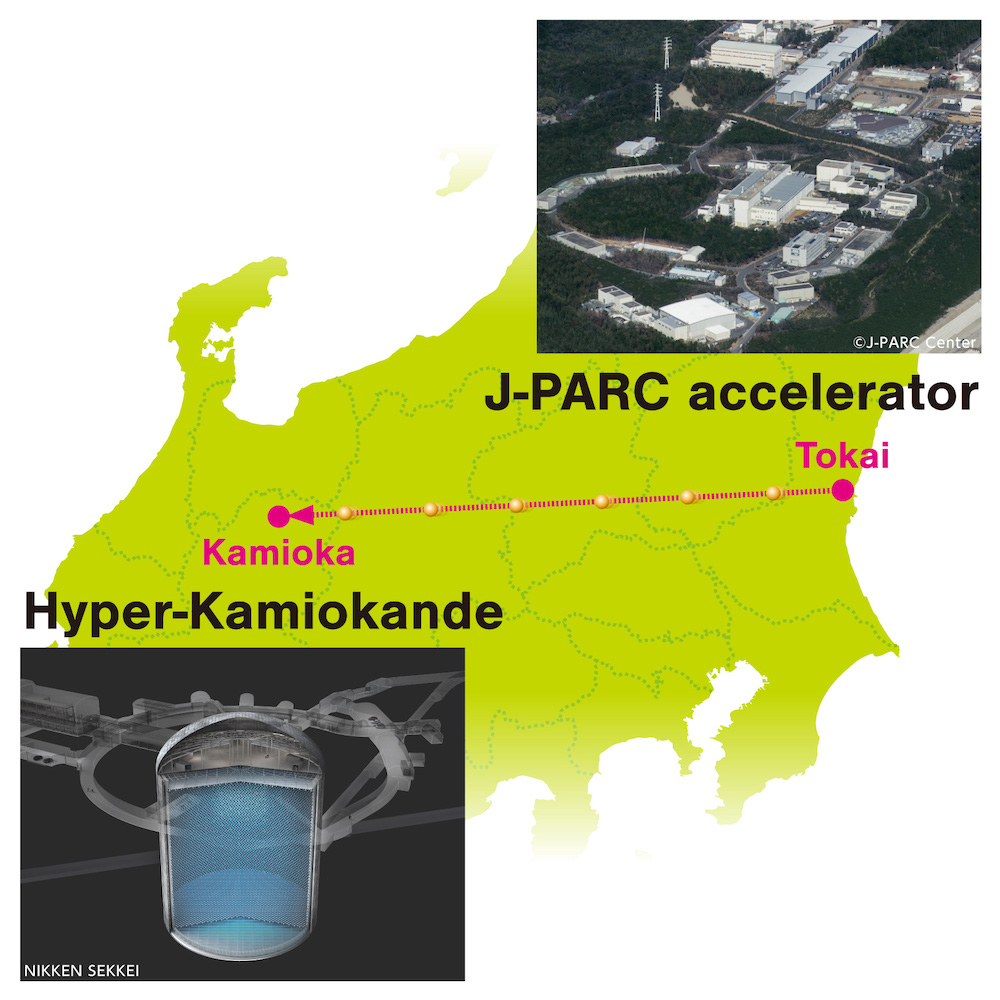
  • The J-PARC beam travels about 295 km.
  • A 260 kt water detector provides large event samples.
  • Near detectors measure the incident beam and reduce interaction uncertainties.
  • Beam, atmospheric, solar, and supernova neutrinos share one observatory.

Hyper-Kamiokande: Cherenkov rings
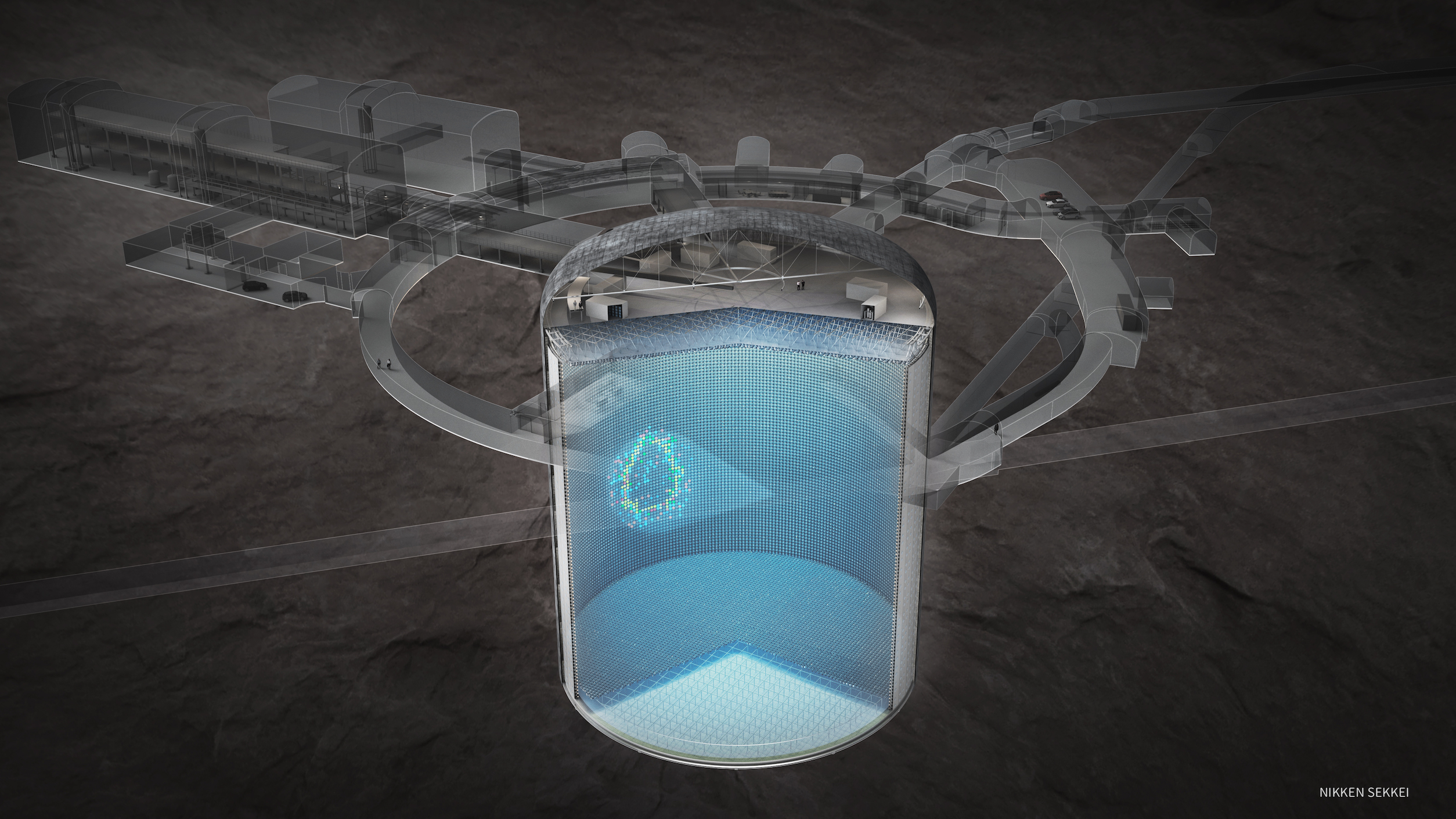
  • Charged particles emit Cherenkov light as they cross the purified water.

  • Photomultipliers record light: a muon tends to make a sharp ring, while an electron shower makes a diffuse edge.

Hyper-K trades microscopic track detail for a very large target mass.

Neutrinos as probes

Source Typical energy Hidden information carried by neutrinos
Nucleon target GeV Quark-flavor content and parton distributions
Sun MeV Nuclear burning in the solar core
Earth MeV Radioactive heat from the crust and mantle
Core-collapse supernova MeV Collapse, bounce, accretion, and cooling
Cosmic accelerators TeV–PeV Hadronic processes in extreme environments

Neutrinos escape dense regions that are opaque to light and point back to their origin.

Deep inelastic scattering resolves partons
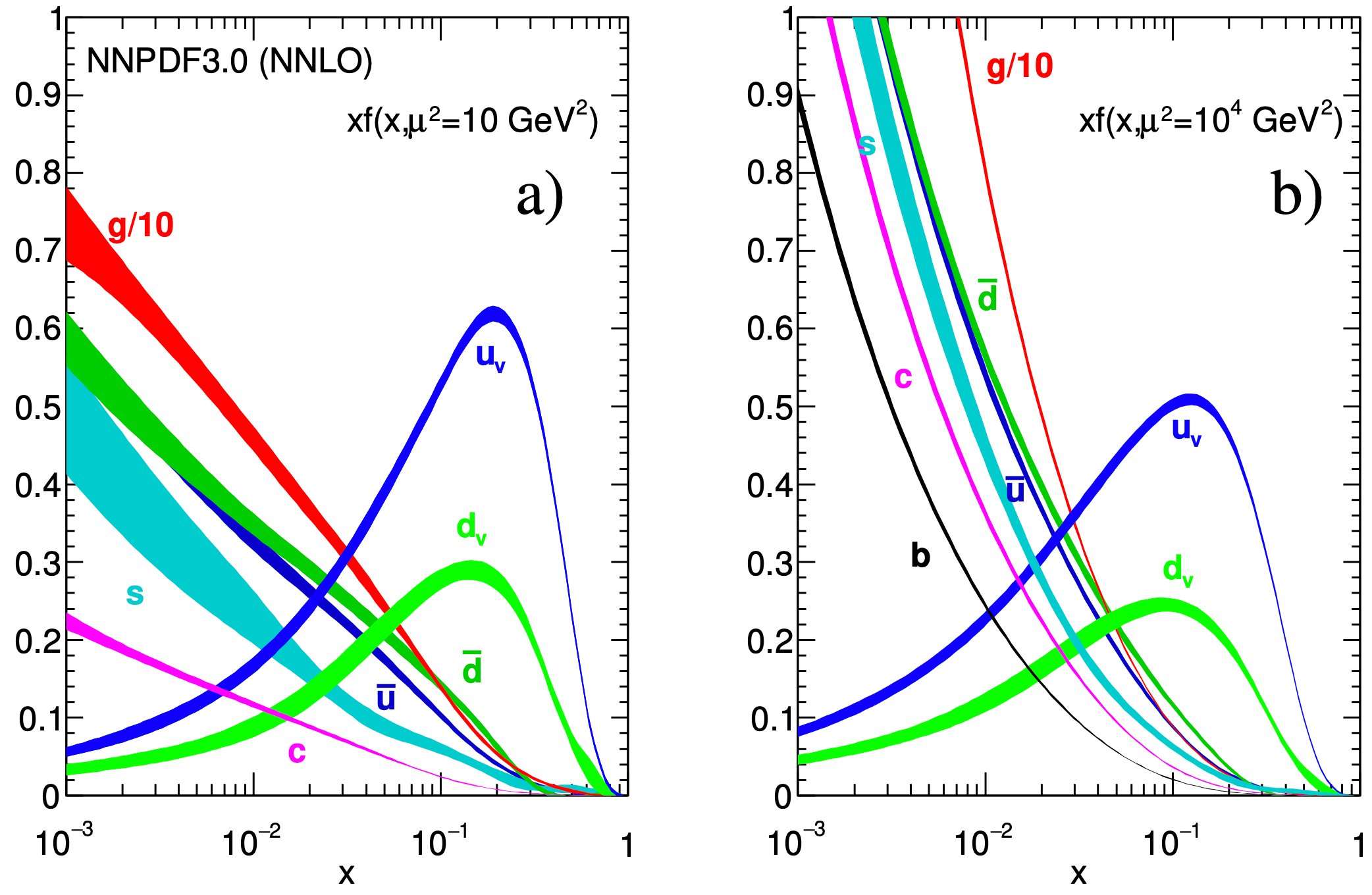
  • \(x\) is the fraction of nucleon momentum carried by a parton.
  • \(Q^2\) sets the spatial resolution of the probe.
  • The proton contains valence quarks, a sea of quark–antiquark pairs, and gluons.
  • Their distributions evolve with \(Q^2\).

What neutrino DIS adds

Probe Main coupling Information from inclusive scattering
Charged lepton Photon, weighted by quark charge squared Strong constraints on proton structure and its \(x,Q^2\) dependence
Neutrino and antineutrino Charged weak current, with different quark combinations Complementary flavor separation, including valence and strange contributions

Neutrino measurements often use nuclear targets, so nuclear corrections matter in a precise extraction of free-proton parton distributions.

Paukkunen and Salgado, 2010 on neutrino DIS in PDF fits. The channels complement one another; neither alone determines every flavor.

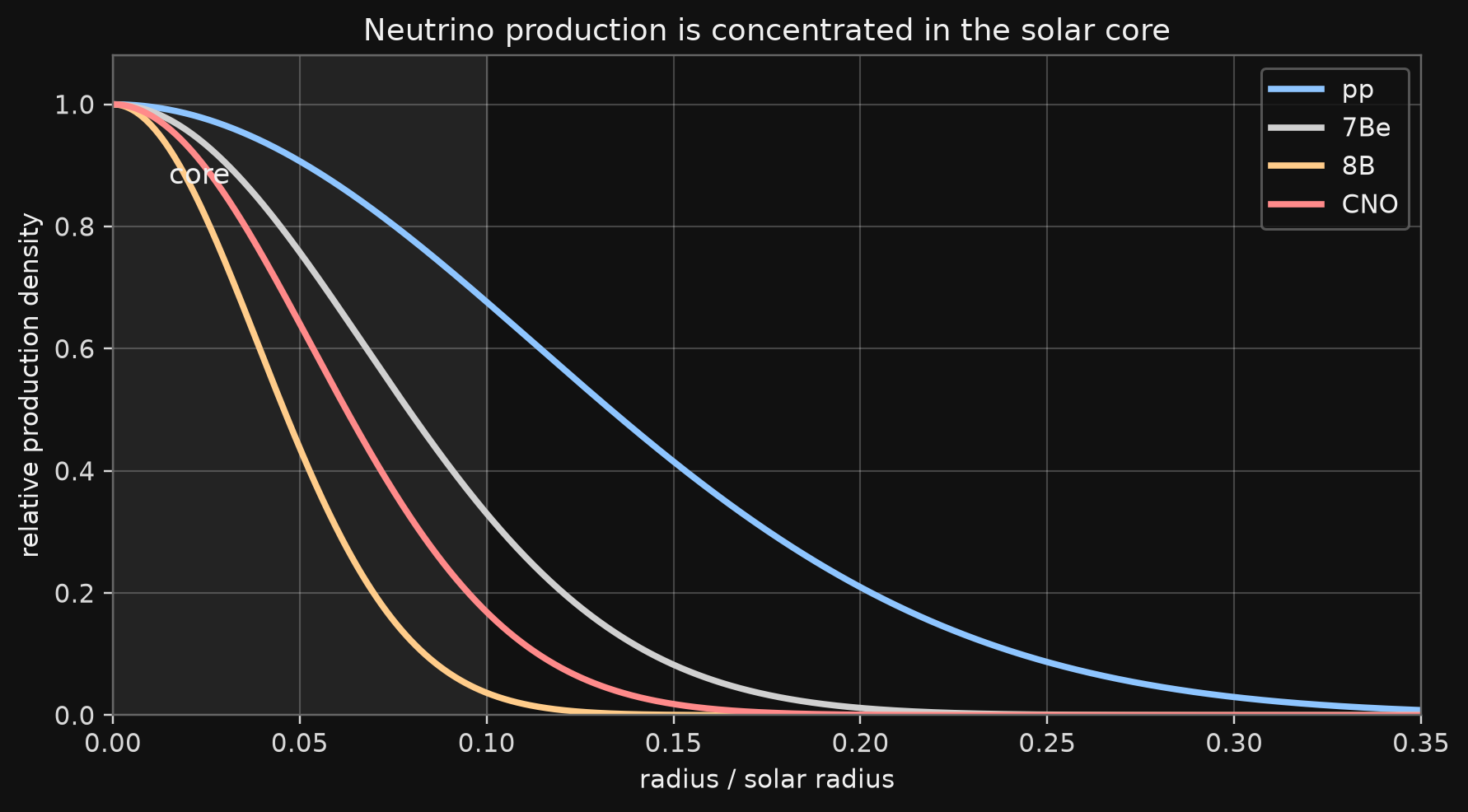
Looking inside the Sun

Solar neutrinos provide a direct, real-time view of nuclear reactions in the core.

Different components probe different reactions, temperatures, and production radii.

Looking inside the Earth
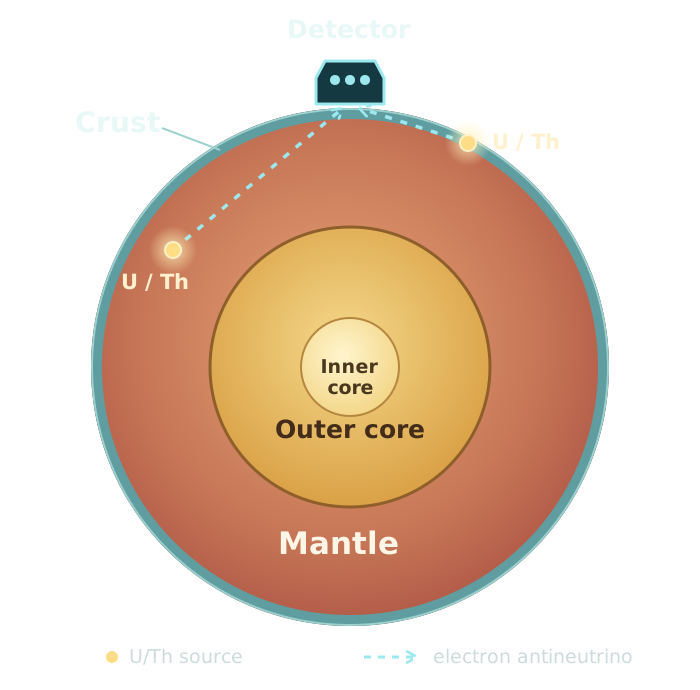
Crust enlarged; paths illustrative. Layers: USGS · U/Th sources: Borexino.

Electron antineutrinos from the \(^{238}\)U and \(^{232}\)Th decay chains reveal:

  • the radiogenic contribution to Earth’s heat;
  • the distribution of heat-producing elements;
  • the difficult separation of crust and mantle signals.

Geoneutrinos connect particle detection to the planet’s thermal history.

Supernova neutrinos
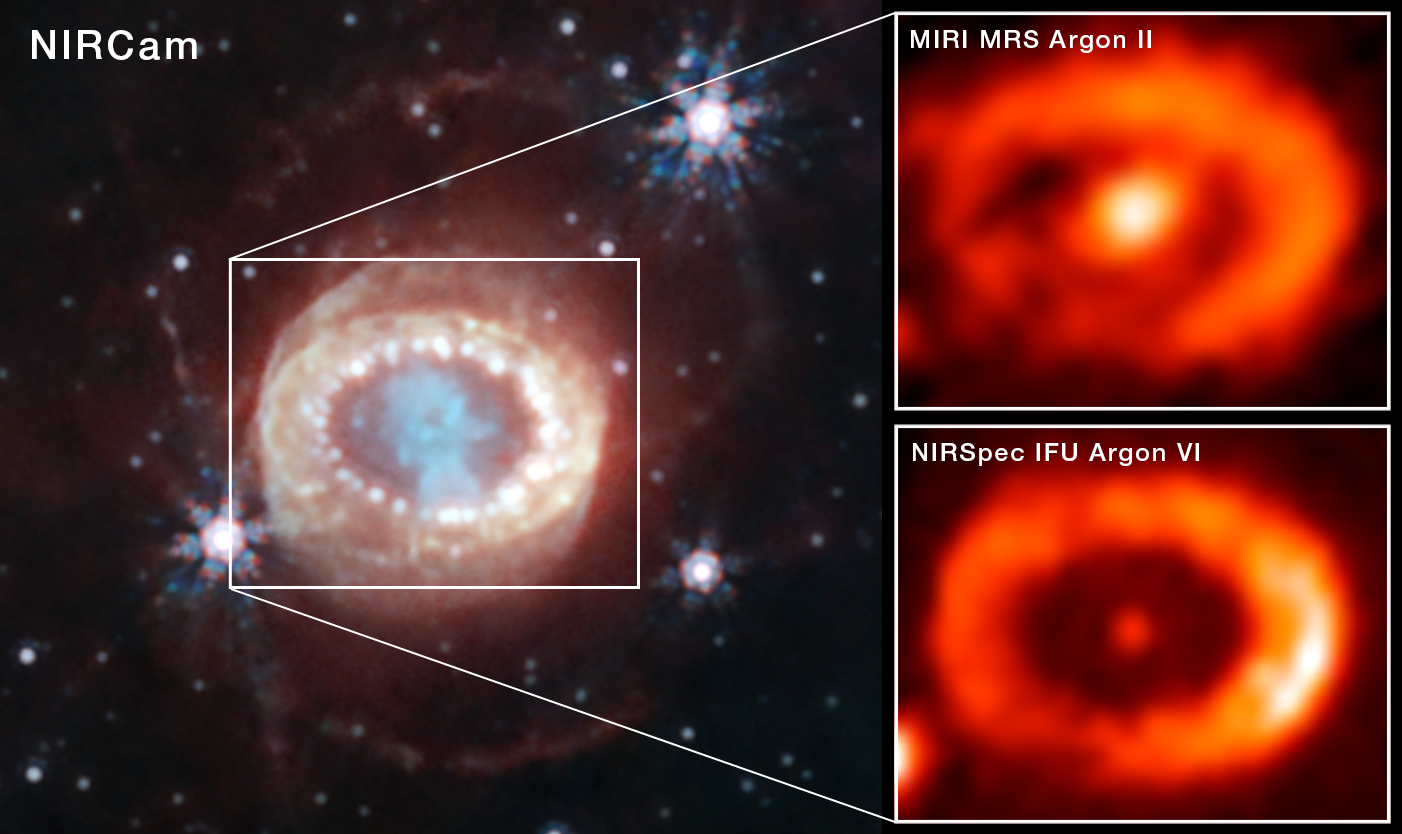
The roughly two dozen neutrinos detected from SN 1987A opened neutrino astronomy beyond the Sun.

A future Galactic event could resolve:

  • collapse and core bounce;
  • accretion dynamics;
  • proto-neutron-star cooling;
  • flavor transformation in extreme matter.

High-energy neutrino astronomy

  • Neutral messengers point back to their sources.
  • Hadronic interactions produce neutrinos together with photons and cosmic rays.
  • IceCube, Baikal-GVD, and KM3NeT open complementary views of the sky.

The signal is faint, but it is unusually clean evidence of particle acceleration.

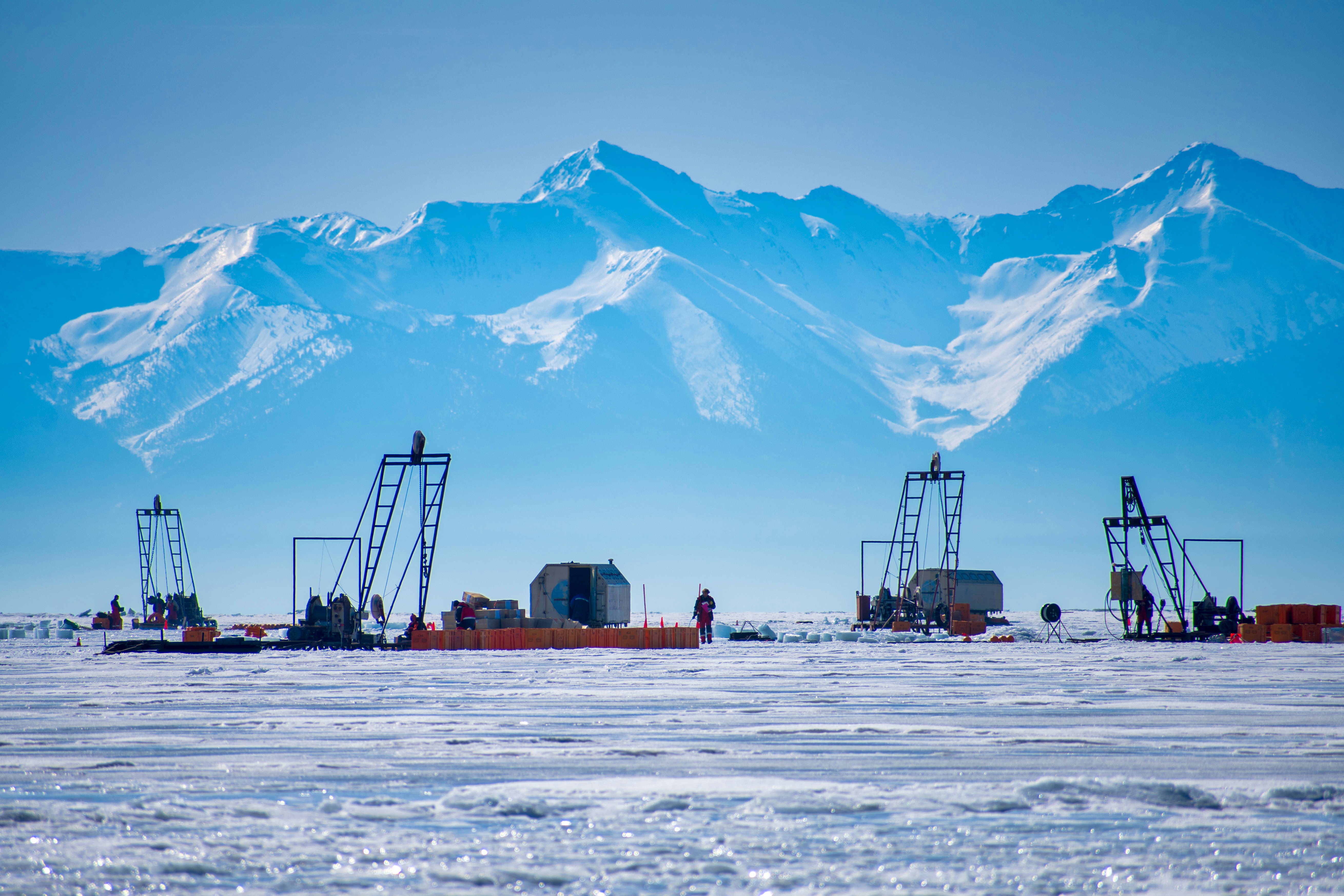
Baikal-GVD

Deployment on Lake Baikal. Photo: B. Shaybonov.

A cubic-kilometer-scale telescope uses deep, clear lake water as both target and Cherenkov medium.

The program addresses:

  • the diffuse astrophysical flux;
  • searches for point-like sources;
  • the Galactic plane;
  • multimessenger coincidences.

Summary

  • Fundamentals

    • Neutrino mass and mixing
  • Frontiers

    • Ordering, absolute mass, CP violation, and models of flavor
  • Probes

    • Proton structure, the Sun, Earth, supernovae, and the high-energy Universe