Particles, Fields, and their Interactions
Baikal Summer School
Dmitry V. Naumov
Joint Institute for Nuclear Research
2026-07-12
Natural System of Units
\[ \boxed{\hbar=c=1} \]
- Dimensions: \[ [\mathrm{Energy}] = [\mathrm{mass}] = [\mathrm{length}]^{-1} = [\mathrm{time}]^{-1} \]
- Relationships:
- Energy: \(E^2 = \mathbf{p}^2 + m^2\),
- Wavelength: \(\lambda = 2\pi/p\),
- Time: \(t = 1/E\).
- Conversions: \[ \begin{aligned} 1 &= \hbar c = 197.327\ \mathrm{MeV\,fm},\\ 1\mathrm{GeV}^{-1} &= 0.197\ \mathrm{fm},\\ 1\mathrm{fm}&=5.067\ \mathrm{GeV}^{-1},\\ 1\mathrm{s} &= 1.519\times 10^{24}\ \mathrm{GeV}^{-1},\\ \end{aligned} \]
Momentum or Coordinate?
- The Heisenberg uncertainty: \[ \sigma_x\sigma_p\ge \frac{\hbar}{2} \to \sigma_x\sigma_p\ge \frac{1}{2}. \]
- Let us denote a relative momentum dispersion: \[ \varepsilon_p\equiv \frac{\sigma_p}{p}. \]
- Then the coordinate dispersion is: \[ \sigma_x\ge \frac{1}{2\sigma_p} = \frac{1}{2\varepsilon_p p}=10 \, \mathrm{fm}\frac{10^{-2}}{\varepsilon_p}\frac{\mathrm{GeV}}{p}. \]
Momentum or Coordinate?
Then the coordinate dispersion is: \[ \sigma_x\ge \frac{1}{2\sigma_p} = \frac{1}{2\varepsilon_p p}=10 \, \mathrm{fm}\frac{10^{-2}}{\varepsilon_p}\frac{\mathrm{GeV}}{p}. \]
Best experimental resolution \[ \delta_x\simeq 1\mu \mathrm{m}\gg \sigma_x. \]
Thus, experimentalists can measure the momentum of a particle with a relative precision \(\varepsilon_p\sim 10^{-2}\), but cannot measure its position with a comparable precision.
Matter
Zoo of particles
- 118 chemical elements in the periodic table.
- More than 3000 different atomic nuclei including isotopes.
- Isotopes can be stable or unstable.
- Unstable nuclei decay via:
- alpha (\({}^4\text{He}\)),
- beta (\({e^\pm + \nu}\)),
- gamma (\(\gamma\)) decays,
- spontaneous fission,
- and other processes such as neutron capture.
Fundamental Particles
- All known matter is made of a small number of fundamental particles.
- Fundamental particles are indivisible in the framework of modern theory.
- Fundamental particles are divided into two classes:
- Fermions: half-integer spin (\(\tfrac{1}{2}\hbar, \tfrac{3}{2}\hbar, \ldots\))
- Bosons: integer spin (\(0\hbar, 1\hbar, 2\hbar, \ldots\))
Antiparticles
For a particle and its antiparticle:
- masses are equal;
- spins are equal;
- additive charges change sign;
- electric charge changes sign;
- color changes into anticolor.
Examples:
\[ e^-\leftrightarrow e^+,\qquad p\leftrightarrow \bar p,\qquad n\leftrightarrow \bar n. \]
Fermions and Bosons
Fermions
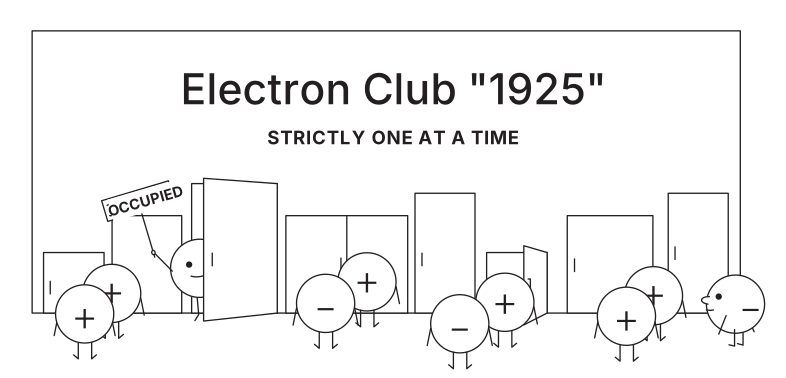
Fermions have half-integer spin and obey Fermi-Dirac statistics.
The fundamental Standard Model (next lecture) fermions are:
- leptons: \(e,\mu,\tau,\nu_e,\nu_\mu,\nu_\tau\);
- quarks: \(u,d,s,c,b,t\).
We are many-sheeted Möbius strips. Live with that.
Bosons
Bosons have integer spin and obey Bose-Einstein statistics.
In the Standard Model:
- gauge bosons: \(\gamma, g, W^\pm, Z\);
- Higgs boson: \(H\).
Leptons
Leptons do not carry color charge.
Charged leptons:
\[ e^-,\quad \mu^-,\quad \tau^-. \]
- Neutrinos:
\[ \nu_e,\quad \nu_\mu,\quad \nu_\tau. \]
- Neutrinos have \(Q=0\), so they do not participate in electromagnetic interactions.
Quarks
Quarks carry color charge and participate in the strong interaction.
Electric charges:
\[ Q_u=Q_c=Q_t=+\frac23,\qquad Q_d=Q_s=Q_b=-\frac13. \]
Because of confinement, free quarks are not observed as isolated particles.
Observable hadrons:
- baryons: \(qqq\), for example \(p,n\);
- mesons: \(q\bar q\), for example \(\pi,K\).
Gauge Bosons
Gauge bosons are associated with gauge interactions:
| Boson | Interaction | Couples to |
|---|---|---|
| \(\gamma\) | electromagnetic | electric charge |
| \(g\) | strong | color |
| \(W^\pm\) | weak charged current | weak doublets |
| \(Z\) | weak neutral current | electroweak charge |
\[ \mathrm{spin}=1. \]
Higgs Boson
- The Higgs boson is a scalar:
\[ \mathrm{spin}=0. \]
- Higgs boson is not a “fifth force” in a sense of “gauge interactions”
Particles and Fields
Coupled Oscillators as a Field Model
Normal modes: \(w=\omega_{mn}\)
\[
M\ddot q_{ij}=-k_0 q_{ij}-k_c(4q_{ij}-q_{i+1,j}-q_{i-1,j}-q_{i,j+1}-q_{i,j-1})
\]
\[
q_{ij}^{(m,n)}(t)=A_{mn}\sin\!\frac{m\pi i}{N_x+1}\sin\!\frac{n\pi j}{N_y+1}\cos(\omega_{mn}t)
\]
\[
\omega_{mn}^2=\frac{k_0+4k_c\left[\sin^2\!\frac{m\pi}{2(N_x+1)}+\sin^2\!\frac{n\pi}{2(N_y+1)}\right]}{M}
\]
The pair \((m,n)\) labels standing-wave harmonics in \(x,y\).
- Coupled two-dimensional oscillator lattice.
- Mode (1,1), w = 2.36
- Mode (1,2), w = 2.54
- Mode (2,1), w = 2.54
- Mode (2,2), w = 2.70
- Local kick at (5,5)
- The disturbance spreads through the coupled lattice.
- The discrete lattice becomes a continuous field.
- Field wave evolution
- Particles are localized excitations of fields.
Quantum Field and Particles
- A field assigns a dynamical variable to every point in space: \[ q_i(t)\ \longrightarrow\ \phi(\mathbf x,t). \]
- It can be viewed as the continuum limit of many coupled oscillators: \[ N\to\infty,\qquad a\to 0,\qquad Na=\mathrm{fixed}. \]
- Quantization turns each normal mode into a quantum oscillator.
- A particle with definite momentum is one quantum of such a normal mode: \[ \sqrt{2E_{\mathbf p}}a^\dagger_{\mathbf p}|0\rangle = |\mathbf p\rangle . \]
- The vacuum is the zero-particles state of the fields, not empty space.
- Interactions create, destroy, and transform field excitations.
Free Equations of Motion and Solutions
- Scalar Field:
\[ (\partial^2+m^2)\phi=0 \rightarrow \phi(x)=\int\!\frac{d^3p}{(2\pi)^3}\frac{1}{\sqrt{2E_{\mathbf p}}}\left[a_{\mathbf p}e^{-ip\cdot x}+a^\dagger_{\mathbf p}e^{ip\cdot x}\right]. \]
- Spinor Field
\[ (i\gamma^\mu\partial_\mu-m)\psi=0 \rightarrow \psi(x)=\sum_s\int\!\frac{d^3p}{(2\pi)^3}\frac{1}{\sqrt{2E_{\mathbf p}}}\left[a_s(\mathbf p)u_s(\mathbf p)e^{-ip\cdot x}+b_s^\dagger(\mathbf p)v_s(\mathbf p)e^{ip\cdot x}\right]. \]
\[ (\not p-m)u_s=0,\qquad (\not p+m)v_s=0. \]
Free Equations of Motion and Solutions
- Vector Field
\[ \partial_\mu F^{\mu\nu}=0 \leftrightarrow \partial_\mu A^\mu=0 \rightarrow A_\mu(x)= \sum_\lambda\int\!\frac{d^3p}{(2\pi)^3} \frac{1}{\sqrt{2E_{\mathbf p}}} \left[ \epsilon_\mu^{(\lambda)}a_{\lambda,\mathbf p}e^{-ip\cdot x} +\epsilon_\mu^{(\lambda)\ast}a^\dagger_{\lambda,\mathbf p}e^{ip\cdot x} \right], \]
The Standard Model as Quantum Fields
SM field content
quarks: \(u,d,c,s,t,b\quad(\times 3)\)
charged leptons: \(e,\mu,\tau\)
neutrinos: \(\nu_e,\nu_\mu,\nu_\tau\)
gauge: \(\gamma,\ g,\ W^\pm,\ Z\)
scalar: \(H\)



Why Particle Physics?
- Fundamental questions:
- Which fields fill the Universe?
- What are their quanta?
- How do they interact?
- Methods:
- Theoretical: quantum field theory, symmetries, and conservation laws.
- Experimental: particle accelerators, detectors, and data analysis.
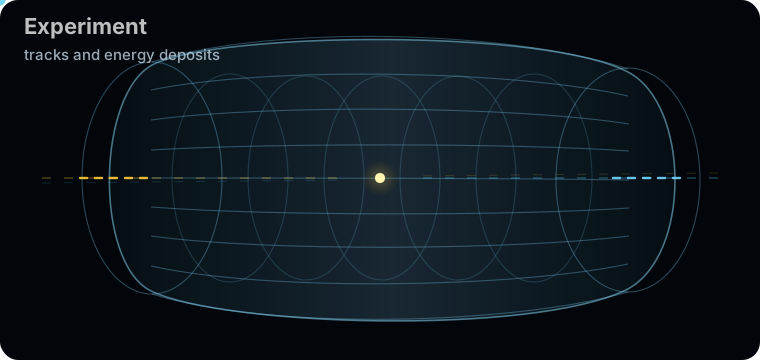
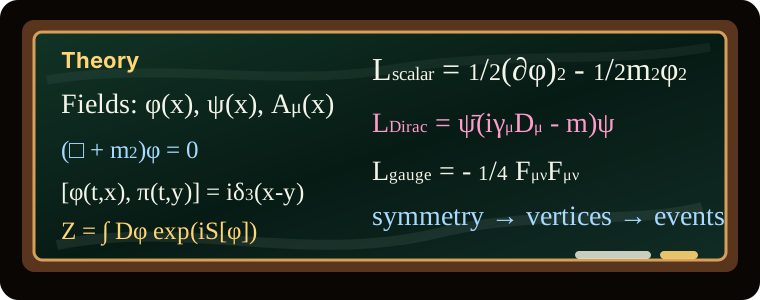
Experimental Pillars of the Standard Model
Experiments did not just discover particles. They uncovered the underlying structure of the theory.
| Discovery | Experimental lesson | Impact on the Standard Model | |
|---|---|---|---|
| Positron | The electron has an antiparticle. | Antiparticles became mandatory in relativistic QFT. | |
| Neutrino and beta decay | Missing energy and momentum are carried by an invisible particle. | The lepton sector and weak interaction entered the theory. | |
| Parity violation | The weak interaction distinguishes left from right. | Weak currents have a chiral structure. | |
| Strange particles and Ω⁻ | Hadrons form regular multiplets. | The quark classification u, d, s became compelling. | |
| Deep-inelastic scattering | The proton contains point-like constituents. | Quarks became real partonic degrees of freedom. | |
| Neutral weak currents | A neutrino can scatter without producing a charged lepton. | Electroweak SU(2)L × U(1)Y was confirmed. | |
| Jets and three-jet events | Hadrons appear as traces of quarks and gluons. | QCD gained direct experimental support. | |
| W±, Z0, top, Higgs | Weak bosons, the final quark, and the Higgs scalar were found. | The minimal SM particle content was experimentally completed. |
Interactions
Interactions as Lagrangian Terms
- Interactions are allowed terms in the Lagrangian:
\[ \mathcal L=\mathcal L_{\rm free}+\mathcal L_{\rm int}. \]
They create, destroy, or transform field quanta.
For example, QED contains the vertex
\[ \mathcal L_{\rm int}=-e\,\bar\psi\gamma^\mu A_\mu\psi . \]
- In a diagram, force is encoded as exchange of a virtual field quantum.
The mediator mass changes the range: in 3d, \(V(r)\sim e^{-m r}/r\).
Electromagnetic Interaction
Electron-electron scattering:
\[ e^- e^- \to e^- e^-. \]
The electrons exchange a virtual photon. The diagram encodes the allowed QED vertices and the momentum flow in the amplitude.
Weak Neutral Current
Muon-neutrino scattering through a neutral weak current:
\[ \nu_\mu \mu^- \to \nu_\mu \mu^-. \]
The mediator is a virtual \(Z\) boson. Flavor is conserved at the neutral-current vertex.
Weak Charged Current
A charged-current process changes lepton flavor:
\[ \nu_\mu e^- \to \nu_e \mu^-. \]
The mediator is a virtual \(W\) boson. The electric charge is conserved at each vertex.
Strong Interaction
Quark-quark scattering:
\[ q q \to q q. \]
Quarks exchange a virtual gluon. The strong interaction couples to color charge, not to electric charge.
Rutherford Scattering
- Rutherford scattering is a classic experiment that revealed the structure of the atom.
- Alpha particles are scattered off a thin gold foil, and their deflection angles are measured.
- The results showed that most of the alpha particles passed through the foil with little deflection, while a small fraction were deflected at large angles.
- This led to the conclusion that atoms have a small, dense nucleus surrounded by a cloud of electrons.
To Understand the Inside
- Sometimes the fastest way to understand an object is to take it apart.
- Rutherford scattering did this for atoms without touching them directly.
- This experiment was pivotal in the development of the nuclear model of the atom.
- It also became a basic instrument for later discoveries in particle physics.

The cross-section
- The cross-section is a measure of the probability of a scattering event occurring.
- It is defined as the effective area that a target presents to an incoming particle:
\[ \text{interaction rate} = \sigma \times \text{flux}. \]
The larger the effective area, the more particles scatter out of the beam.
The cross-section
For a process: \[ p+\mathrm{nucleus}\to p+\mathrm{nucleus} \] classical theory and QED predict the same dependence of the differential cross-section \[ \frac{d\sigma}{d\Omega} \propto \frac{1}{\sin^4(\theta/2)}. \]
The total cross-section is divering: \[ \sigma \propto \int d\Omega \frac{1}{\sin^4(\theta/2)} = \infty. \]
Experimentally, the total cross-section is finite.
What is the reason for this discrepancy?!
The plane wave assumption
- If the plane wave of the incoming particle is replaced by a wave packet:
- the zero-angle amplitude is finite with its phase logarithmically diverging.
- the non-zero angle aplitude is logarithmically diverging.
- The discrepancy is softened but not removed.
Zero photons assumtion
- We silently assumed that the incoming and outgoing states contain zero photons: \[ p+\mathrm{nucleus}\to p+\mathrm{nucleus} \]
- But the charged particle is accelerated in the Coulomb field of the nucleus and emits photons. Thus the assumptiion is not valid. The correct process is: \[ p+\mathrm{nucleus}\to p+\mathrm{nucleus}+n\gamma. \]
The solution
- The question “exactly zero photons” is not physical for charged particles.
- A detector has a finite photon-energy resolution \(\Delta E\).
- Therefore the observable quantity is an inclusive cross-section:
\[ d\sigma_{\mathrm{obs}} = d\sigma(p\to p') + \sum_{E_\gamma<\Delta E} d\sigma(p\to p'+n\gamma). \]
Soft photons that cannot be resolved must be summed over.
Let \[ L=\ln\frac{Q^2}{m^2}, \qquad \ell_\mu=\ln\frac{Q^2}{\mu^2}, \qquad Q^2=-q^2 . \]
Real soft photons: \[ \frac{d\sigma_{\mathrm{real}}}{d\Omega} = \left(\frac{d\sigma}{d\Omega}\right)_0 \left[ 1+\frac{\alpha}{\pi}L\ell_\mu+O(\alpha^2) \right]. \]
Virtual photons: \[ \frac{d\sigma_{\mathrm{virt}}}{d\Omega} = \left(\frac{d\sigma}{d\Omega}\right)_0 \left[ 1-\frac{\alpha}{\pi}L\ell_\mu+O(\alpha^2) \right]. \]
\[ \boxed{ d\sigma_{\mathrm{obs}} =d\sigma_{\mathrm{real}}+d\sigma_{\mathrm{virt}} \quad \text{is finite.} } \]
Summary
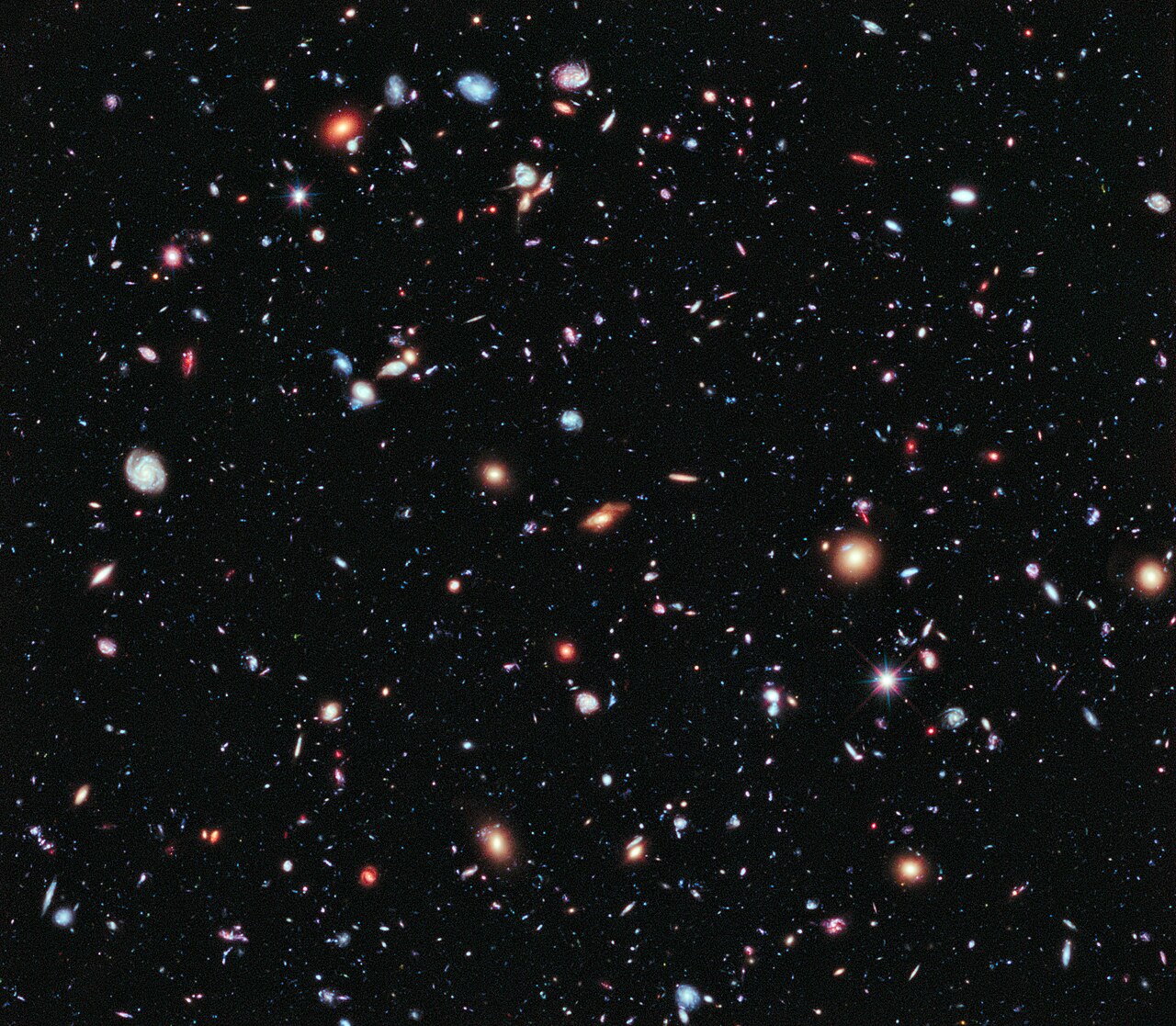
- Matter is described by quantum fields, basic objects filling the Universe.
- Particles are quanta of these fields.
- Interactions are constrained by symmetries and charges.
- Experiments revealed the Standard Model structure.
- What is the Standard Model?