Neutrino Oscillations III
The Earth seen by neutrinos
What geophysics knows
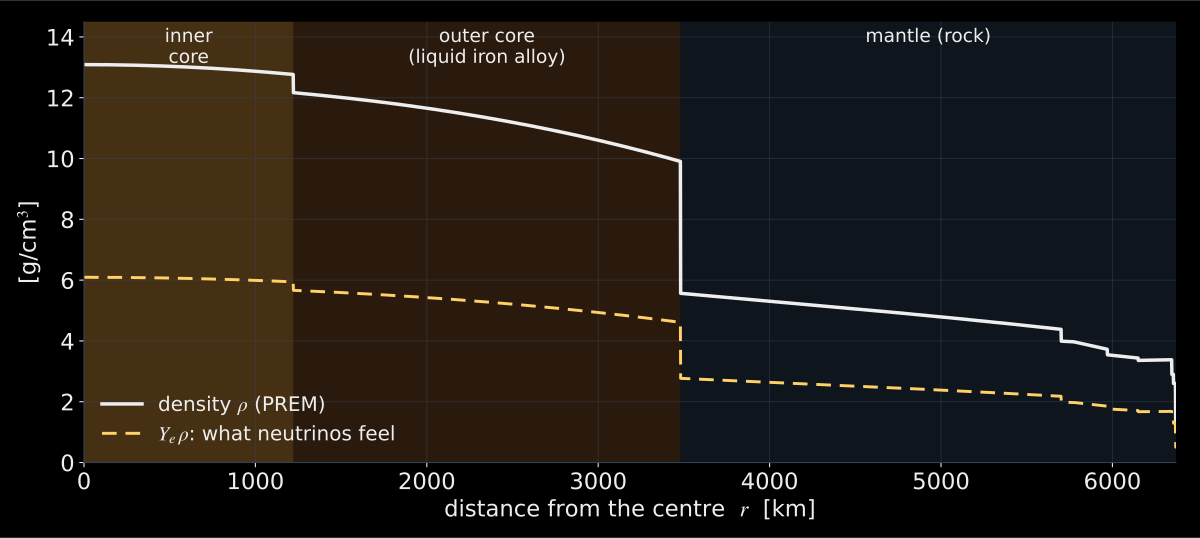
- Seismic waves, the Earth’s mass and moment of inertia give the density profile (PREM).
- The composition is inferred indirectly: the outer core is 5–10 % less dense than pure iron, so it contains light elements — but which ones, and how much?
PREM: Dziewonski & Anderson (1981). Density deficit: Badro, Côté & Brodholt, PNAS 111, 7542 (2014). Dashed: \(Y_e\rho\) with the model compositions of the previous slides.
How opaque is the Earth?
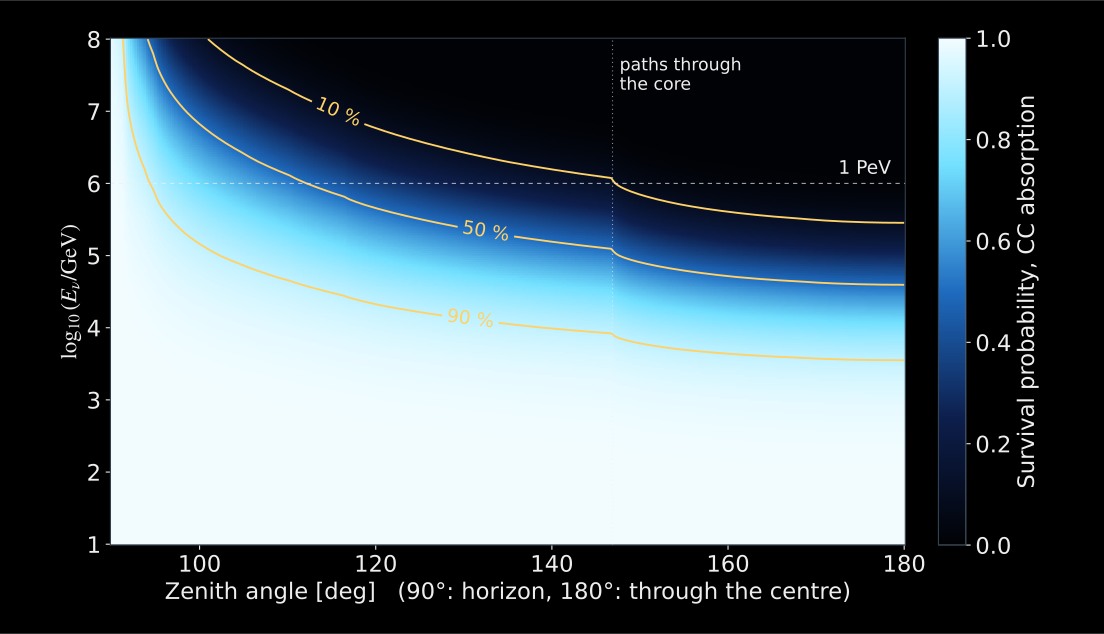
- At 10 TeV about three quarters of the neutrinos cross the whole diameter; above ~100 TeV the core paths are dark.
- The darkness depends on the column \(X=\int\rho\,dl\): absorption measures mass density.
Computed: PREM, CSMS cross sections, detector 1 km deep · CC absorption only, average of \(\nu\) and \(\bar\nu\).
Absorption tomography: IceCube weighed the Earth
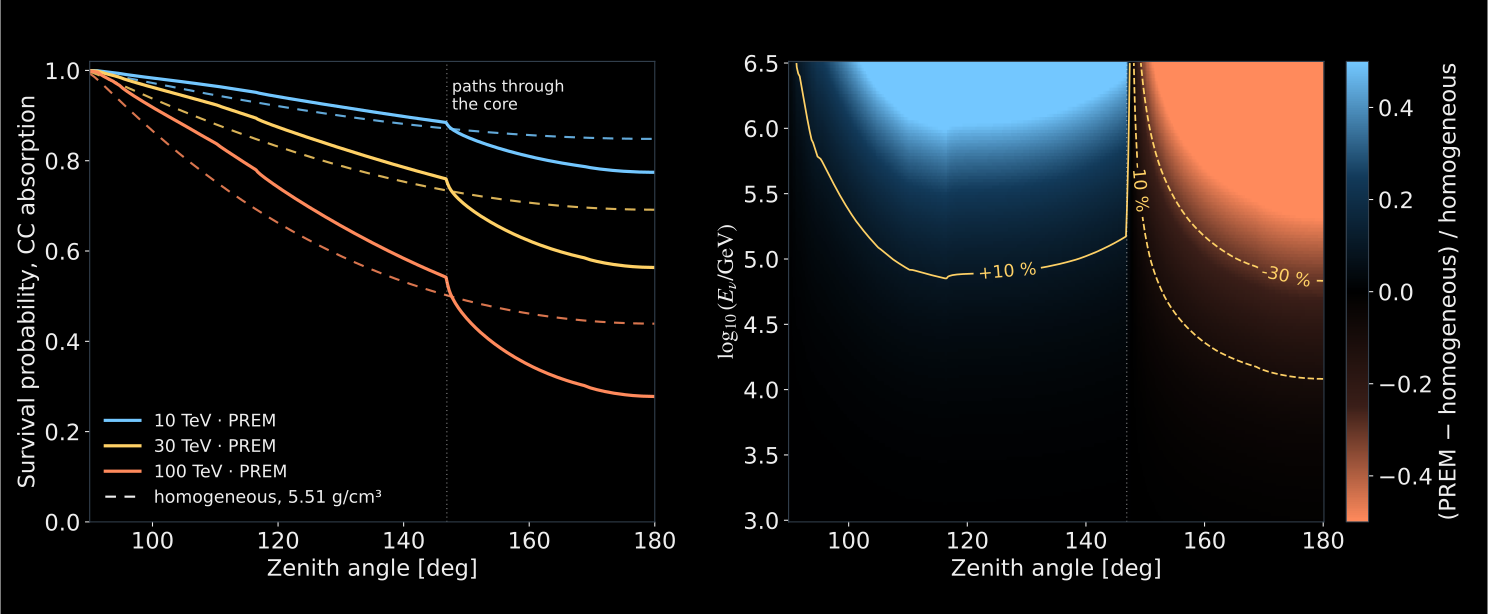
One year of IceCube up-going muons, 0.4–20 TeV (20 145 events):
- Earth’s mass \(6.0^{+1.6}_{-1.3}\times10^{24}\) kg; gravity: \(5.97\times10^{24}\) kg.
- Core mass \(2.72^{+0.97}_{-0.89}\times10^{24}\) kg; the core is denser than the mantle.
A weak-interaction measurement of the Earth’s mass, without gravity.
Figure computed: PREM vs homogeneous Earth of the same mass, CC absorption only. Measurement: 68 % credible intervals · Donini, Palomares-Ruiz & Salvado, Nature Physics 15, 37 (2019)
Paths through the Earth
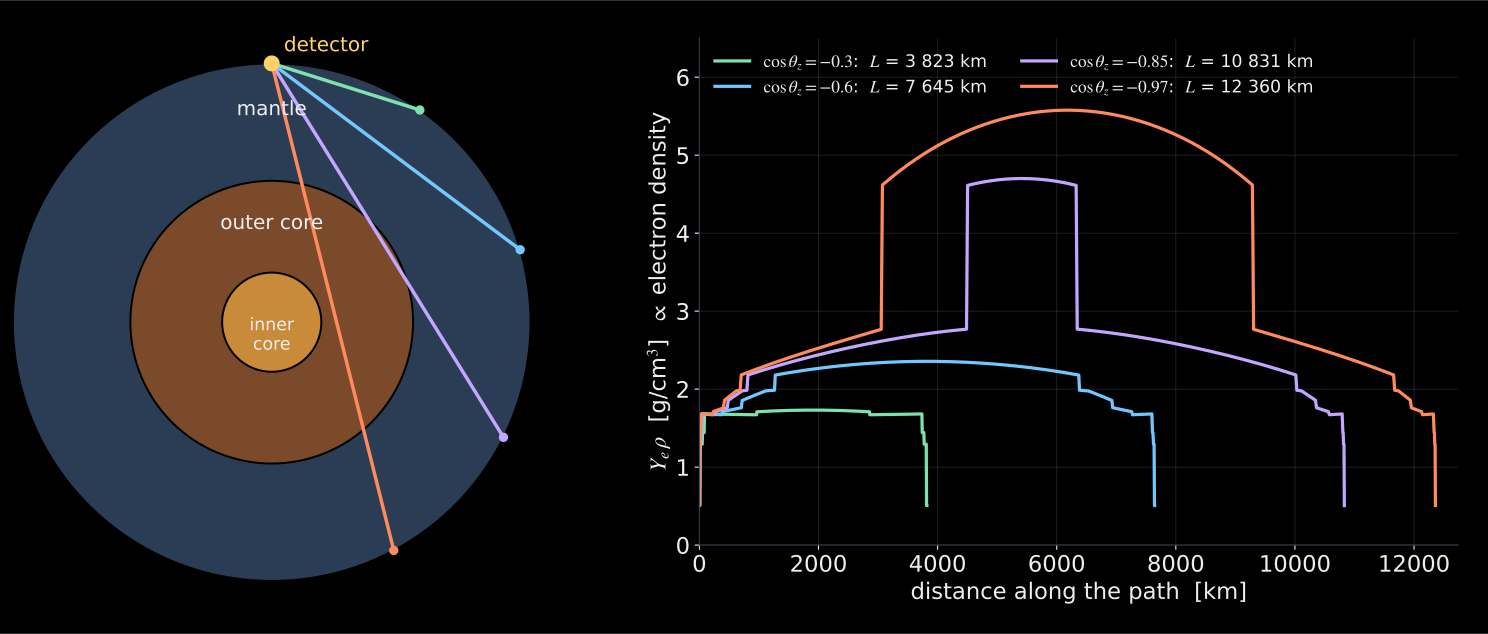
- The arrival direction \(\cos\theta_z\) fixes the path: \(L=2R_\oplus|\cos\theta_z|\).
- Paths with \(\cos\theta_z<-0.84\) cross the core; below \(-0.98\) also the inner core.
The oscillogram of the Earth
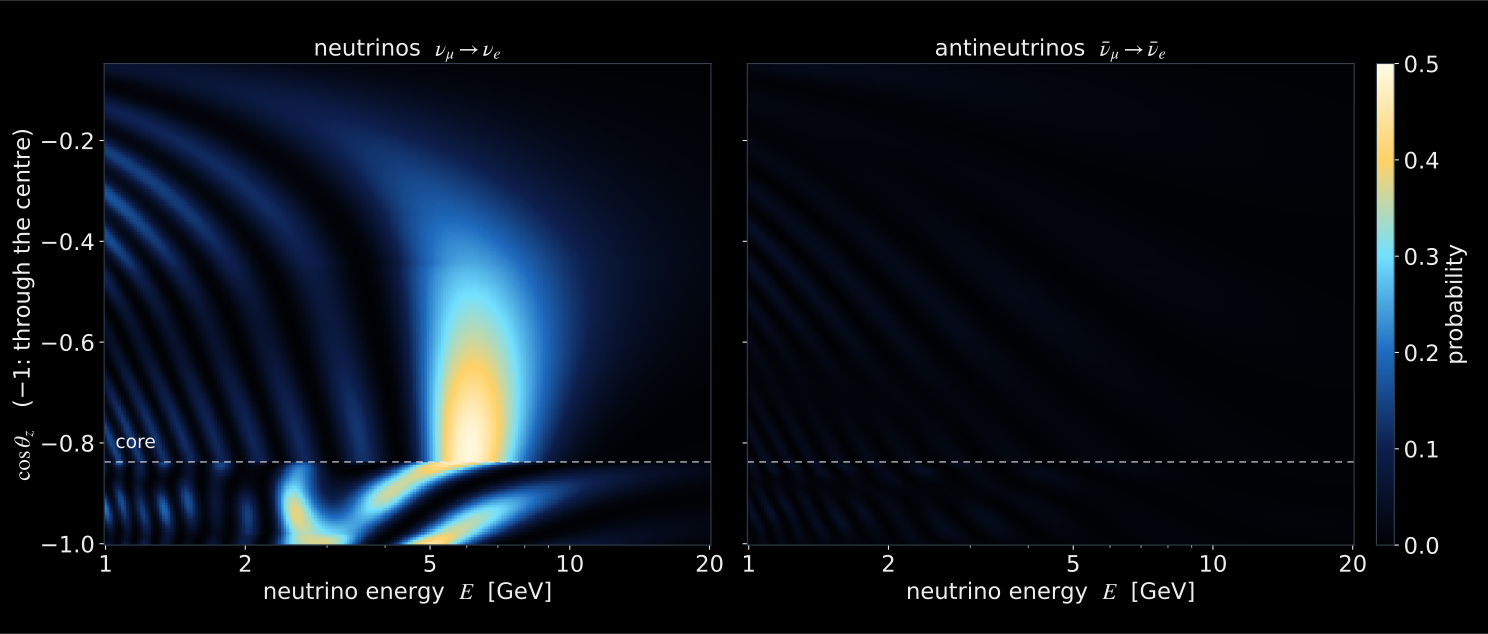
- Mantle resonance near 6 GeV: \(P(\nu_\mu\to\nu_e)\) grows from a few % in vacuum to almost 50 %.
- Core-crossing paths: mantle and core layers interfere — sharp features at 2–5 GeV.
- Antineutrinos (normal ordering): no resonance. The asymmetry reveals the mass ordering.
Computed: three flavors, NuFIT 6.1 best fit (normal ordering), PREM with \(Y_e^{\rm mantle}=0.497\), \(Y_e^{\rm core}=0.466\); detector at the surface. Core–mantle enhancement: Akhmedov, Nucl. Phys. B 538, 25 (1999); Petcov, Phys. Lett. B 434, 321 (1998).
How large is the composition signal?
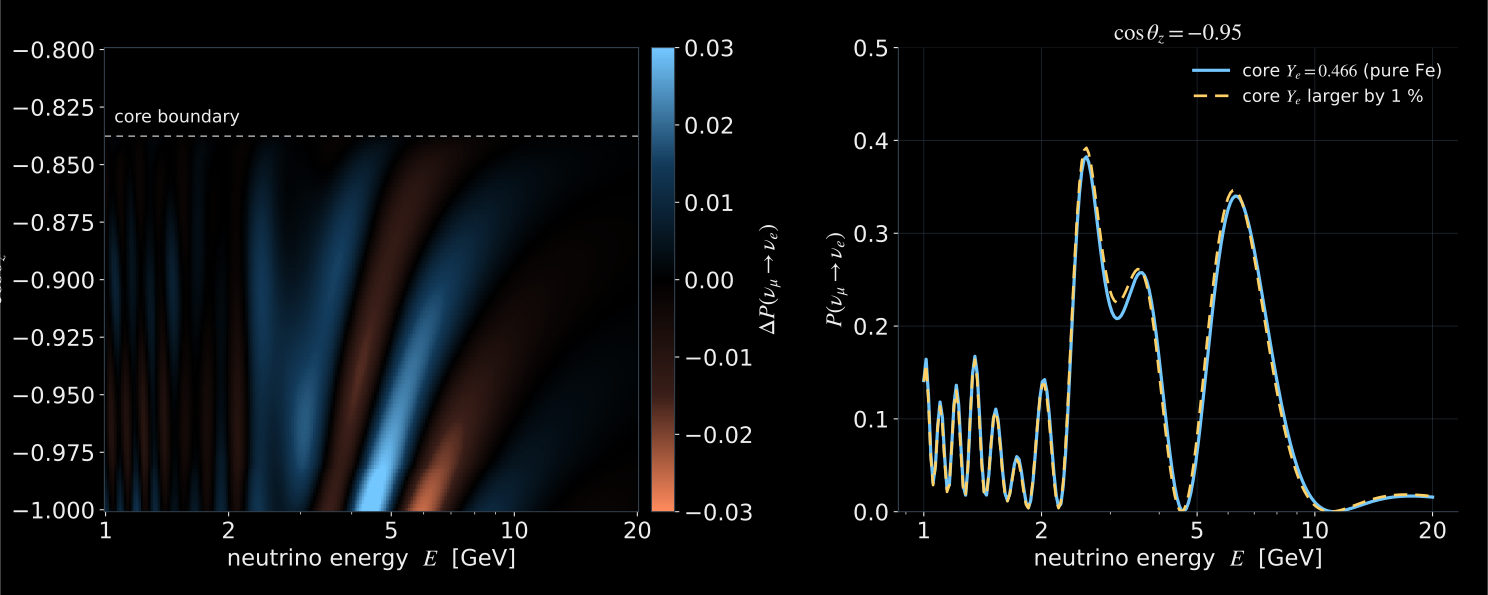
- \(+1\,\%\) in the core \(Y_e\) changes \(P\) by up to \(\pm0.03\), only for core-crossing paths of 2–10 GeV; resolution smears much of this fine pattern.
Computed with the same model; only the core \(Y_e\) changed; no detector response or flux.
Geoneutrinos: the Earth’s radioactive heat
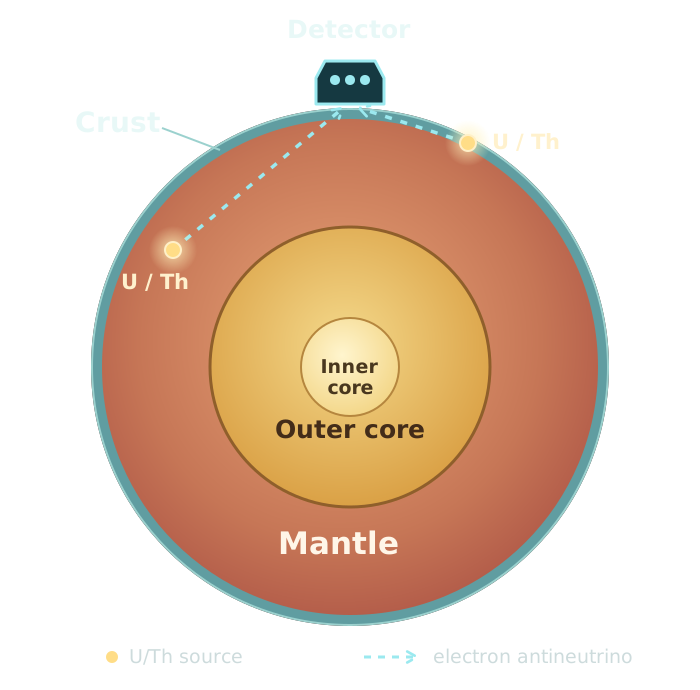
Crust enlarged; paths illustrative.
- \(^{238}\)U and \(^{232}\)Th chains emit \(\bar\nu_e\) up to 3.27 and 2.25 MeV; detected by \(\bar\nu_e+p\to e^++n\) above 1.806 MeV.
- The Earth loses \(47\pm2\) TW of heat. How much is radiogenic, how much primordial?
- Radiogenic U+Th heat: Borexino \(38.2^{+13.6}_{-12.7}\) TW; KamLAND \(15.4^{+8.3}_{-7.9}\) TW. KamLAND sees geoneutrinos at 8.5σ.
- Geoneutrinos oscillate too: averaged over many oscillation lengths, \(P_{ee}\approx0.55\).
Heat flow: Davies & Davies, Solid Earth 1, 5 (2010) · Borexino, PRD 101, 012009 (2020) · KamLAND, GRL 49, e2022GL099566 (2022), Th/U free · \(P_{ee}=c_{13}^4(1-\tfrac12\sin^22\theta_{12})+s_{13}^4\) with NuFIT 6.1.
How much of the Earth’s heat is radiogenic?
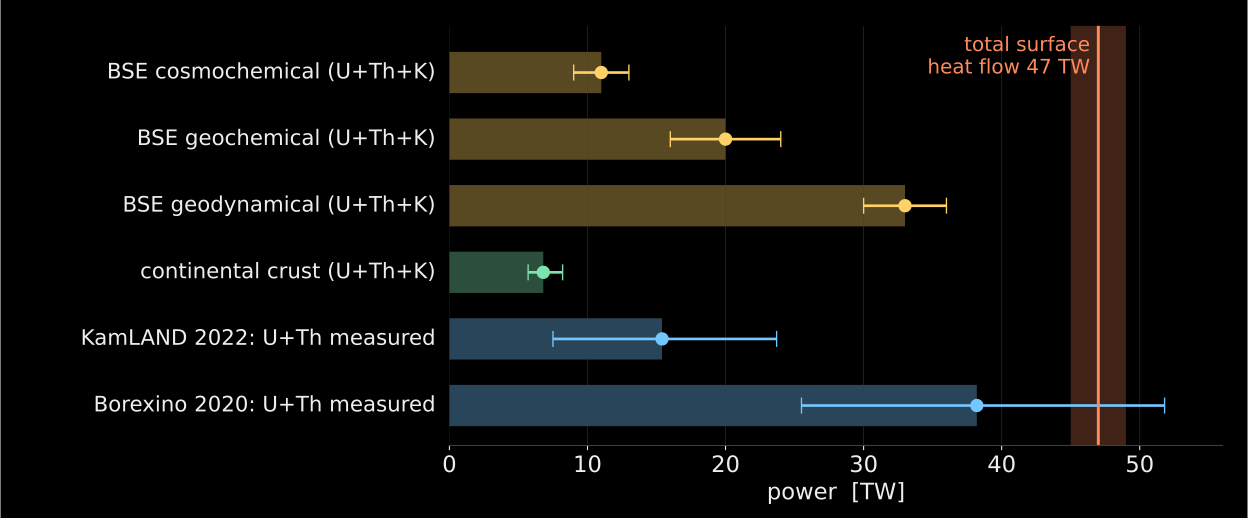
- Earth models disagree by a factor of 3: 11–33 TW of radiogenic heat out of 47 TW. The rest is primordial heat.
- The crust is sampled by rocks; geoneutrinos see the U and Th of the mantle directly.
Šrámek et al., EPSL 361, 356 (2013), Table 2 · Huang et al., G³ 14, 2003 (2013) · Davies & Davies (2010) · Borexino 2020 · KamLAND 2022 (Th/U free). Models and crust: U+Th+K; measurements: U+Th only.