Neutrino Oscillations II
Matter and the Sun
Joint Institute for Nuclear Research, Dubna
Where we stopped
\[ \boxed{P_{\alpha\to\beta}=\sin^22\theta\,\sin^2\!\left(1.267\,\frac{\Delta m^2[\mathrm{eV^2}]\,L[\mathrm{km}]}{E[\mathrm{GeV}]}\right)} \]
- Flavor states are superpositions of mass waves.
- The waves accumulate different phases: \(\Delta\varphi=\Delta m^2L/2E\).
- Two clocks: \(\Delta m^2_{31}=2.5\times10^{-3}\), \(\Delta m^2_{21}=7.5\times10^{-5}\ \mathrm{eV^2}\).
Today
- Matter acts on neutrinos like glass on light.
- A resonance makes small mixing large.
- Slowly changing density: the Sun converts \(\nu_e\) into one mass state.
- Matter tells neutrinos from antineutrinos: the mass ordering.
Neutrinos in matter
Light in glass
- Light in glass is slower: refractive index \(n\approx1.5\).
- No photon is absorbed. Each atom scatters a little forward; the scattered waves add coherently to the incoming wave and shift its phase.
- The phase shift accumulates with distance: \(\delta\varphi=(n-1)\,\omega L/c\).
For neutrinos
The same coherent forward scattering exists, but is tiny. In rock at \(E=1\) GeV:
\(|n-1|\approx 2\times10^{-22}\)
Does it matter at all?
It matters if it is comparable to the vacuum effect: the mass-induced difference \(\Delta m^2/2E\) is itself only \(10^{-21}\) of the energy.
Phase from many thin layers
Extra phase at the exit: 0.75 rad. The frequency is the same on both sides of the layer.
Each thin layer adds a small forward-scattered wave. Together they only shift the phase of the passing wave: this is the refractive index.
Only \(\nu_e\) feels the electrons
- Matter contains electrons, protons, neutrons.
- All flavors scatter forward via \(Z\) exchange equally: a common phase, invisible in oscillations.
- Only \(\nu_e\) also scatters on electrons via \(W\) exchange: an extra potential energy
\[ \boxed{V=\sqrt2\,G_F\,n_e} \]
- Antineutrinos: \(V\to-V\).
In practical units
\[ \boxed{V=7.63\times10^{-14}\ \mathrm{eV}\;\;Y_e\,\frac{\rho}{\mathrm{g\,cm^{-3}}}} \]
\(Y_e\): electrons per nucleon; \(\rho\): mass density.
Neutrinos measure the electron density \(n_e=Y_e\,\rho\,N_A\) — not the mass density.
\(7.63\times10^{-14}=\sqrt2\,G_FN_A(\hbar c)^3\) with \(G_F/(\hbar c)^3=1.1663787\times10^{-5}\ \mathrm{GeV^{-2}}\), CODATA 2022.
Tiny, but compared to what?
Matter potential \(V\)
| Medium | \(Y_e\rho\) [g/cm³] | \(V\) [eV] |
|---|---|---|
| Earth’s crust | 1.3 | \(1.0\times10^{-13}\) |
| Earth’s mantle | 2.2 | \(1.7\times10^{-13}\) |
| Earth’s outer core | 5.1 | \(3.9\times10^{-13}\) |
Vacuum term \(\Delta m^2_{31}/2E\)
| \(E\) | \(\Delta m^2_{31}/2E\) [eV] |
|---|---|
| 1 GeV | \(1.3\times10^{-12}\) |
| 3 GeV | \(4.2\times10^{-13}\) |
| 10 GeV | \(1.3\times10^{-13}\) |
For neutrinos of a few GeV crossing the Earth, matter and vacuum terms are equal. The natural measure is \(A=2EV/\Delta m^2\): matter grows in importance with energy.
Computed: \(Y_e\rho\) averaged over PREM layers with model compositions (mantle: Mg₂SiO₄, \(Y_e=0.497\); core: Fe, \(Y_e=0.466\)).
Two waves in matter
Transition probability: 0.750. Equal phases give no transition.
In matter the waves that travel unchanged are no longer \(\nu_1\) and \(\nu_2\): new eigenstates with a new mixing angle \(\theta_m\) and a new splitting.
Mixing in matter
\[ \boxed{\sin^22\theta_m=\frac{\sin^22\theta}{(\cos2\theta-A)^2+\sin^22\theta}}, \qquad A=\frac{2EV}{\Delta m^2}. \]
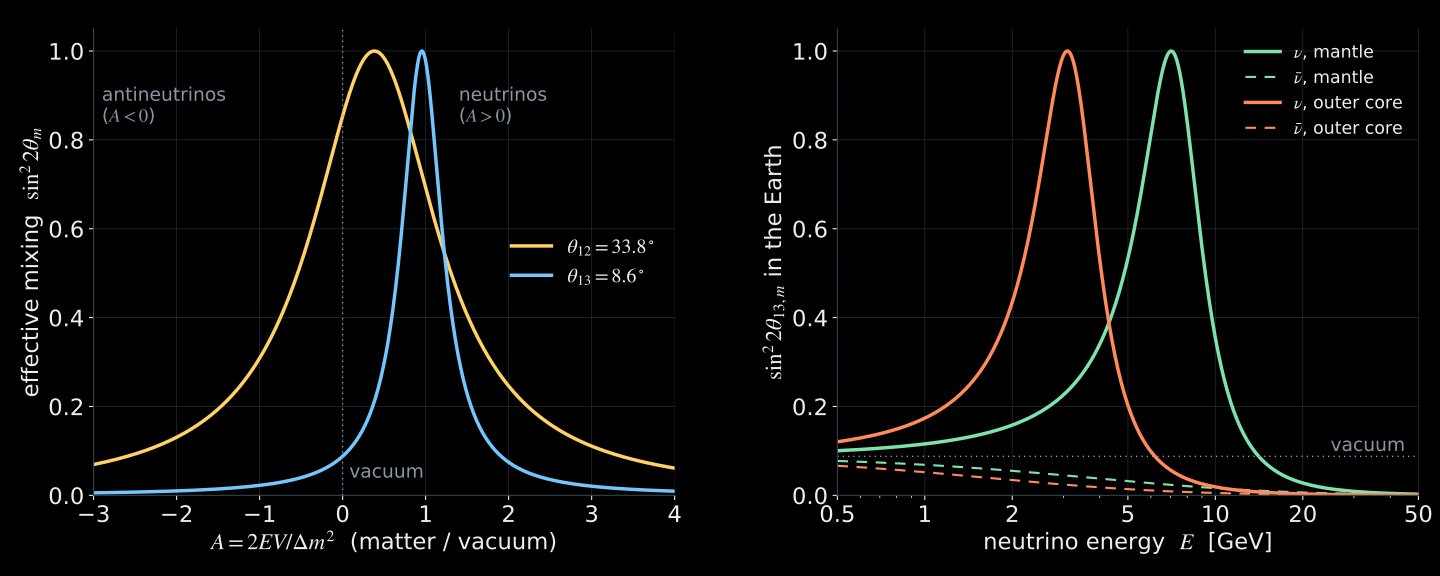
- Resonance at \(A=\cos2\theta\): even the small angle \(\theta_{13}=8.6^\circ\) becomes maximal mixing (MSW: Mikheyev, Smirnov, Wolfenstein).
- Antineutrinos (\(A<0\)) have no resonance: matter tells \(\nu\) from \(\bar\nu\) and the sign of \(\Delta m^2\).
One layer of constant density
Press “resonance”: the amplitude reaches 1. Press “A ≫ 1”: dense matter freezes the flavor. Press “antineutrino”: no resonance.
Slowly changing density
When the density changes slowly
- In a uniform layer the two matter eigenstates keep their flavor composition.
- If the density changes slowly, a state that starts as one eigenstate stays in it, while the eigenstate itself turns from one flavor to another.
- Like a spin following a slowly rotating magnetic field: no jump, only following.
\[ \gamma_{\rm res}=\frac{\Delta m^2\sin^22\theta}{2E\cos2\theta\,|d\ln n_e/dx|_{\rm res}}\gg1 \]
Fast change: a jump
If the density changes quickly, the state can jump to the other branch. For a linear crossing the jump probability is approximately
\[ P_c\simeq e^{-\pi\gamma_{\rm res}/2}. \]
\(\gamma_{\rm res}\): adiabaticity parameter at the resonance; Landau–Zener estimate. MSW: Wolfenstein, Phys. Rev. D 17, 2369 (1978); Mikheyev & Smirnov, Sov. J. Nucl. Phys. 42, 913 (1985).
Follow the branch
“Adiabatic”: the state follows the upper branch and leaves as the other flavor. “Fast”: it jumps across the gap. “Small θ”: the gap is narrow and following is harder.
The Sun
The Sun as a flavor converter
- In the dense core, high-energy \(\nu_e\) are born almost purely as the heavier matter state \(\nu_{2m}\).
- The density falls slowly compared with the oscillation length: the state follows the heavier eigenstate adiabatically.
- It leaves the Sun as the vacuum state \(\nu_2\), which is \(\nu_e\) only with probability \(|U_{e2}|^2\approx\sin^2\theta_{12}\).
Two plateaus
Low energy (vacuum averaging):
\[ P_{ee}\simeq1-\tfrac12\sin^22\theta_{12}\approx0.57 \]
High energy (adiabatic MSW):
\[ P_{ee}\simeq\sin^2\theta_{12}\approx0.31 \]
This explains SNO’s one third for the high-energy \(^8\)B neutrinos, while low-energy pp neutrinos survive more often.
Where the switch happens
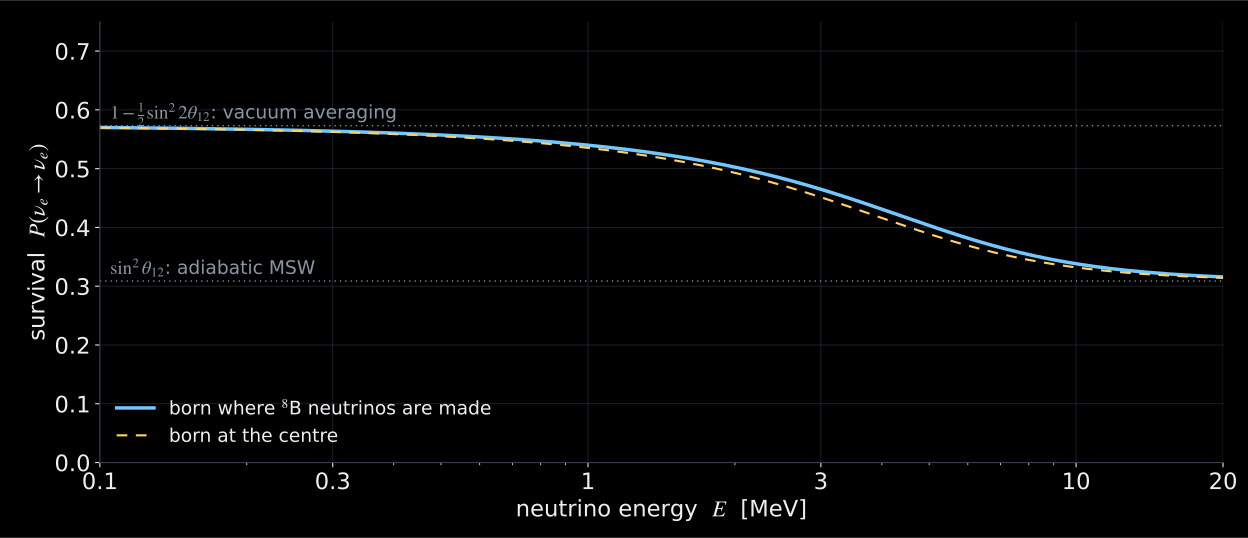
- At the solar centre \(n_e\approx6.2\times10^{25}\ \mathrm{cm^{-3}}\), i.e. \(Y_e\rho\approx100\) g/cm³: the resonance energy for \(\Delta m^2_{21}\) is \(\approx1.8\) MeV.
- Below 1 MeV the Sun acts like vacuum; above 10 MeV the conversion is almost complete: one figure explains both pp and \(^8\)B data.
Computed: two-flavor adiabatic formula \(P_{ee}=\tfrac12(1+\cos2\theta_{12}\cos2\theta_m^0)\), \(\sin^2\theta_{12}=0.309\) (NuFIT 6.1); \(n_e\) at production from the BS05(OP) solar model (Bahcall, Serenelli & Basu, ApJ 621, L85 (2005)): centre, and \(5.5\times10^{25}\ \mathrm{cm^{-3}}\) in the \(^8\)B production region. \(\theta_{13}\) omitted.
The Earth at night
- At night solar neutrinos cross the Earth before reaching the detector.
- The Earth’s matter turns part of the arriving \(\nu_2\) back into \(\nu_e\): regeneration.
- Expected: slightly more \(\nu_e\) at night.
Super-Kamiokande, SK-I to IV:
\[ A_{\rm D/N}=\frac{\Phi_{\rm day}-\Phi_{\rm night}}{\tfrac12(\Phi_{\rm day}+\Phi_{\rm night})} =(-2.86\pm0.85\pm0.32)\ \% \]
Why it is small
For solar energies \(2EV\ll\Delta m^2_{21}\) in the Earth: \(A\approx0.005\text{–}0.1\) for 1–10 MeV. A weak “lens” gives a percent-level effect.
Why it is important
It is the first sign of the Earth’s matter in neutrino oscillations: \(3.2\sigma\).
Super-Kamiokande, Phys. Rev. D 109, 092001 (2024); value for \(\Delta m^2_{21}=6.1\times10^{-5}\ \mathrm{eV^2}\) (solar best fit).
Matter and the mass ordering
Long baselines: matter separates \(\nu\) from \(\bar\nu\)
Switch the ordering; switch matter off; move δ. Which baseline separates the orderings best?
What the baseline lab shows
\(P(\nu_\mu\to\nu_e)\) at the first maximum, \(\delta=270^\circ\):
| \(\nu\), NO | \(\bar\nu\), NO | \(\nu\), IO | \(\bar\nu\), IO | |
|---|---|---|---|---|
| vacuum | 0.055 | |||
| 295 km, 0.6 GeV | 0.060 | 0.027 | 0.057 | 0.041 |
| 1300 km, 2.6 GeV | 0.084 | 0.017 | 0.037 | 0.060 |
- Matter enters through \(A=2EV/\Delta m^2\), which grows with \(E\propto L\): at 295 km \(A\approx0.05\), at 1300 km \(A\approx0.24\).
- Normal ordering: matter helps \(\nu\), suppresses \(\bar\nu\); inverted: the opposite.
- The CP phase also makes \(\nu\) and \(\bar\nu\) differ. Long baselines disentangle the two effects by their energy dependence.
Computed: three flavors, NuFIT 6.1 angles and splittings, \(\delta\) fixed to \(270^\circ\) for both orderings; straight path through PREM with continental crust (mean ρ = 3.07 g/cm³ for 1300 km; DUNE analyses use 2.848 g/cm³); maxima taken within ±30 % of the first-maximum energy \(E_1=1.267\cdot\Delta m^2_{31}L/(\pi/2)\).
Summary of Lecture II
- Matter gives \(\nu_e\) an extra potential \(V=\sqrt2G_Fn_e\): refraction, not absorption.
- It matters when \(2EV\sim\Delta m^2\): MeV in the Sun, GeV in the Earth. At resonance even small mixing becomes maximal.
- Slowly changing density: the state follows an eigenstate. The Sun turns high-energy \(\nu_e\) into \(\nu_2\): \(P_{ee}\approx0.31\).
- The Earth regenerates a little \(\nu_e\) at night and separates \(\nu\) from \(\bar\nu\) on long baselines: the mass ordering.
Next: turn the argument around. If matter changes oscillations, oscillations can measure matter — inside the Earth.