Neutrino Oscillations I
A quantum clock in vacuum
Joint Institute for Nuclear Research, Dubna
Three lectures, one question
I · Vacuum
- Ghost particles and missing neutrinos
- One neutrino, two waves
- The formula and its two knobs
- Numbers: lengths, energies, masses
- Three flavors, two clocks
II · Matter and the Sun
- Refraction of neutrinos
- Resonance: small mixing made large
- Slowly changing density
- The Sun as a flavor converter
- Matter and the mass ordering
III · The Earth
- What geophysics knows
- Absorption: the Earth’s mass
- Oscillations: the core’s electrons
- Geoneutrinos: the Earth’s heat
Can a particle that crosses the whole Earth almost unnoticed be used to look inside it?
Ghost particles
How invisible is a neutrino?
From the Sun
\(6.5\times10^{10}\)
neutrinos through each cm² every second, day and night
In water
\(\approx 60\) light-years
mean free path of a 3 MeV reactor antineutrino
\[ \lambda=\frac{1}{n_p\,\sigma},\qquad \sigma(\bar\nu_e p\to e^+n)\big|_{3\,\rm MeV}\simeq2.6\times10^{-43}\ \mathrm{cm^2},\qquad n_p=6.7\times10^{22}\ \mathrm{cm^{-3}}. \]
The weak interaction makes neutrinos hard to catch, and for the same reason they carry undisturbed information from deep inside the Sun and the Earth.
Flux: standard solar model B16-GS98, sum of the tabulated components (Vinyoles et al. 2017). Cross section: Vogel & Beacom 1999, zeroth order; free protons of water.
A neutrino is named after its partner
The weak interaction always creates or absorbs a neutrino together with a charged lepton:
\[ \begin{aligned} \pi^+&\to\mu^+ +\nu_\mu, & n&\to p+e^-+\bar\nu_e,\\ \nu_e+n&\to p+e^-, & \nu_\mu+n&\to p+\mu^- . \end{aligned} \]
- Three charged leptons \(e,\mu,\tau\) give three flavors \(\nu_e,\nu_\mu,\nu_\tau\).
- The flavor is the label written at birth: it says which charged lepton the neutrino will produce in a detector.
Naive expectation
A \(\nu_\mu\) born with a muon must produce a muon in the detector, no matter how far away the detector is.
Observation
Far away, part of the \(\nu_\mu\) produce electrons or taus, or nothing visible.
How a detector reads the flavor
- A neutrino is seen only through the charged lepton it makes: \(e\), \(\mu\) or \(\tau\).
- In water a charged particle faster than light in water emits Cherenkov light on a cone.
- Super-Kamiokande, 50 000 t of water: a muon gives a sharp ring; an electron showers and gives a smeared ring.
- Reactor \(\bar\nu_e\) in liquid scintillator: \(\bar\nu_e+p\to e^++n\) — a prompt flash, then ~200 μs later a 2.2 MeV γ from neutron capture.
Two puzzles, one answer
The Sun: too few \(\nu_e\)
- Homestake (chlorine, \(\nu_e\) only): \(2.56\pm0.16\pm0.16\) SNU against \(7.6^{+1.3}_{-1.1}\) SNU predicted — about one third.
- SNO (2002) counted \(\nu_e\) and all flavors separately: \(\Phi_{\nu_e}=1.76\), \(\Phi_{\rm all}=5.09\) (×10⁶ cm⁻² s⁻¹). About one third arrive as \(\nu_e\); the total agrees with the solar model.
The atmosphere: too few from below
- Cosmic rays make \(\nu_\mu\) everywhere around the Earth.
- Super-Kamiokande (1998): \(\nu_\mu\) coming up through the Earth (up to 12 700 km) are depleted; those from above, crossing only the atmosphere, are not.
- Up–down asymmetry of multi-GeV \(\mu\)-like events: \(-0.296\pm0.048\pm0.01\); for \(e\)-like events: \(-0.036\pm0.067\pm0.02\), consistent with zero.
Neutrinos are not lost: they change flavor on the way, and the change depends on the distance travelled. Nobel Prize 2015: T. Kajita and A. B. McDonald.
A quantum chameleon
One neutrino, two waves
Two ways to describe the same neutrino
Flavor states \(\nu_e,\nu_\mu\)
Created and detected by the weak interaction.
Mass states \(\nu_1,\nu_2\)
Waves with definite masses \(m_1,m_2\): they travel without changing.
One state space, two sets of axes, turned by the mixing angle \(\theta\):
\[ \boxed{ \begin{aligned} |\nu_e\rangle&=\cos\theta\,|\nu_1\rangle+\sin\theta\,|\nu_2\rangle\\ |\nu_\mu\rangle&=-\sin\theta\,|\nu_1\rangle+\cos\theta\,|\nu_2\rangle \end{aligned}} \]
- \(\theta=0\): each flavor is a mass state; nothing happens.
- \(\theta\neq0\): a \(\nu_e\) is a superposition of two waves.
Like polarized light behind a rotated polarizer: what is created along one axis is detected along another.
Two phases, one probability
Two mass components acquire different phases. Their sum at detection sets the probabilities of the flavor outcomes.
An everyday analogy: beats
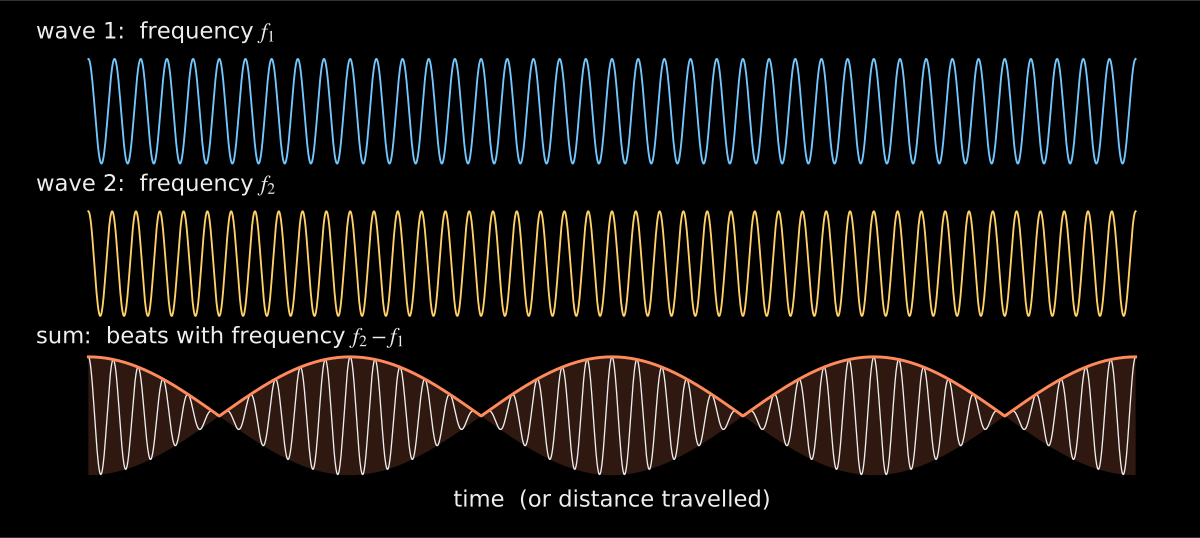
- Two tuning forks with slightly different pitch: you hear a slow swelling and fading — the beat.
- The beat period is set by the difference of the frequencies, not by the frequencies themselves.
- A neutrino carries two mass waves; the detector “hears” their beat as a varying flavor content.
Where does the frequency difference come from?
At fixed energy \(E\) the two mass waves have slightly different momenta:
\[ p_i=\sqrt{E^2-m_i^2}\simeq E-\frac{m_i^2}{2E} \qquad(\hbar=c=1,\ m_i\ll E). \]
After a distance \(L\) the two waves acquire different phases \(p_iL\). Their difference:
\[ \boxed{\Delta\varphi=(p_1-p_2)\,L=\frac{\Delta m^2\,L}{2E}}, \qquad \Delta m^2=m_2^2-m_1^2 . \]
- Grows with distance \(L\).
- Shrinks with energy \(E\): fast neutrinos age slowly.
- Needs different masses: \(\Delta m^2\neq0\).
- Only \(\Delta m^2\) enters, never the masses themselves.
The oscillation formula
Project the evolved state onto \(\nu_\mu\) and square:
\[ \boxed{ P(\nu_e\to\nu_\mu)=\sin^2 2\theta\;\sin^2\!\left(\frac{\Delta m^2L}{4E}\right) =\sin^2 2\theta\;\sin^2\!\left(1.267\,\frac{\Delta m^2[\mathrm{eV^2}]\;L[\mathrm{km}]}{E[\mathrm{GeV}]}\right)} \]
Knob 1: the angle \(\theta\)
Sets the height of the oscillation: \(P_{\max}=\sin^22\theta\).
Knob 2: \(\Delta m^2\cdot L/E\)
Sets where the maxima are. The oscillation length:
\[ L_{\rm osc}=\frac{4\pi E}{\Delta m^2}=2.48\ \mathrm{km}\;\frac{E[\mathrm{GeV}]}{\Delta m^2[\mathrm{eV^2}]} \]
\(1.267=10^{3}/(4\cdot10^{9}\,\hbar c)\) with \(\hbar c=197.327\ \mathrm{MeV\,fm}\) (CODATA 2022). Survival: \(P(\nu_e\to\nu_e)=1-P(\nu_e\to\nu_\mu)\).
Build an oscillation yourself
A = sin²2θ = 0.750
Set \(\theta=0\): what happens? Set \(\theta=45^\circ\): where is the first maximum? Where does the transition probability return to zero?
The same physics with two pendulums
P₁ + P₂ = 1 exactly, no averaging
Push one pendulum: the swing moves slowly to the other one and back. Each normal mode keeps its own frequency; the energy transfer is their beat.
Numbers
How small is the effect?
Take \(\Delta m^2=2.5\times10^{-3}\ \mathrm{eV^2}\) and \(E=1\) GeV:
\[ \frac{\Delta m^2}{2E}=1.3\times10^{-12}\ \mathrm{eV}, \qquad \frac{\Delta m^2/2E}{E}=1.3\times10^{-21}. \]
Yet after \(L_{\rm osc}\approx 1000\) km this tiny difference has turned into a full \(2\pi\) of phase.
An interferometer
A relative precision of \(10^{-21}\) is like measuring the Sun–Earth distance to
0.2 nm
the size of an atom.
Oscillations are interference: they reach masses far too small for any balance — at least one neutrino is heavier than \(\sqrt{2.5\times10^{-3}}\ \mathrm{eV}=0.05\) eV, ten million times lighter than the electron.
Oscillation lengths
\(L_{\rm osc}=2.48\ \mathrm{km}\cdot E[\mathrm{GeV}]/\Delta m^2[\mathrm{eV^2}]\) with the two measured splittings \(\Delta m^2_{31}=2.5\times10^{-3}\) and \(\Delta m^2_{21}=7.5\times10^{-5}\ \mathrm{eV^2}\):
| Source | Example energy | \(L_{\rm osc}\), fast clock \(\Delta m^2_{31}\) | \(L_{\rm osc}\), slow clock \(\Delta m^2_{21}\) | Typical \(L\) |
|---|---|---|---|---|
| Sun | 1 MeV | 1 km | 33 km | \(1.5\times10^{8}\) km |
| Reactor | 4 MeV | 4 km | 130 km | 1.65–180 km |
| Accelerator | 0.6–2 GeV | 600–2000 km | \(2\text{–}7\times10^{4}\) km | 295–1300 km |
| Atmosphere | 10 GeV | \(10^4\) km | \(3\times10^{5}\) km | up to 12 700 km |
The first maximum sits at \(L=L_{\rm osc}/2\). Choosing \(L/E\) chooses which clock you watch.
Where experiments sit
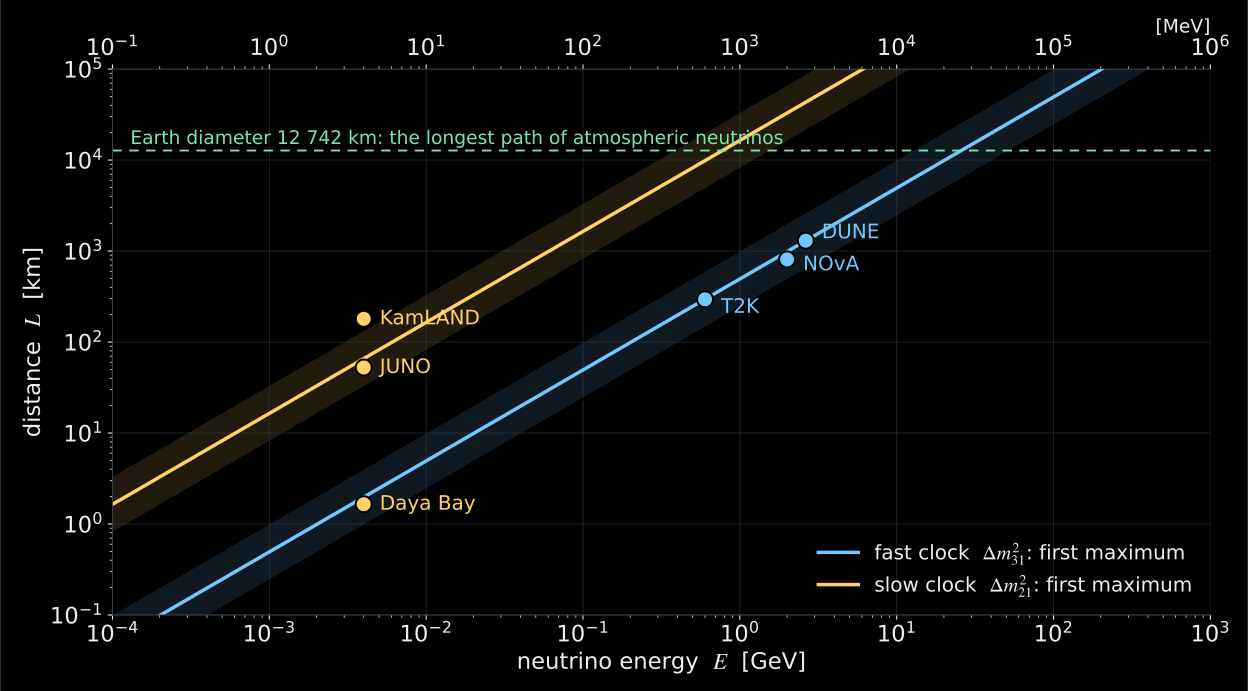
Lines: \(1.267\,\Delta m^2L/E=\pi/2\); bands: factor 2 around it. Baselines: Daya Bay far hall 1.65 km, JUNO 52.5 km, KamLAND ≈180 km, T2K 295 km (0.6 GeV), NOvA 810 km (2 GeV), DUNE 1300 km (drawn at its first maximum, 2.6 GeV). Reactors drawn at 4 MeV.
When the clock is too fast to read
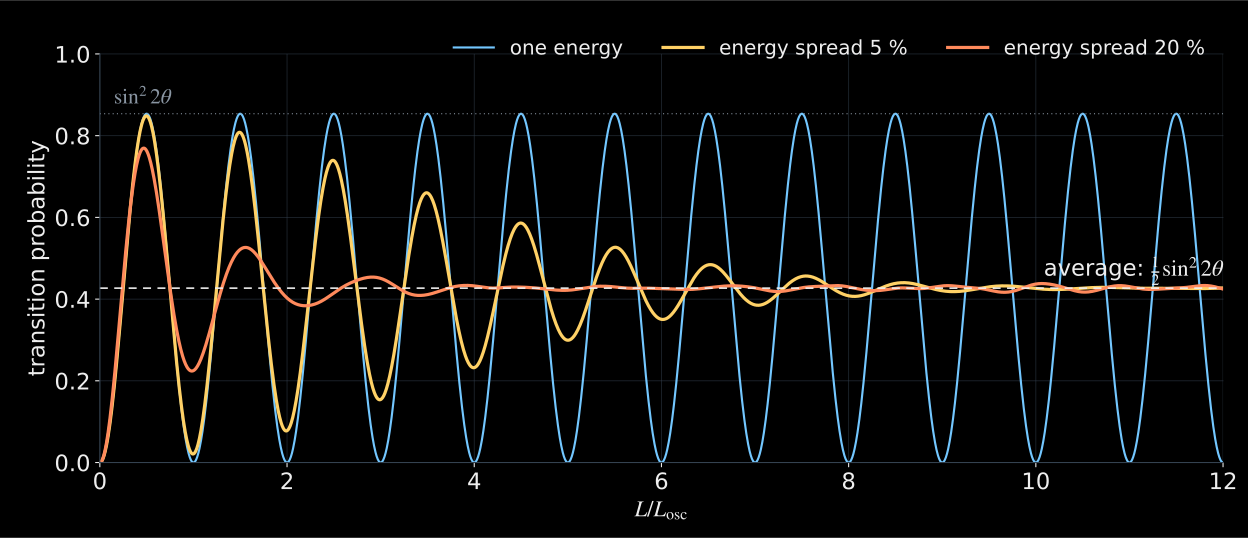
- Real sources have a spread of energies and a finite size; detectors have finite resolution.
- Far beyond \(L_{\rm osc}\) the phases of different neutrinos scatter: the oscillation averages out to \(\tfrac12\sin^22\theta\).
- Solar neutrinos travel \(10^{8}L_{\rm osc}\): in vacuum we would only see the average, \(P_{ee}=1-\tfrac12\sin^22\theta_{12}\approx0.57\).
Three flavors
Three neutrinos, two clocks
Three mass states give two independent splittings:
\[ \frac{\Delta m^2_{31}}{\Delta m^2_{21}}\approx 33 . \]
Flavor content of the mass states (fractions \(|U_{\alpha i}|^2\)):
| \(\nu_1\) | \(\nu_2\) | \(\nu_3\) | |
|---|---|---|---|
| \(e\) | 0.68 | 0.30 | 0.02 |
| \(\mu\) | 0.11 | 0.43 | 0.46 |
| \(\tau\) | 0.21 | 0.27 | 0.52 |
Is \(\nu_3\) the heaviest or the lightest? The mass ordering is not yet established; normal ordering is preferred at about 2–3σ.
Best-fit values, normal ordering: NuFIT 6.1 (2025). Three angles \(\theta_{12}\approx34^\circ\), \(\theta_{23}\approx43^\circ\), \(\theta_{13}\approx8.6^\circ\) and one CP phase. Ordering: NuFIT 6.1, \(\Delta\chi^2_{\rm IO}=5.9\) with SK atmospheric data; JUNO (2026), NO favoured at ≥2.1σ.
Three flavors on one triangle
Each point of the triangle is a flavor mixture \((P_e,P_\mu,P_\tau)\). Start with \(\nu_\mu\) and watch the slow and the fast clock draw the path.
Explore three-flavor probabilities
Two clocks in one experiment
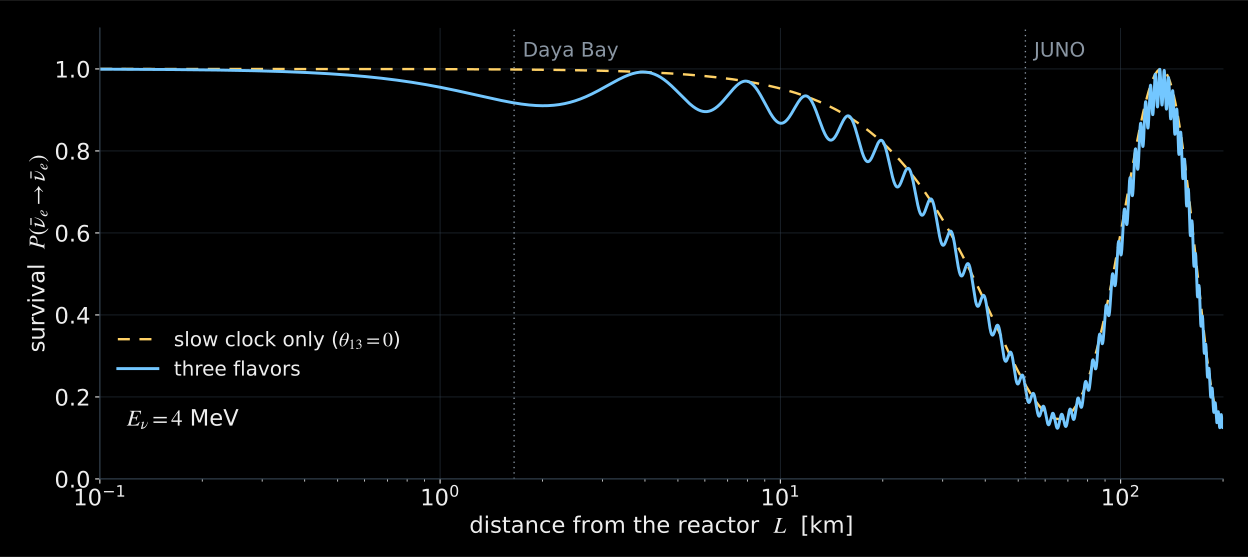
- Near (1–2 km): a shallow dip from the fast clock; its depth \(\sin^22\theta_{13}\approx0.09\) — measured by Daya Bay (2012).
- Far (50–60 km): the deep dip of the slow clock with fast ripples on top. Their phase depends on the mass ordering: this is what JUNO measures.
Computed: three-flavor vacuum oscillations, NuFIT 6.1 best fit, \(E_\nu=4\) MeV. First measurement: Daya Bay, \(\sin^22\theta_{13}=0.092\pm0.016\pm0.005\) (PRL 108, 171803 (2012)).
What oscillations tell us — and what they do not
Established
- Neutrinos have mass: physics beyond the minimal Standard Model.
- Three flavors mix through three angles.
- Two mass splittings, \(7.5\times10^{-5}\) and \(2.5\times10^{-3}\ \mathrm{eV^2}\).
- Solar, atmospheric, reactor and accelerator data fit one picture.
Open
- The ordering: is \(\nu_3\) heaviest or lightest?
- CP violation: do neutrinos and antineutrinos oscillate differently?
- The absolute mass scale: oscillations see only differences.
- Is \(\theta_{23}\) exactly \(45^\circ\)?
Summary of Lecture I
\[ \boxed{P_{\alpha\to\beta}=\sin^22\theta\,\sin^2\!\left(1.267\,\frac{\Delta m^2L}{E}\right)} \]
- Flavor is created and detected; mass states propagate. The mismatch, set by \(\theta\), makes interference possible.
- Different masses give different phases: a clock that ticks with \(\Delta m^2L/E\).
- The effect is a relative difference of \(10^{-21}\), made visible over hundreds of kilometres.
- Three flavors, two clocks: \(\Delta m^2_{31}\) (fast) and \(\Delta m^2_{21}\) (slow).
So far the neutrino flew through empty space. Next: what matter does to the clock — in the Sun, and on long paths through the Earth.