Introduction to Neutrino Physics
JINR
For a particle with spin \(1/2\) the helicity operator is
\[ \hat{\mathbf S}=\frac{\boldsymbol\sigma}{2}, \qquad \hat h = 2\hat{\mathbf S}\cdot\hat{\mathbf p} = \boldsymbol\sigma\cdot\hat{\mathbf p}, \qquad \hat{\mathbf p}=\frac{\mathbf p}{|\mathbf p|}. \]
Right-handed helicity state
\[h=+1\]
Left-handed helicity state
\[h=-1\]
Helicity answers the question:
are the spin and the momentum directed the same way or opposite ways?
\[ \begin{aligned} \mathbf S\uparrow\uparrow\mathbf p &\quad\Longrightarrow\quad h=+1,\\[0.5em] \mathbf S\uparrow\downarrow\mathbf p &\quad\Longrightarrow\quad h=-1. \end{aligned} \]
A massive particle has a rest frame. An observer can first catch up with the particle and then move faster than it.
In the new reference frame the sign of the momentum changes, while the direction of the spin remains the same:
\[ \mathbf p\to-\mathbf p, \qquad \mathbf S\to\mathbf S. \]
Consequently,
\[ h=\boldsymbol\sigma\cdot\hat{\mathbf p} \quad\longrightarrow\quad -h. \]
A massless particle moves with speed \(v=1\) in all inertial frames. An inertial observer cannot overtake it and see a momentum directed backward.
Therefore an admissible Lorentz transformation cannot perform
\[ \mathbf p\to-\mathbf p \]
without changing the physical state itself.
For \(m>0\) the sign of the helicity depends on the reference frame.
For \(m=0\) the direction of the momentum cannot be reversed by a transition to another inertial frame, so
\[ \boxed{\text{the helicity of a massless particle is Lorentz-invariant}.} \]
Neutrinos have mass, but in most experiments their energy is much greater than their rest energy:
\[ E_\nu\gg m_\nu, \qquad \beta_\nu\equiv v_\nu\simeq1. \]
The difference between helicity and chirality is determined by the small ratio
\[ \frac{m_\nu}{E_\nu}\ll1. \]
A left-handed weak vertex almost always produces a neutrino with \(h=-1\). The probability of the opposite helicity is
\[ P_{\rm wrong} =\frac{1-\beta_\nu}{2} \simeq \left(\frac{m_\nu}{2E_\nu}\right)^2. \]
The amplitude is suppressed as \(m_\nu/E_\nu\), and the probability as the square of this ratio.
Take
\[ m_\nu=0.1~\mathrm{eV}, \qquad E_\nu=1~\mathrm{MeV}=10^6~\mathrm{eV}. \]
Then
\[ \frac{m_\nu}{2E_\nu} =\frac{0.1}{2\cdot10^6} =5\cdot10^{-8}, \]
\[ \boxed{ P_{\rm wrong}\simeq (5\cdot10^{-8})^2 =2.5\cdot10^{-15}}. \]
In practice the observed helicity coincides with the chirality selected by the weak interaction.
The projection of the spin onto the momentum:
\[ h=\boldsymbol\sigma\cdot\hat{\mathbf p}. \]
For a massive particle it depends on the reference frame.
The projection of the field onto the eigenstates of \(\gamma^5\):
\[ P_{L,R}=\frac{1\mp\gamma^5}{2}. \]
It determines how the field enters the weak interaction.
For \(m=0\) chirality and helicity coincide. For \(m>0\) they are different characteristics — below one can see how large their difference is.
We work in the Dirac basis.
The two-component spinor \(\xi_h\) is an eigenvector of helicity:
\[ (\boldsymbol\sigma\!\cdot\!\hat{\mathbf p})\xi_h=h\xi_h, \qquad h=\pm1. \]
The positive-frequency solution of the Dirac equation:
\[ u_h(\mathbf p)= \begin{pmatrix} a\,\xi_h\\[3pt] h b\,\xi_h \end{pmatrix}, \]
\[ a=\sqrt{E+m},\qquad b=\sqrt{E-m},\qquad ab=p. \]
The sign \(h\) appears only in the lower component: this is exactly why the left and right projectors will act differently on the two helicity states.
In the Dirac basis chirality does not coincide with the “upper” or “lower” half of the four-component spinor.
\[ \gamma_D^0= \begin{pmatrix}I&0\\0&-I\end{pmatrix}, \qquad \gamma_D^5= \begin{pmatrix}0&I\\I&0\end{pmatrix}, \]
\[ I\equiv I_{2\times2}. \]
\[ P_{L,R}=\frac{1\mp\gamma_D^5}{2} =\frac12 \begin{pmatrix} I&\mp I\\ \mp I&I \end{pmatrix}. \]
\[ P_L+P_R=1, \qquad P_LP_R=0. \]
\(P_L\) and \(P_R\) select the eigenstates of \(\gamma^5\) with eigenvalues \(-1\) and \(+1\).
Now let us act with the projectors on the state with definite helicity \(h\).
\[ P_Lu_h=\frac{a-hb}{2} \begin{pmatrix}\xi_h\\-\xi_h\end{pmatrix}, \]
\[ P_Ru_h=\frac{a+hb}{2} \begin{pmatrix}\xi_h\\ \xi_h\end{pmatrix}. \]
Since
\[ u_h^\dagger u_h=a^2+b^2=2E, \]
the fraction of the \(X\)-chiral component is
\[ f_X(h)\equiv \frac{\|P_Xu_h\|^2}{\|u_h\|^2}, \qquad X=L,R. \]
It remains to compute the norms of the two projections and divide them by the norm of the original spinor.
We set \(\xi_h^\dagger\xi_h=1\) and use \(u_h^\dagger u_h=a^2+b^2=2E\).
1. Norms of the projections
\[ \begin{aligned} \|P_Lu_h\|^2 &=\frac{(a-hb)^2}{4} \left(\|\xi_h\|^2+\|-\xi_h\|^2\right)\\ &=\frac{(a-hb)^2}{2},\\[5pt] \|P_Ru_h\|^2 &=\frac{(a+hb)^2}{2}. \end{aligned} \]
2. Expanding the square
\[ \begin{aligned} (a\mp hb)^2 &=a^2+b^2\mp2hab\\ &=2E\mp2hp\\ &=2E(1\mp h\beta), \end{aligned} \]
\[ ab=p, \qquad \beta=\frac{p}{E}. \]
3. Dividing by the norm of the original spinor
\[ \boxed{ f_{L,R}(h)=\frac{(a\mp hb)^2}{4E} =\frac{1\mp h\beta}{2}}, \qquad \beta=\frac{p}{E}. \]
The upper sign corresponds to \(L\), the lower to \(R\).
\(f_X(h)\) is the fraction of the norm of the spinor with fixed helicity \(h\) that is selected by the chiral projector \(P_X\).
In a weak vertex of type \(X\) the amplitude contains \(P_Xu_h\), so the rate of production or detection of the state \(h\) is proportional to \(f_X(h)\).
For fixed chirality
\[ f_X(-1)+f_X(+1)=1. \]
Consequently, after normalization over the two possible helicities
\[ \boxed{P(h\mid X)=f_X(h)}. \]
A neutrino from a left-handed weak vertex:
\[ P(h=-1\mid L)=\frac{1+\beta}{2}, \qquad P(h=+1\mid L)=\frac{1-\beta}{2} \simeq\frac{m^2}{4E^2}. \]
For \(E\gg m\) almost all neutrinos have \(h=-1\), and the admixture of the “wrong” helicity is suppressed as \(m^2/E^2\).
This is not simple:
We need a process in which the neutrino helicity leaves a measurable trace in other processes.
In 1958 Maurice Goldhaber, Andrew Sunyar and Lee Grodzins proposed measuring the neutrino helicity through a sequence of two quantum transitions.
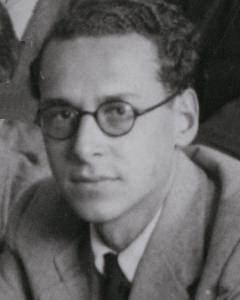
Maurice Goldhaber
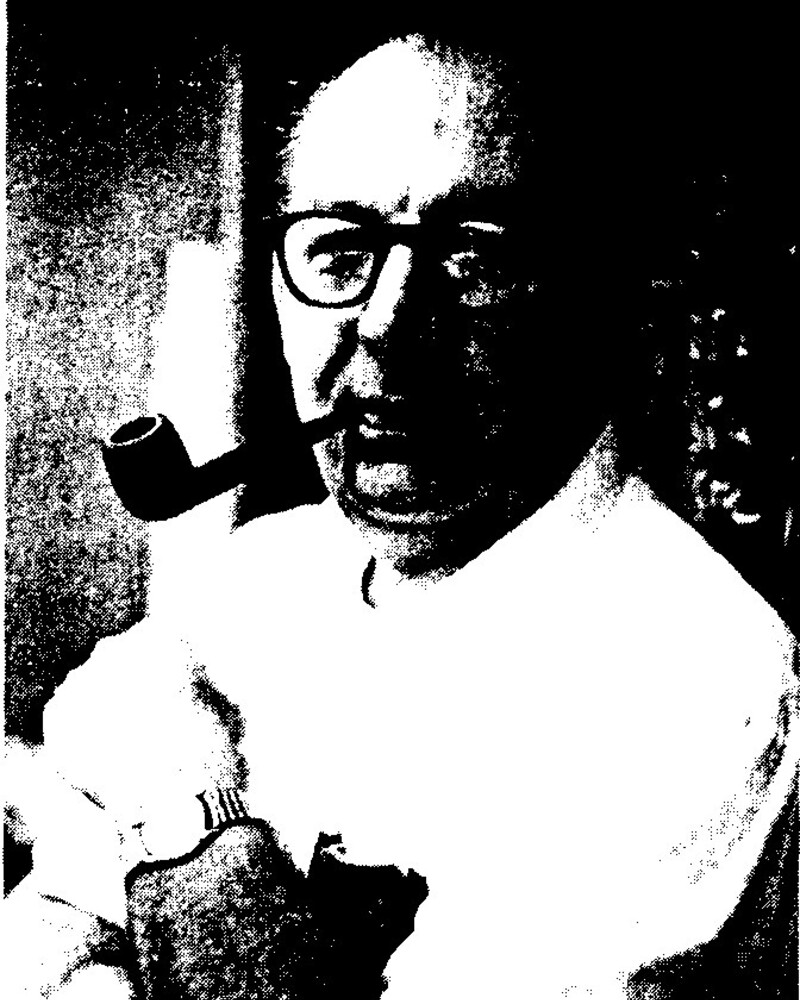
Andrew Sunyar
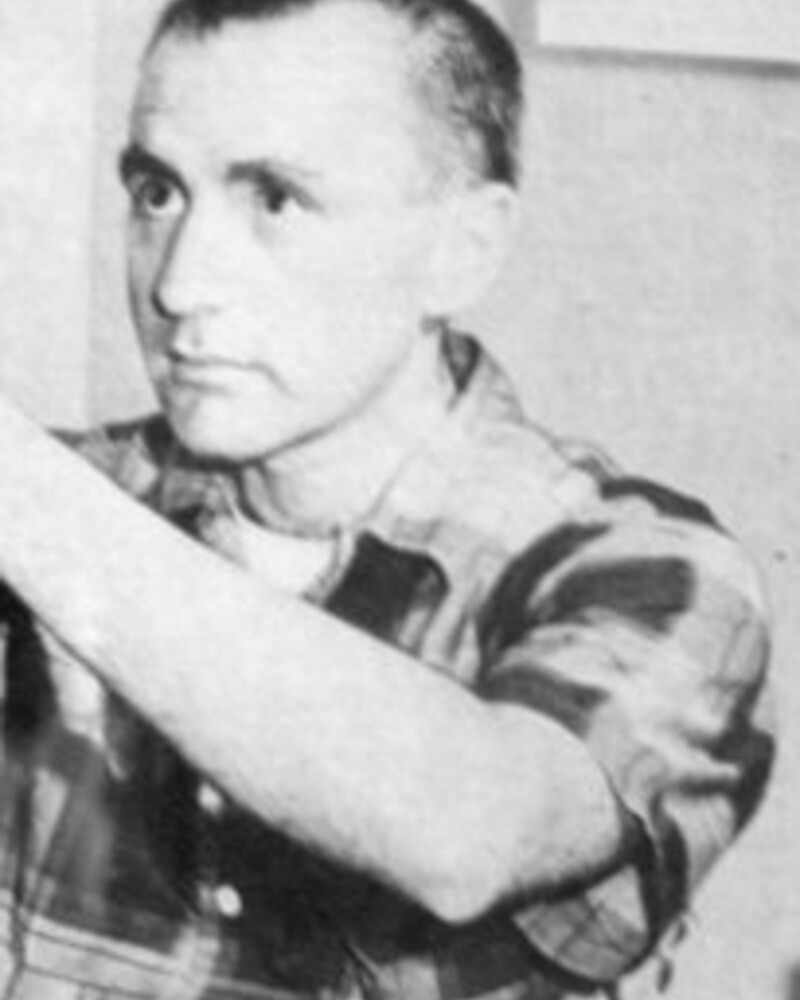
Lee Grodzins
The idea: to make the nucleus and the photon “remember” in turn the projection of the neutrino spin.
Consider electron capture
\[ A(0)+e^-\longrightarrow B^*(1)+\nu_e. \]
The initial nucleus has spin \(0\), and the daughter nucleus is produced in an excited state with spin \(1\).
In the final state the projection of angular momentum is shared between the nucleus \(B^*\) and the neutrino.
Initial nucleus
\[J_A=0\]
Electron in the (K) shell
\[J_e=\frac12\]
Excited nucleus
\[J_{B^*}=1\]
Neutrino
\[S_\nu=\frac12\]
Since the initial nucleus carries no angular momentum,
\[ \mathbf J_{e} = \mathbf J_{B^*}+\mathbf S_\nu. \]
After choosing the axis along the neutrino momentum, this vector equality turns into a relation between projections:
\[ m_e=m_{B^*}+m_\nu. \]
By measuring the spin projection \(B^*\), one can reconstruct the projection of the neutrino spin.
Conservation of the projection: \(+\tfrac12=+1-\tfrac12\).
Let us direct the \(z\) axis along the neutrino momentum and use \(m_e=m_{B^*}+m_\nu\):
| \(m_e\) | \(m_{B^*}\) | \(m_\nu\) | \(h_\nu\) |
|---|---|---|---|
| \(+\tfrac12\) | \(0\) | \(+\tfrac12\) | \(+1\) |
| \(+\tfrac12\) | \(+1\) | \(-\tfrac12\) | \(-1\) |
| \(-\tfrac12\) | \(0\) | \(-\tfrac12\) | \(-1\) |
| \(-\tfrac12\) | \(-1\) | \(+\tfrac12\) | \(+1\) |
In the green rows the measurement \(m_{B^*}\) uniquely fixes \(h_\nu\); for \(m_{B^*}=0\) two possibilities remain.
One must measure the projection of the nuclear spin in order to reconstruct the projection of the neutrino spin.
Since the final nucleus has spin \(0\), the photon carries away the spin projection of the excited nucleus:
\[ m_\gamma=m_{B^*}=\pm1. \]
Logic of the measurement: the neutrino spin projection determines the projection of \(B^*\), and the photon preserves this label.
We do not detect the neutrino: from the photon spin we find the projection of \(B^*\), and from it, the projection of the neutrino spin.
The naive picture correctly conveys the sign of the effect, but does not give a strict prohibition:
By reversing the magnetic field, we change the direction of the electron spins. The difference in transmissions \(N_+-N_-\) measures the circular polarization of the photon.
The spin projection onto a fixed axis \(z\) is not yet the helicity: one needs to know in which direction the particle was flying. Let us compare two photon emission directions.
The same neutrino helicity allows both photon helicities. One needs to select photons by their direction relative to the recoil \(B^*\).
A resonance can serve as a kinematic filter: the absorber will register only photons of the required energy. First, let us check whether the emission and absorption energies coincide for nuclei at rest.
When a photon is emitted, the nucleus receives a recoil momentum. Therefore part of the transition energy \(\Delta E\) is converted into the kinetic energy of the nucleus:
\[ E_\gamma^{\rm em} \simeq \Delta E-\frac{(\Delta E)^2}{2M}. \]
The energy of the emitted photon turns out to be lower than the energy of the nuclear transition.
In absorption, the photon must not only excite the nucleus but also impart a recoil momentum to it. Therefore the required energy is
\[ E_\gamma^{\rm abs} \simeq \Delta E+\frac{(\Delta E)^2}{2M}. \]
It turns out to be higher than the transition energy.
The difference between the emission and absorption energies is
\[ E_\gamma^{\rm abs}-E_\gamma^{\rm em} \simeq\frac{(\Delta E)^2}{M}. \]
Consequently,
\[ E_\gamma^{\rm em}<E_\gamma^{\rm abs}. \]
A free nucleus at rest cannot resonantly absorb a photon emitted by an identical nucleus: the recoil energy gets in the way.
Consider the selected capture branch of an atom at rest:
\[ A+e^-\longrightarrow B^*+\nu_e. \]
Let \(Q\) denote the energy remaining after subtracting the rest energies and the internal energy of the selected level \(B^*\). Neglecting the momentum of the bound electron and the neutrino mass, we obtain
\[ \begin{aligned} \mathbf p_{B^*}&=-\mathbf p_\nu, & p_\nu&\simeq E_\nu,\\ Q&=E_\nu+\frac{p_{B^*}^2}{2M} =E_\nu+\frac{E_\nu^2}{2M}. \end{aligned} \]
Hence the neutrino energy and the nuclear recoil energy are
\[ \boxed{\begin{aligned} E_\nu&=\frac{2Q}{1+\sqrt{1+2Q/M}} \simeq Q-\frac{Q^2}{2M},\\[2pt] E_R&\equiv Q-E_\nu =\frac{p_\nu^2}{2M} \simeq\frac{Q^2}{2M}. \end{aligned}} \]
The ground and excited states of the same nucleus \(B\) differ by the internal energy \(\Delta E\); \(M\) is the nuclear mass in the recoil term. In the rest frame \(B^*\)
\[ B^*\longrightarrow B+\gamma, \qquad E_{\rm int}(B^*)-E_{\rm int}(B)=\Delta E, \]
\[ \begin{aligned} \mathbf 0=\mathbf p_B+\mathbf p_\gamma, \qquad p_B=p_\gamma=E_\gamma,\\ M+\Delta E =\sqrt{M^2+p_B^2}+E_\gamma. \end{aligned} \]
Solving this equation for \(E_\gamma\), we obtain
\[ \boxed{\begin{aligned} E_\gamma^{\rm em} &=\frac{\Delta E\,(2M+\Delta E)}{2(M+\Delta E)},\\[3pt] E_\gamma^{\rm em} &\simeq \Delta E-\frac{(\Delta E)^2}{2M}, \qquad \Delta E\ll M. \end{aligned}} \]
After electron capture the nucleus \(B^*\) is moving. Therefore, in the rest frame of the absorber,
\[ E_\gamma\simeq E_\gamma^{\rm em} \left(1+\mathbf v_{B^*}\!\cdot\!\hat{\mathbf p}_\gamma\right) =E_\gamma^{\rm em} \left(1+v_{B^*}\cos\theta\right), \]
where \(v_{B^*}=|\mathbf v_{B^*}|\) and \(\theta\) is the angle between the source velocity and the photon momentum. Therefore for \(\theta=0\) the energy is increased, and for \(\theta=\pi\) it is decreased.
An absorber at rest requires the energy
\[ E_\gamma^{\rm abs} =\Delta E+\frac{(\Delta E)^2}{2M}. \]
Its velocity is already fixed by the neutrino energy:
\[ v_{B^*}\simeq\frac{E_\nu}{M}. \]
Substituting the Doppler shift and requiring the energies to coincide:
\[ \left(\Delta E-\frac{(\Delta E)^2}{2M}\right) \left(1+\frac{E_\nu}{M}\cos\theta_{\rm res}\right) \simeq \Delta E+\frac{(\Delta E)^2}{2M}. \]
To first order in \(1/M\):
\[ \frac{\Delta E\,E_\nu}{M}\cos\theta_{\rm res} \simeq\frac{(\Delta E)^2}{M}, \qquad \boxed{\cos\theta_{\rm res}\simeq\frac{\Delta E}{E_\nu}}. \]
For \(E_\nu\simeq\Delta E\) we obtain \(\theta_{\rm res}\simeq0\), that is,
\[ \mathbf p_\gamma\parallel\mathbf p_{B^*} \quad\Longrightarrow\quad \mathbf p_\gamma\uparrow\downarrow\mathbf p_\nu. \]
For the main branch of the experiment \(E_\nu\simeq\Delta E\simeq0.96\ \mathrm{MeV}\) and \(M\simeq1.42\times10^5\ \mathrm{MeV}\).
The neutrino momentum determines the recoil
\[ \begin{aligned} v_{B^*}&\simeq\frac{E_\nu}{M} \simeq6.7\times10^{-6},\\ E_R&\equiv\frac{p_\nu^2}{2M} \simeq\frac{E_\nu^2}{2M} \simeq3.2\ \mathrm{eV}. \end{aligned} \]
In SI units \(v_{B^*}\simeq2.0\ \mathrm{km/s}\).
The resonance selects the angle
\[ \boxed{\cos\theta_{\rm res}\simeq \frac{\Delta E}{E_\nu}\simeq1}, \qquad \theta_{\rm res}\simeq0. \]
The photon travels along the recoil direction \(B^*\); the line width and thermal motion leave a narrow cone of directions.
The velocity is not tuned: the absorber itself selects the suitable angle between \(\mathbf p_{B^*}\) and \(\mathbf p_\gamma\).
At \(T=300\ \mathrm K\) the mean thermal energy of the nucleus and the directed recoil energy after electron capture are
\[ \langle K\rangle_{\rm th}=\frac32k_BT\simeq0.039\ \mathrm{eV}, \qquad E_R\simeq3.2\ \mathrm{eV} \simeq80\langle K\rangle_{\rm th}. \]
The nucleus \(B^*\) moves through the crystal. Collisions with lattice atoms change its momentum and may reorient its spin. What matters for the experiment is which happens first:
\[ \tau_\gamma \quad\text{or}\quad \tau_{\rm slow}. \]
\(\tau_\gamma\) is the photon emission time, \(\tau_{\rm slow}\) is the time for losing the initial direction. Complete thermalization is not required.
The fragment you sent contains only the placeholder token and no Russian text, so there is nothing to translate. Reproduced exactly as required:
If the rest of the slide text was meant to be included, please resend it and I’ll translate it.
\(E_R\gg\langle K\rangle_{\rm th}\): the nucleus will inevitably be slowed down. Will \(B^*\) manage to emit a photon sooner?
Estimate of the time for appreciable slowing down
After electron capture, the kinematics gives \(v_{B^*}\simeq2.0\times10^3\ \mathrm{m/s}\). For the estimate we assume that the direction of the momentum changes appreciably after a path of the order of one interatomic spacing: \(\ell_{\rm slow}\sim0.3\text{—}0.4\ \mathrm{nm}\).
\[ \tau_{\rm slow} \sim\frac{\ell_{\rm slow}}{v_{B^*}} \sim\frac{0.3\text{—}0.4\ \mathrm{nm}} {2.0\times10^3\ \mathrm{m/s}} \simeq0.15\text{—}0.20\ \mathrm{ps}. \]
This is an order-of-magnitude estimate: one interatomic spacing is taken as the path of appreciable loss of direction, with no microscopic model of the slowing down.
Decay of the excited level
For the level \({}^{152}\mathrm{Sm}^{*}\)
\[ \tau_\gamma=(3\pm1)\times10^{-14}\ \mathrm{s} \simeq0.03\ \mathrm{ps}. \]
This is roughly seven times shorter than the time for appreciable slowing down: \(\tau_{\rm slow}/\tau_\gamma\sim7\).
For exponential decay, the probability of emitting a photon before appreciable slowing down is
\[ P_{\rm emit} =1-\exp\!\left(-\frac{\tau_{\rm slow}}{\tau_\gamma}\right) \simeq1-e^{-7}\simeq0.999. \]
Almost all excited nuclei emit a photon before appreciable loss of the direction of the recoil. The resonance preserves information about the kinematics of electron capture.
The experiment uses a chain of two transitions:
\[ {}^{152m}\mathrm{Eu}(0^-)+e^- \longrightarrow {}^{152}\mathrm{Sm}^{*}(1^-)+\nu_e, \]
\[ {}^{152}\mathrm{Sm}^{*}(1^-) \longrightarrow {}^{152}\mathrm{Sm}(0^+)+\gamma. \]
The first transition creates a moving excited nucleus with spin \(1\) and fixes the direction of the recoil. The second transition occurs within \(\tau_\gamma\simeq0.03\ \mathrm{ps}\): the photon carries away the spin label, and its Doppler shift still depends on the direction of motion of the nucleus.
The short lifetime of the level turns the spectroscopic resonance into a kinematic direction filter.
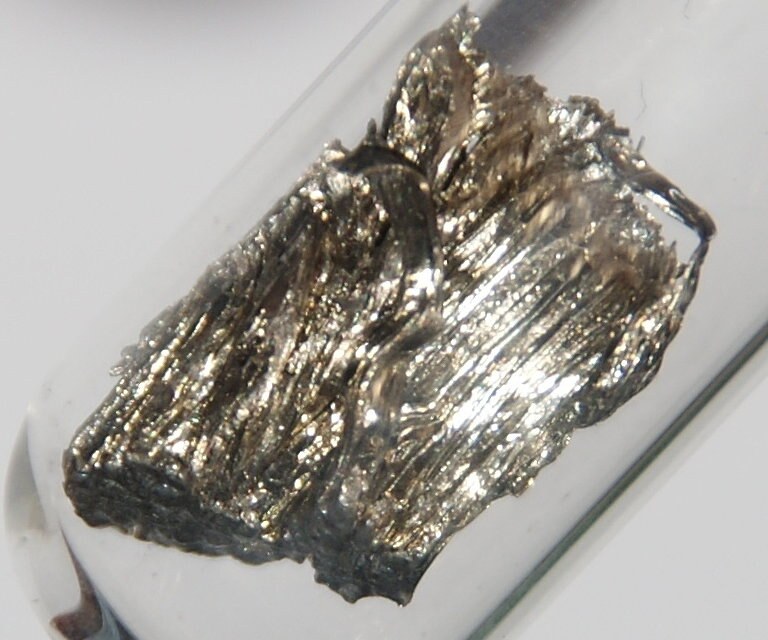
\({}^{152m}\mathrm{Eu}\) — electron-capture source
\[ \Longrightarrow \]
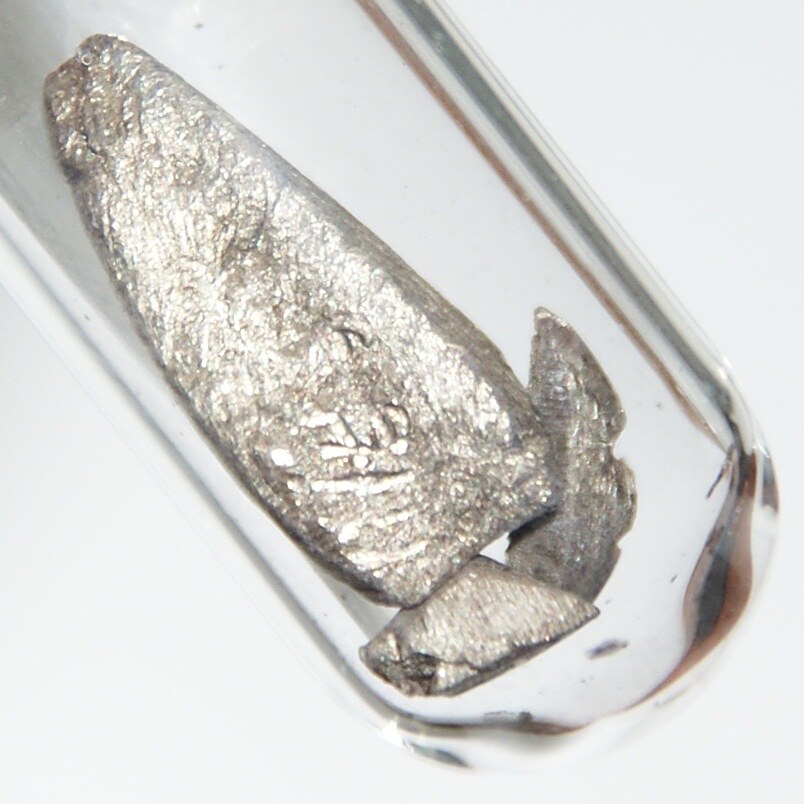
\({}^{152}\mathrm{Sm}\) — resonant absorber
For resonant absorption the same transition in \({}^{152}\mathrm{Sm}\) is used: the source produces photons, and the samarium at rest serves as a narrow energy filter.
The geometry of the setup remains unchanged. Only the direction of the magnetic field in the iron analyzer changes.
Let \(N_+\) and \(N_-\) denote the numbers of transmitted resonant photons for the two field directions:
\[ N_+\equiv N(B), \qquad N_-\equiv N(-B). \]
An equal measurement time allows these numbers to be compared directly.
The difference of the counts is normalized to their sum:
\[ \mathcal A = \frac{N_+-N_-}{N_++N_-}. \]
The sum suppresses the dependence on the overall source intensity, while the difference isolates the effect that changes sign together with the magnetic field.
The magnitude of the effect depends on
After these corrections the sign of \(\mathcal A\) determines the sign of the circular polarization of the photon, and the geometry selected by the resonance gives
\[ \operatorname{sign}\mathcal A \longrightarrow h_\gamma \longrightarrow h_\nu. \]
The experiment does not catch the neutrino: it reads the chain of correlations left by the neutrino in the nucleus and the photon.
Goldhaber, Grodzins, and Sunyar obtained
\[ \boxed{h(\nu_e)=-1\pm0.3}. \]
The sign unambiguously indicated: electron neutrinos are produced left-handed.
The result agrees with the maximal parity violation in the weak interaction.
neutrino
\[h\simeq-1\]
left-handed
antineutrino
\[h\simeq+1\]
right-handed
It is precisely this asymmetry that links the Goldhaber experiment with the parity violation in the Wu experiment.
The helicity \(\nu_\mu\) is determined as follows:
Muon capture produces a polarized nucleus \({}^{12}\mathrm{B}\): \[ \mu^-+{}^{12}\mathrm{C}_{g.s.} \to\nu_\mu+{}^{12}\mathrm{B}_\mathrm{g.s.} \] Its polarization is determined from the subsequent \(\beta\) decay: \[ {}^{12}\mathrm{B}_{g.s.} \to{}^{12}\mathrm{C}_{g.s.}+e^-+\bar\nu_e, \qquad h(\nu_\mu)\approx-1.06\pm0.11. \] The spins of carbon and boron in the ground state are \(0\) and \(1\), respectively.
An independent limit is obtained from the decay chain \[ \pi^+\to\mu^++\nu_\mu, \qquad \mu^+\to e^++\nu_e+\bar\nu_\mu. \] The polarization of \(\mu^+\) is determined from the positron distribution in its decay:
\[ |h(\nu_\mu)|>0.9959 \qquad\text{at the confidence level }90\%. \]
For \(\nu_\tau\), correlations in \(\tau\)-lepton decays are used. The measurements are consistent with
\[ h(\nu_\tau)=-1. \]
CLEO:
\[ h(\nu_\tau) = -0.995\pm0.010\pm0.003. \]
For all three flavors \(h(\nu_\ell)\simeq-1\), \(\ell=e,\mu,\tau\) — the charged weak current has a universal left-chiral structure.
All exercises for lecture 03 → and exercises for the seminar · All course exercises
