Introduction to Neutrino Physics
JINR
Spatial parity replaces each point with its mirror image relative to the origin:
\[ P:\quad (x,y,z)\longmapsto(-x,-y,-z). \]
Under space reflection
\[ P:\qquad \mathbf r\to-\mathbf r, \qquad \mathbf p\to-\mathbf p. \]
But angular momentum and spin are axial vectors:
\[ \mathbf L=\mathbf r\times\mathbf p\to\mathbf L, \qquad \mathbf S\to\mathbf S. \]
Therefore the scalar product
\[ \mathbf S\cdot\mathbf p \xrightarrow{P} -\mathbf S\cdot\mathbf p \]
is odd under \(P\). This observation will be the key to the Wu experiment.
If the Hamiltonian is invariant under reflection,
\[ [H,P]=0, \]
the states can be chosen to be eigenstates of the parity operator:
\[ P\psi(\mathbf r)=\psi(-\mathbf r)=\eta_P\psi(\mathbf r), \qquad \eta_P=\pm1. \]
Even state
\[ \psi(-\mathbf r)=+\psi(\mathbf r). \]
Odd state
\[ \psi(-\mathbf r)=-\psi(\mathbf r). \]
By the mid-1950s, parity conservation was perceived almost as a self-evident law of nature.
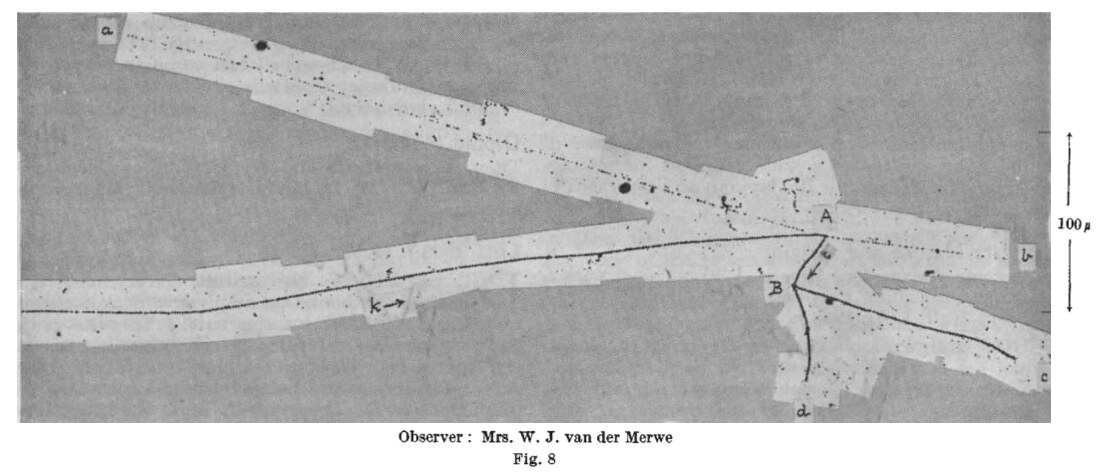
In the early 1950s a positively charged particle with a mass of about \(494~\mathrm{MeV}\) and two decay channels was observed:
\[ \theta^+\to\pi^++\pi^0. \]
\[ \tau^+\to\pi^++\pi^++\pi^-. \]
The masses and lifetimes of \(\theta^+\) and \(\tau^+\) coincided — everything pointed to one and the same particle, the modern \(K^+\).
The pion has negative intrinsic parity:
\[ \eta_\pi=-1. \]
For decays in the \(S\)-wave:
\[ \theta^+\to2\pi, \qquad \eta_f=(-1)^2=+1. \]
\[ \tau^+\to3\pi, \qquad \eta_f=(-1)^3=-1. \]
One particle cannot have both \(\eta_P=+1\) and \(\eta_P=-1\) if parity is conserved.
Either these are two nearly indistinguishable particles, or the weak interaction violates spatial parity.

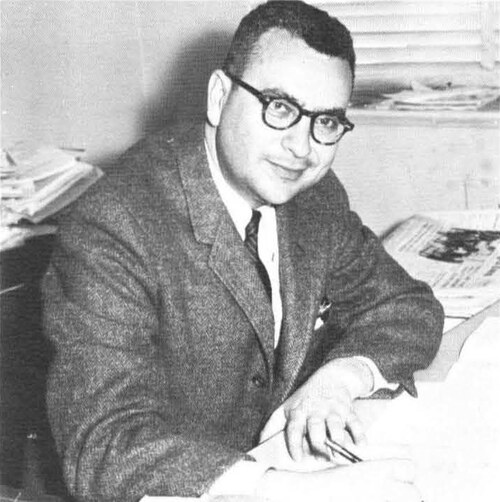
Murray Gell-Mann
Unable to “prove” the conservation of \(P\), he realized early on: this is not a geometric necessity, but a property of a specific theory.

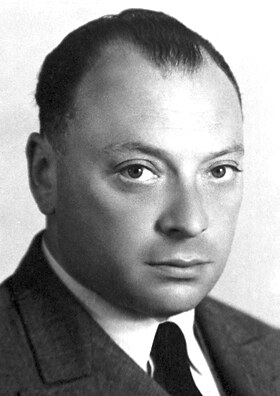
Richard Feynman
Discussed the hypothesis with Gell-Mann and brought the question to the Rochester Conference.
A Week Spent on an Impossible Proof
Professor Herman Feshbach suggested that students prove parity conservation by a change of coordinates. Gell-Mann spent about a week and discovered that no such proof exists — a coordinate transformation by itself does not dictate the laws of nature.
1955 → Rochester, 1956
Gell-Mann and Feynman discussed the violation of \(P\), but did not connect it with the \(\tau\)–\(\theta\) puzzle. At the conference Feynman passed on the idea of his roommate Marty Block; Yang replied that he and Lee had already considered it — without result.
Moscow, May 1956: the hall responds with hostility
Gell-Mann named the violation of \(P\) as a possible solution of the \(\tau\)–\(\theta\) puzzle. From the crowded hall came objections: “This is a violation of Lorentz invariance!” and “Do the laws depend on rotations?”
Gell-Mann’s answer: the conservation of \(P\) is an empirical fact; there is no fundamental reason for it.
The main barrier was not mathematical. Space reflection was mistakenly perceived as a simple change of coordinates — and therefore as a mandatory symmetry of any law of nature.
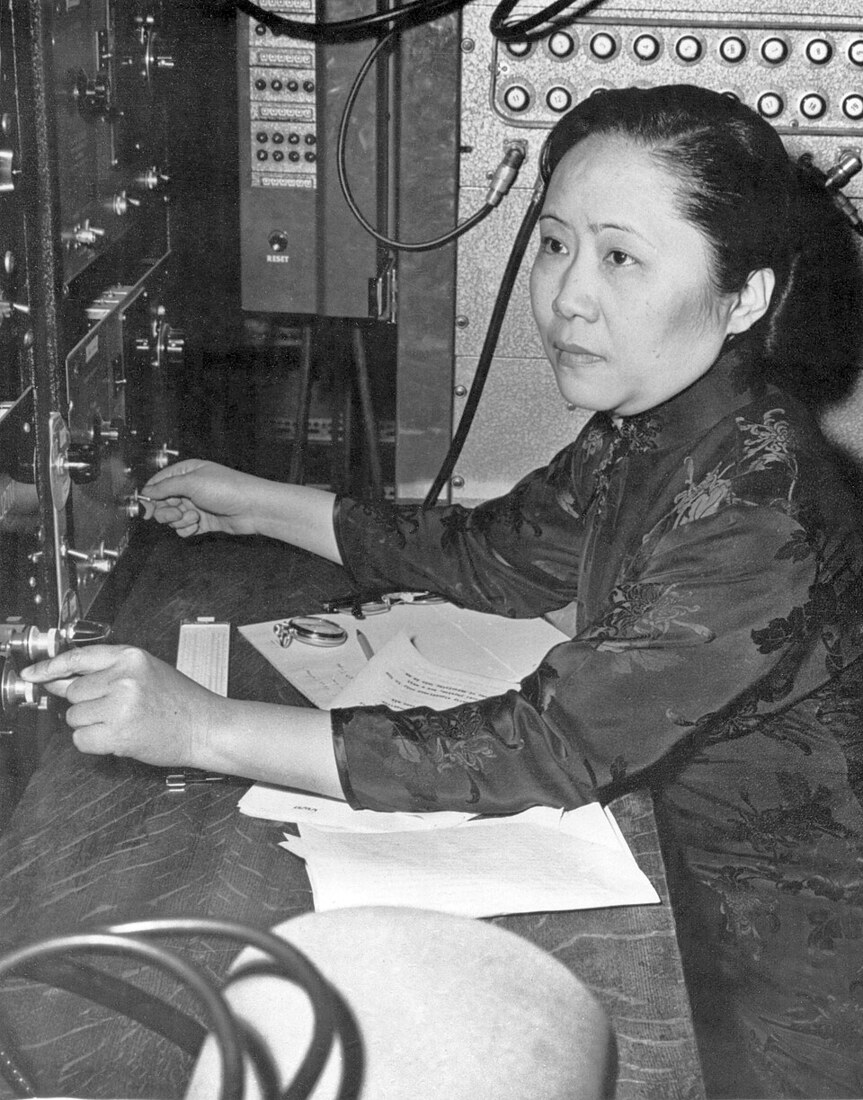
In the summer of 1956, Tsung-Dao Lee and Chen-Ning Yang systematically studied the existing experiments and noticed:
parity conservation had been well tested for electromagnetic and strong processes, but not for weak ones.
They proposed specific tests in \(\beta\) decay, pion decays, and muon decays. To test \(\beta\) decay, Lee turned to Chien-Shiung Wu.
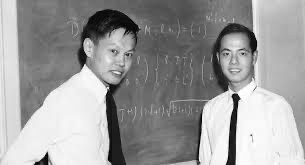
Chien-Shiung Wu was one of the leading specialists in \(\beta\) decay.
At the end of 1956 her group, together with specialists from the National Bureau of Standards, carried out an experiment with polarized \({}^{60}\mathrm{Co}\) nuclei.
The experiment was to answer a simple question:
do electrons emerge equally often along and against the nuclear spin?
It looks like the fragment contains only the placeholder token and no Russian text to translate. Here it is, unchanged:
Polarize the nuclei: align their spins along the magnetic field.
Measure the distribution of electrons relative to the spin direction.
Any asymmetry between \(\theta\) and \(\pi-\theta\) means parity violation (\(P\) violation).
If you meant to send more of the slide, please paste the full fragment and I’ll translate it.
The main \(\beta^-\) decay:
\[ {}^{60}_{27}\mathrm{Co}(5^+) \to {}^{60}_{28}\mathrm{Ni}^{*}(4^+)+e^-+\bar\nu_e. \]
After it, the nickel nucleus emits two \(\gamma\) quanta:
\[ {}^{60}\mathrm{Ni}^{*}(4^+) \to {}^{60}\mathrm{Ni}^{*}(2^+)+\gamma \to {}^{60}\mathrm{Ni}(0^+)+2\gamma. \]
A magnetic moment in a field has energy
\[ E=-\boldsymbol\mu\cdot\mathbf B, \qquad \frac{n_\uparrow}{n_\downarrow} = \exp\!\left(\frac{2\mu B}{k_BT}\right). \]
\[ \mu_B=\frac{e\hbar}{2m_e} =5.79\cdot10^{-5}\ \mathrm{eV/T}, \]
\[ \frac{\mu_B B}{k_BT}\simeq0.67 \quad (B=1~\mathrm{T},\ T=1~\mathrm K). \]
Electron spins are comparatively easy to polarize.
\[ \mu_N=\frac{e\hbar}{2m_p} =3.15\cdot10^{-8}\ \mathrm{eV/T}, \]
\[ \frac{\mu_N B}{k_BT}\simeq3.7\cdot10^{-4} \quad (B=1~\mathrm{T},\ T=1~\mathrm K). \]
For nuclei, a temperature of order \(10^{-2}~\mathrm K\) is required.
\(T_i\simeq1.2~\mathrm K\)
Large spin entropy.
The crystal is coupled to the helium bath.
Heat flows into the bath.
Thermal contact is switched off.
Lattice energy flows into the spins.
When the field is decreased adiabatically, the ratio \(B/T\) remains almost constant:
\[ \frac{B_i}{T_i}\simeq\frac{B_f}{T_f}, \qquad T_f\simeq T_i\frac{B_f}{B_i}\sim10^{-2}\ \mathrm K. \]
The spins take energy from the lattice.
The cold sample keeps its polarization.
For the electrons of \(\beta\) decay
\[ W(\theta) = 1+A\,\mathcal P\,\frac{v}{c}\,f_{\rm bs}\cos\theta, \]
where
\[ \mathcal P=\frac{\langle I_z\rangle}{I} \]
is the nuclear polarization, \(f_{\rm bs}\) is the backscattering correction, and \(A\) is the asymmetry coefficient.
If parity is conserved, the directions \(\mathbf I\) and \(-\mathbf I\) are physically equivalent, and therefore
\[ A=0. \]
The angle is set by the correlation
\[ \cos\theta = \frac{\mathbf I\cdot\mathbf p_e}{I\,p_e}. \]
Under space reflection
\[ \mathbf I\to\mathbf I, \qquad \mathbf p_e\to-\mathbf p_e, \qquad \cos\theta\to-\cos\theta. \]
Consequently,
\[ W(\theta)\xrightarrow{P}W(\pi-\theta). \]
A nonzero term proportional to \(\cos\theta\) means that the mirror process has a different probability.
Measured asymmetry:
For \(\mathcal P\simeq0.65\), \(v/c\simeq0.6\) and \(f_{\rm bs}\simeq2/3\):
The electrons were emitted predominantly opposite to the nuclear spin. The effect disappeared after the sample was heated and its polarization was lost — which is exactly how a physical asymmetry should behave.
The electrons are emitted predominantly opposite to the nuclear spin.
The mirrored process predicts the opposite asymmetry.
The weak interaction distinguishes these two worlds: spatial parity is violated.

The result was so unexpected that many theorists were at first skeptical of it.
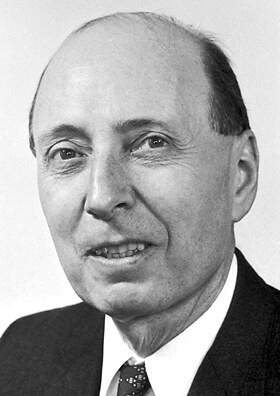
Pauli insisted: the experiment must be repeated and checked by an independent method.
That is exactly what happened almost immediately.
In the decay
\[ \pi^+\to\mu^++\nu_\mu \]
muons are produced polarized. Their polarization can be measured from the asymmetry of positrons in the subsequent decay
\[ \mu^+\to e^++\nu_e+\bar\nu_\mu. \]
Leon Lederman, Richard Garwin, and Marcel Weinrich prepared the experiment in less than a week and in early 1957 confirmed the violation of parity.
Two different weak processes gave the same answer.
| Interaction | Spatial parity |
|---|---|
| strong | conserved |
| electromagnetic | conserved |
| weak | maximally violated |
In the modern theory the charged weak current contains the left-handed projector:
\[ J_L^\mu = \bar\psi\gamma^\mu\frac{1-\gamma^5}{2}\psi. \]
The index \(L\) in the gauge group
\[ SU(2)_L\times U(1)_Y \]
is a reminder: the weak interaction fundamentally distinguishes left from right.
A common reference: polarize \({}^{60}\mathrm{Co}\) nuclei and call “left” the direction in which more electrons are emitted.

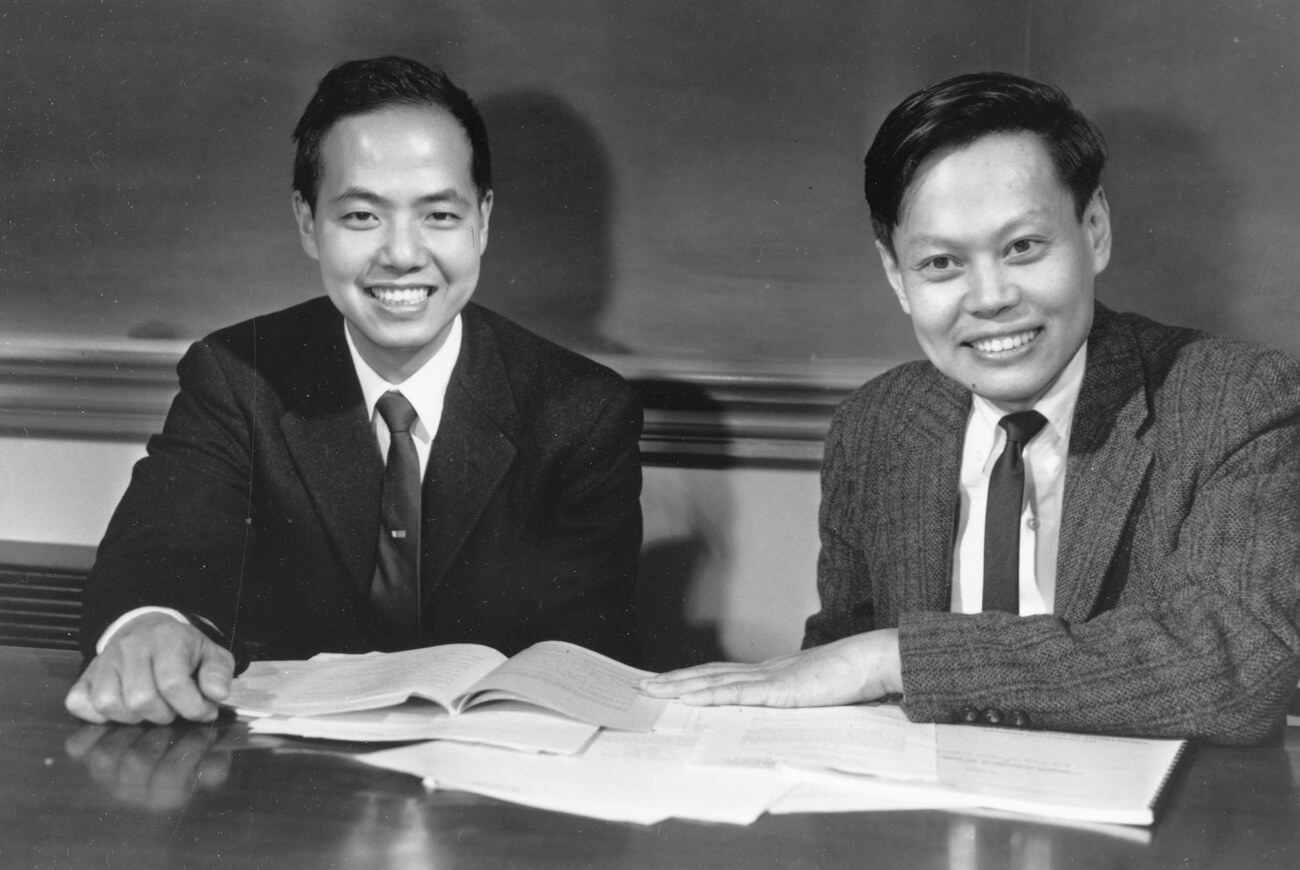
Tsung-Dao Lee and Chen-Ning Yang received the Nobel Prize in Physics “for their penetrating investigation of the so-called parity laws, which has led to important discoveries regarding the elementary particles.”
The discovery came a year after their theoretical work.
Mirror symmetry is not a universal law of nature.
All exercises for lecture 02 → and exercises for the seminar · All course exercises