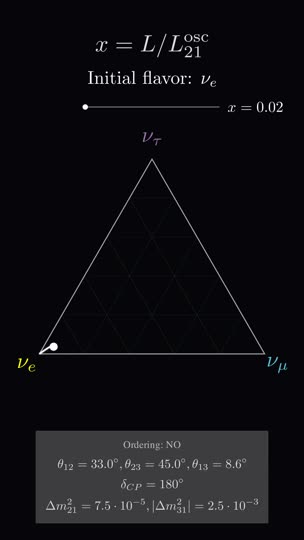
Neutrino oscillations
A geometric visualization of two- and three-flavour neutrino oscillations.
Scientific animations of NeutrinoHit by topic. A frame plays its video right on the page; the buttons below the description open the other videos of the story and the versions in the other language.
76 stories · 152 videos
Neutrino oscillations, showers, nuclear processes and interaction diagrams.
A geometric visualization of two- and three-flavour neutrino oscillations.
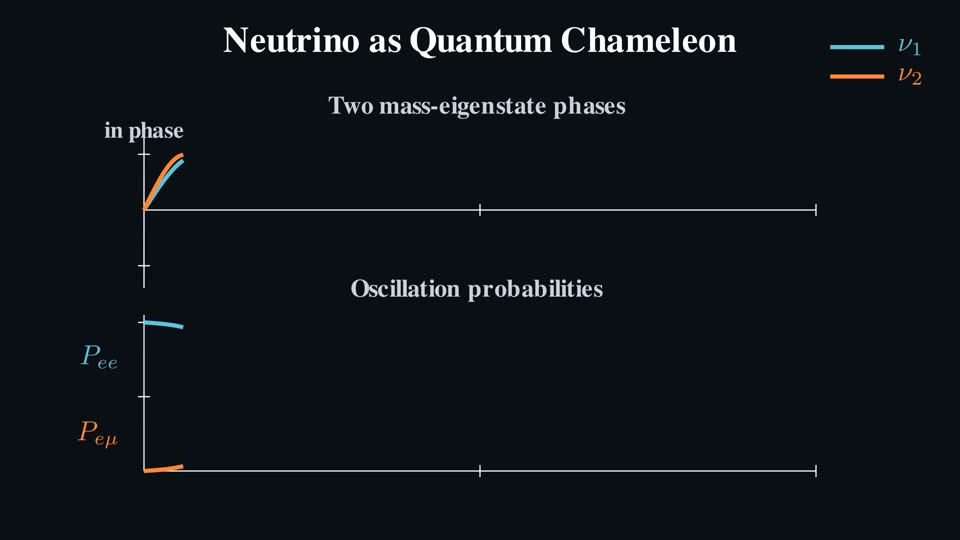
A phase picture of three-flavour neutrino oscillations.

A humorous picture of the neutrino as a quantum chameleon that changes its colour to match its surroundings.
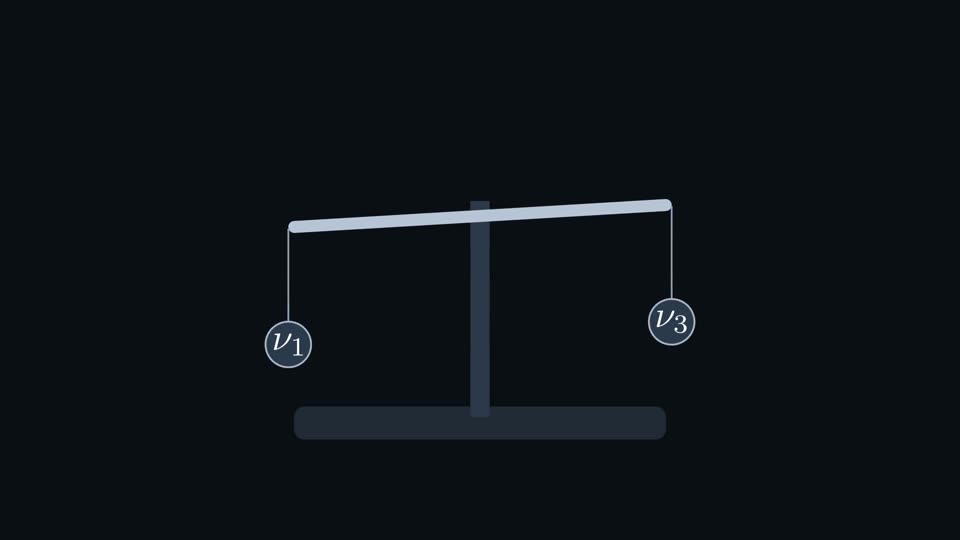
A balance diagram of the normal and inverted mass orderings.
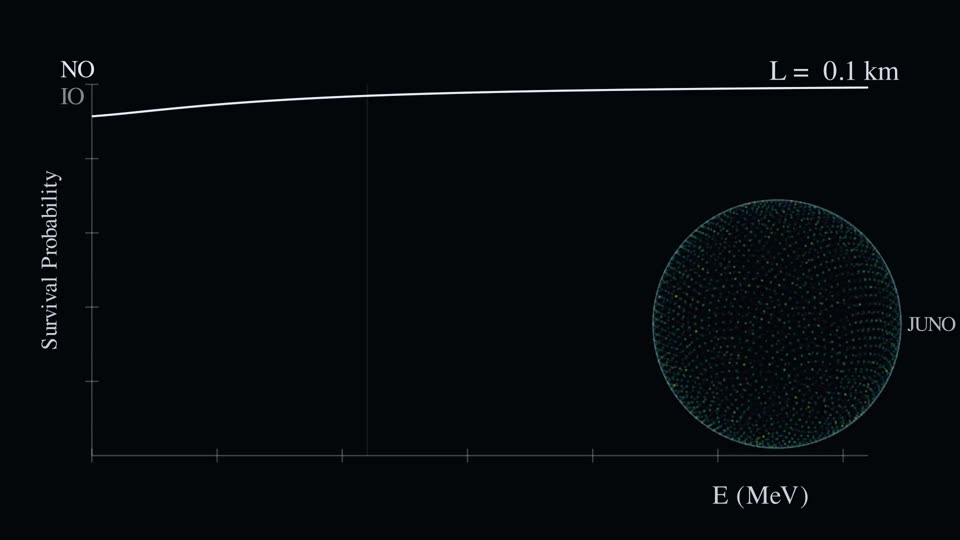
Animations about the JUNO detector, reactor neutrino oscillations and the path of a neutrino to an event.
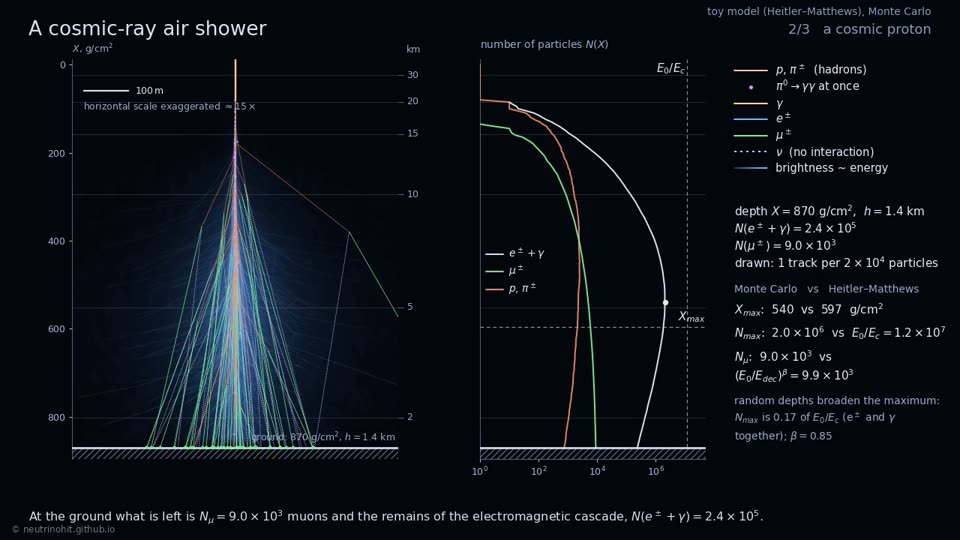
The Heitler–Matthews toy model: the electromagnetic cascade of one photon, a Monte Carlo shower of a 10^15 eV proton, the N(X) profile and Heitler's estimates, a ground detector array, fluorescence and Cherenkov light.
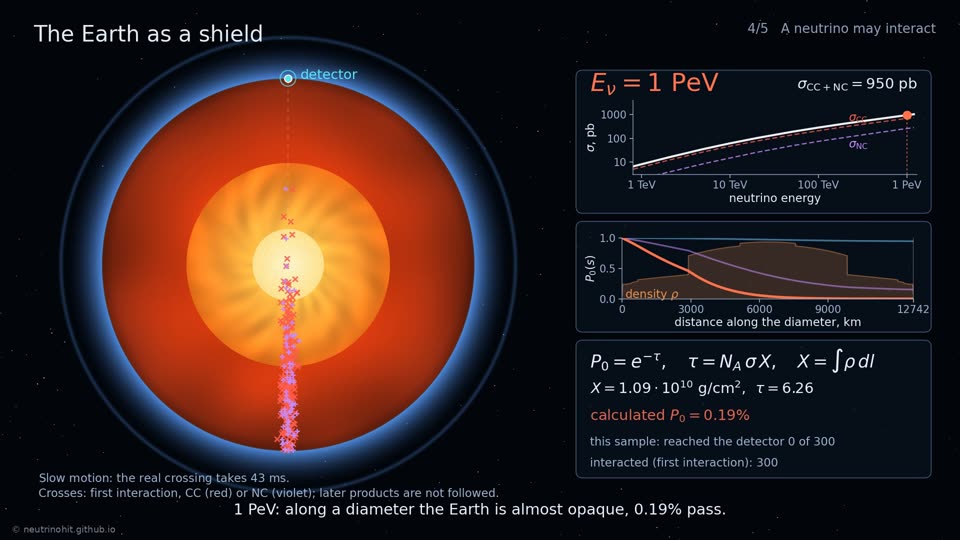
Cosmic rays and their showers over the whole atmosphere; a cut of the planet through the detector (PREM layers); a muon stops within a few kilometres of rock while a neutrino gets through; Monte Carlo: the probability of no interaction along a chord, $P_0=e^{-\tau}$, at 1 TeV, 100 TeV and 1 PeV (CSMS cross-sections) and its dependence on the zenith angle.
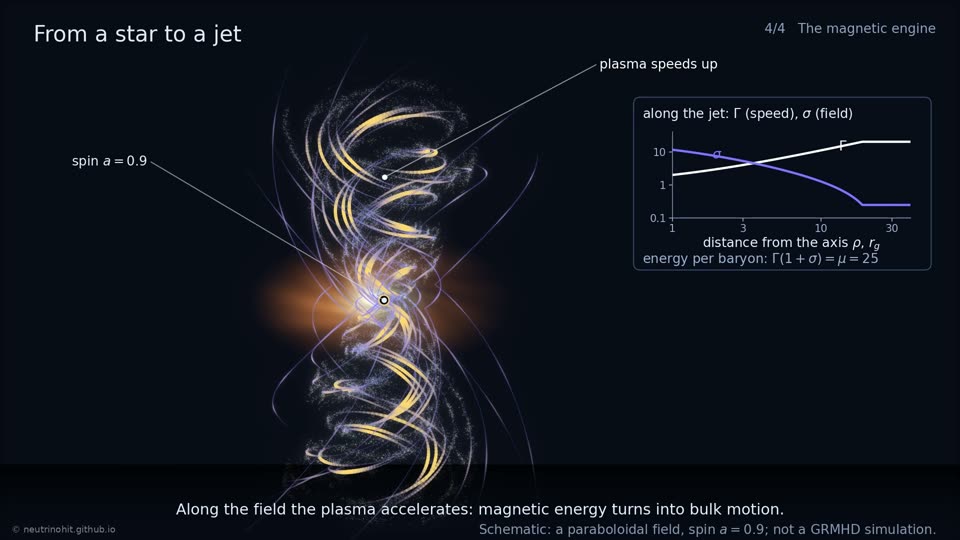
A black hole, its ergosphere and disk; a star is torn apart by tidal forces and matter falls back as $t^{-5/3}$; the spinning hole winds up the magnetic field, the Poynting flux carries energy away and plasma is accelerated along the field (the jet of a tidal disruption event, Swift J1644+57).
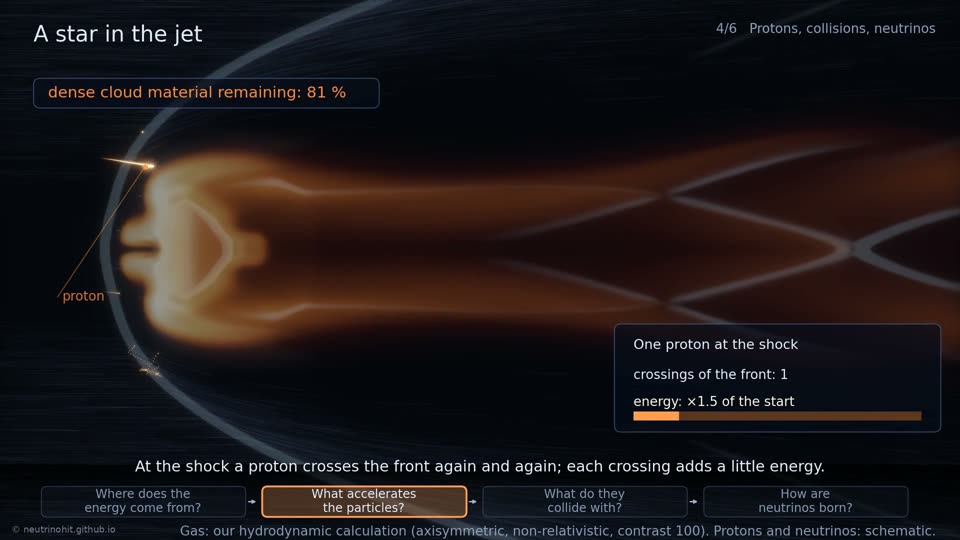
A black hole with an accretion disk launches a jet, and a star with a wind enters it; an axisymmetric hydrodynamic calculation of the disruption of the star at the shock; protons accelerated at the front collide with the matter of the cloud and produce neutrinos and gamma rays; single-pass numbers $\tau_{pp}$, $\kappa\tau_{pp}$; the neutrinos fly to the Earth.
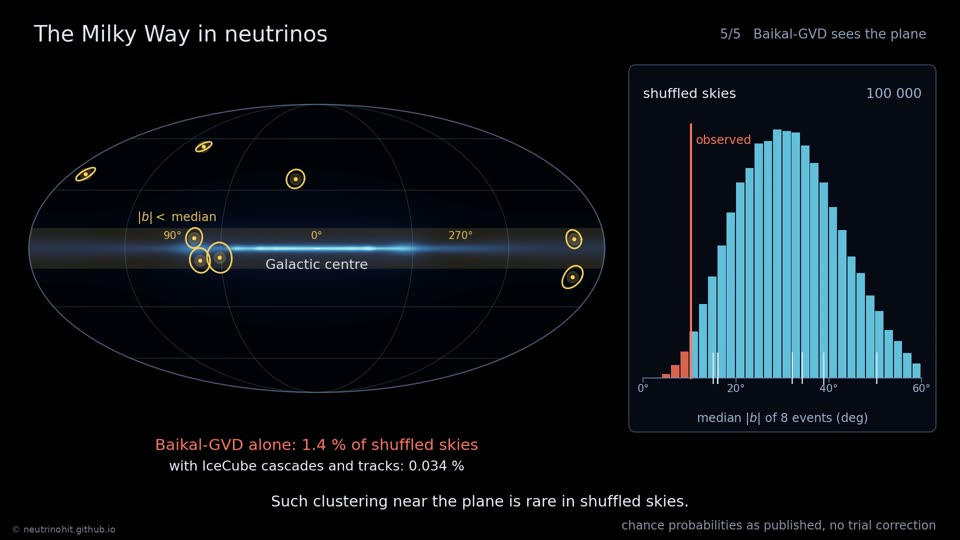
Cosmic-ray protons wander in the Galactic disk and collide with nuclei of interstellar gas; pions are produced, then neutrinos that fly straight. From inside the disk the whole Galaxy is a band across the sky: the map is the integral of “gas × cosmic-ray density” along the line of sight in an illustrative model. From the north the Galactic Centre is below the horizon most of the day (Baikal-GVD 75 %, KM3NeT ARCA 63 %, IceCube 0 %), that is, it is seen through the Earth. Eight Baikal-GVD cascades above 200 TeV lie closer to the plane than in scrambled skies: the median $|b|$ is smaller in only 1.4 % of them (0.034 % together with IceCube data).
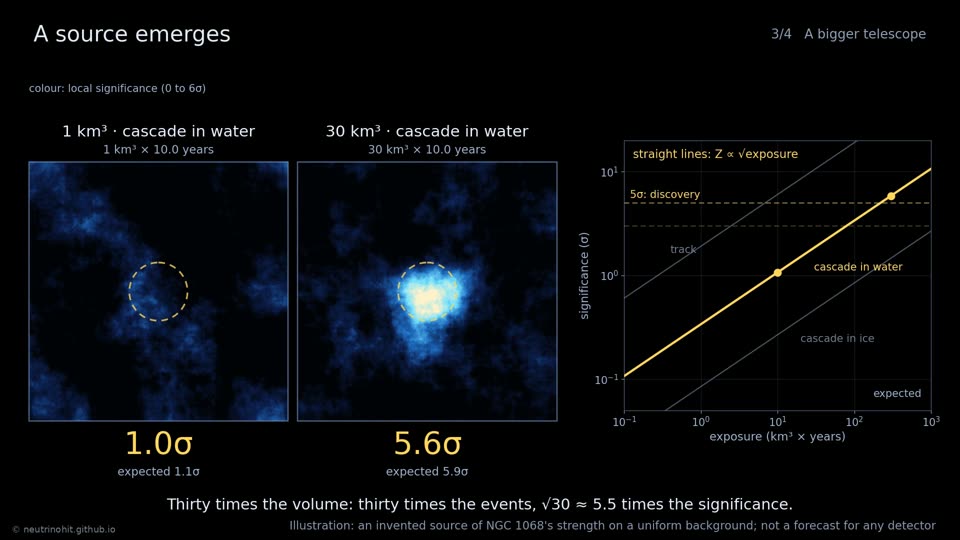
Neutrinos arrive one by one; almost all are atmospheric background, a few come from the source. We count events in a circle around the source and compare with the expected background: the excess grows in proportion to time and the noise as its square root, so the significance grows as √t. The same source over the same years looks different with different direction resolution: a cascade in ice (half of the events within 10°), a cascade in water (2.5°), a track (0.4°). A 30 times larger volume gives √30 ≈ 5.5 times the significance: water cascades invisible in 10 years in 1 km³ pass 5σ in 30 km³. The rule: $Z\propto\sqrt{\text{exposure}}/\sigma_\theta$ while the background dominates.
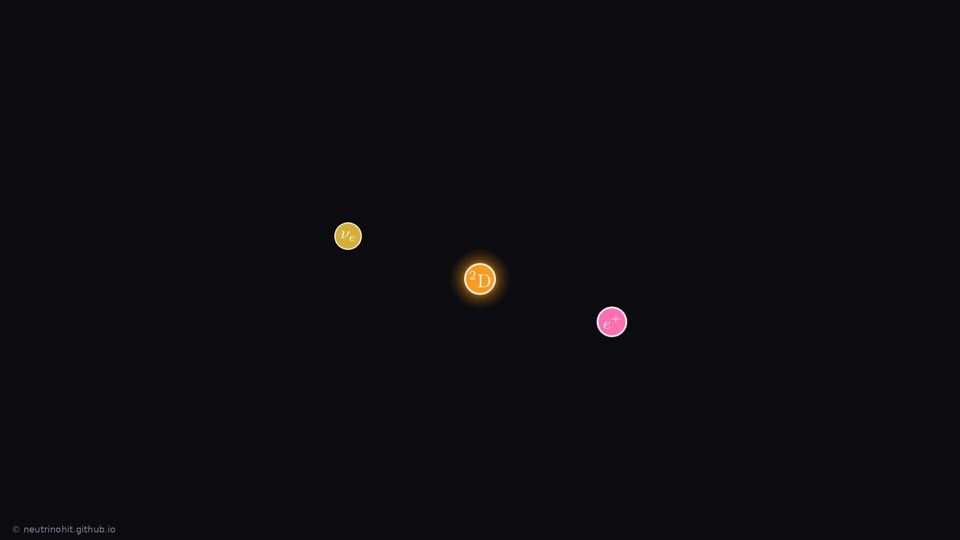
Three key reactions of the solar pp chain.
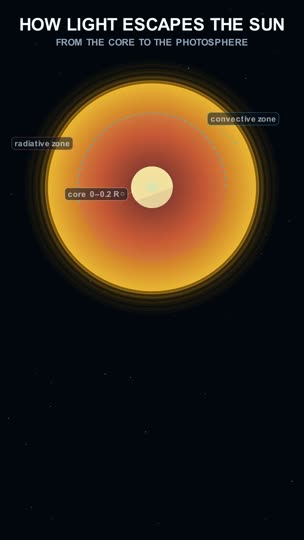
A one-minute physical visualization of radiative transport: a random walk in the core, radiative diffusion, the temperature profile and the transition to the convection zone.
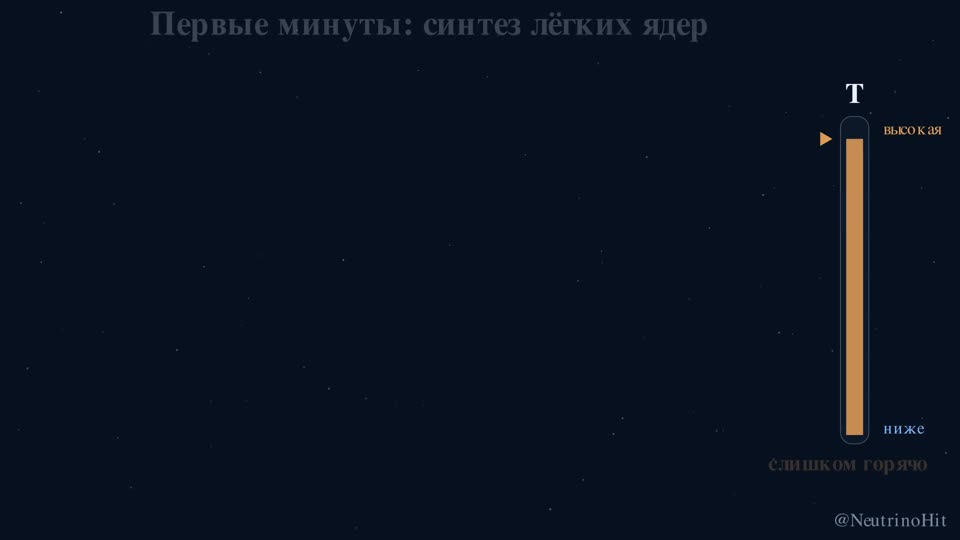
A stylized picture of BBN: the deuterium bottleneck, the synthesis window and neutrons bound in He-4.
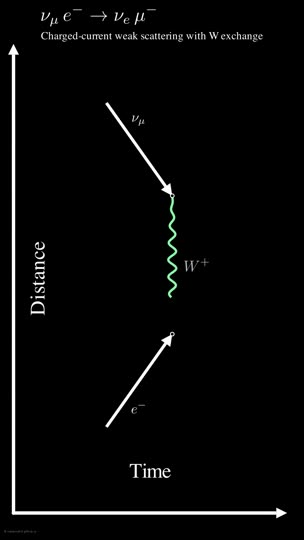
Animated Feynman diagrams of typical scattering processes.
Morphing between spherical and deformed nuclear shapes.
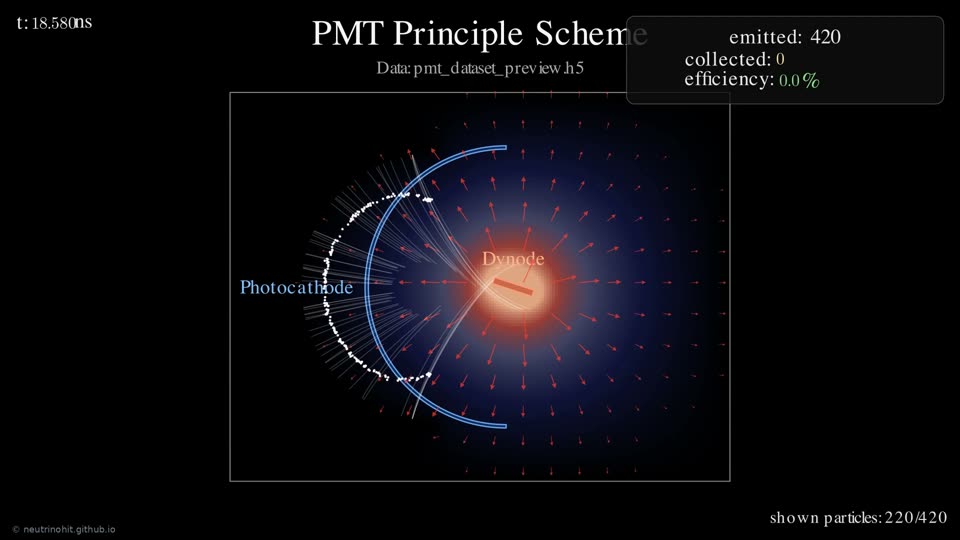
A schematic electron trajectory in a PMT from numerical data.
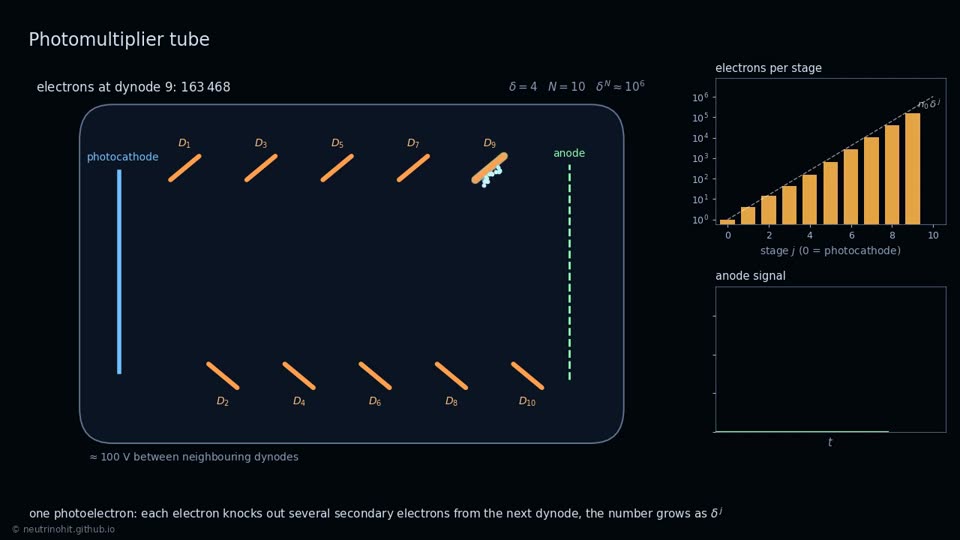
One photoelectron becomes an avalanche: each dynode knocks out on average δ = 4 secondary electrons, ten dynodes give a gain of ≈ 10⁶; then three scintillator flashes and the pulse amplitude, on average proportional to the number of photoelectrons.
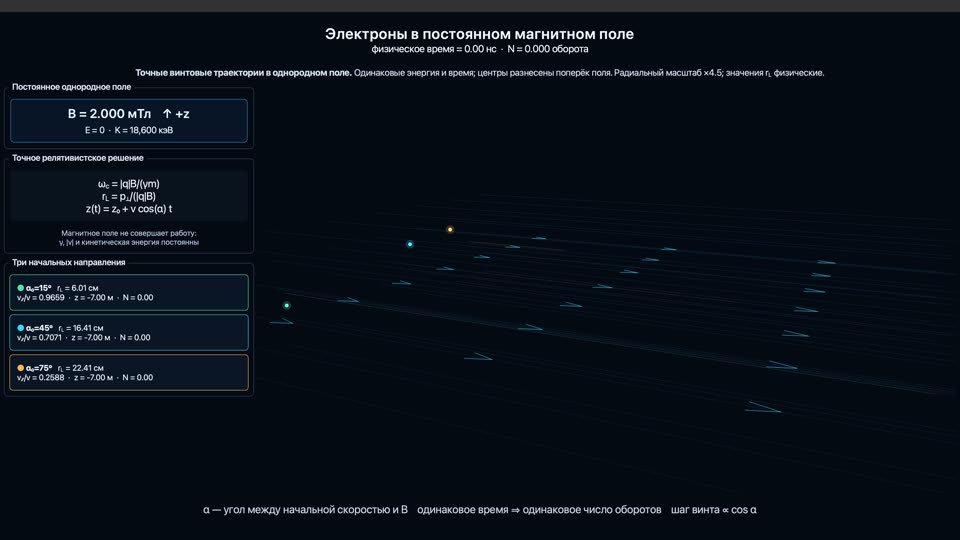
Exact relativistic helical motion, reversible magnetic collimation and electrostatic analysis of electrons in the KATRIN spectrometer.
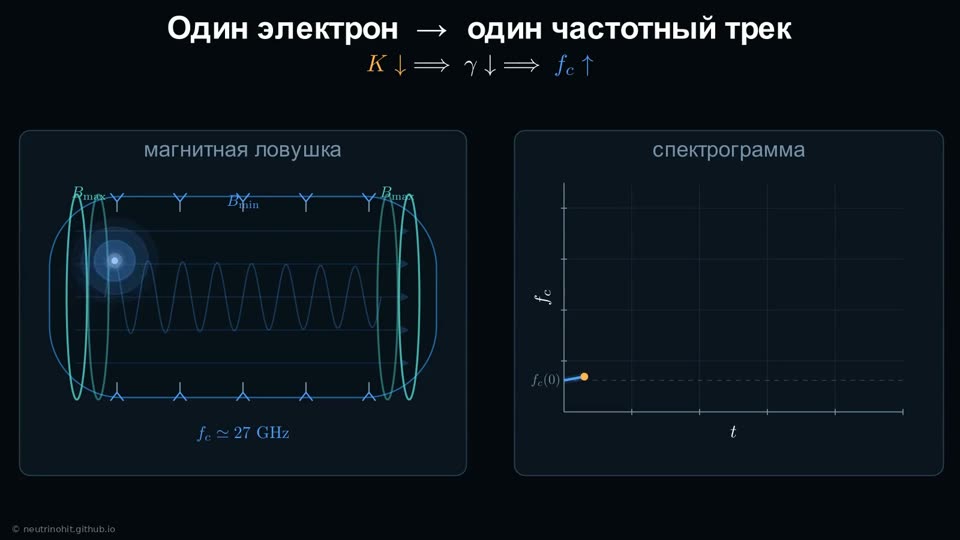
A schematic visualization of CRES: a trapped electron, cyclotron microwave radiation and a rising frequency track as the electron loses energy.
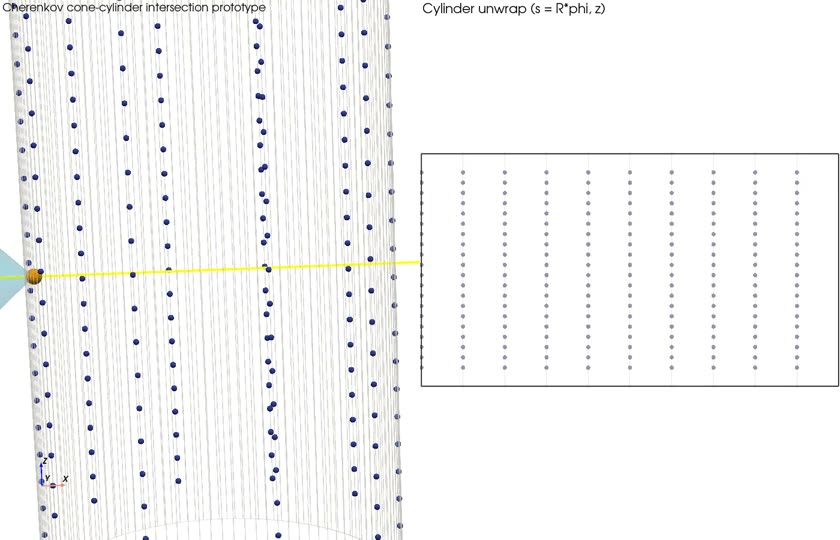
The geometry of Cherenkov radiation in a cylindrical scene.
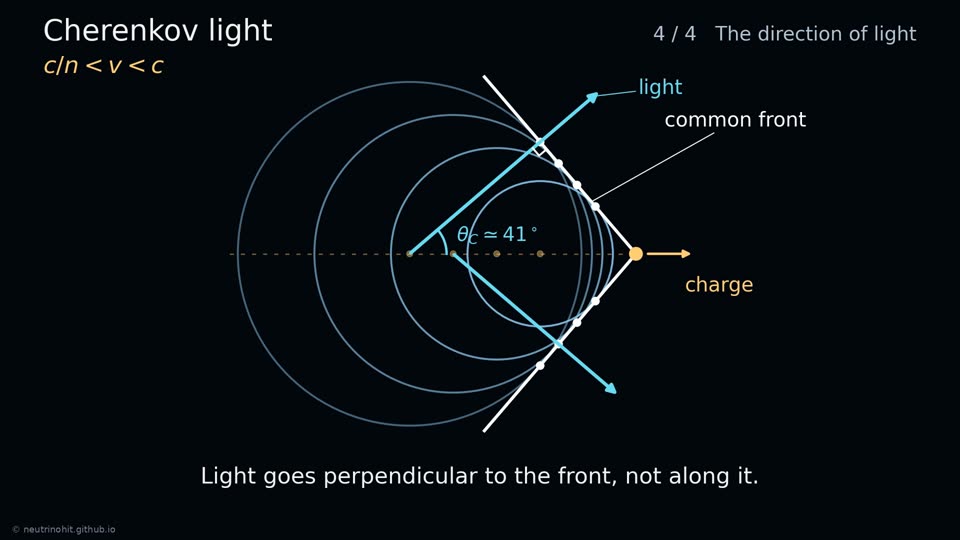
Four wavefronts, two separate runs at constant speed and pauses for explanation. A slow particle stays inside the fronts; a fast one overtakes them. The common tangent forms the surface of a cone, and the light goes across it. No plot and no ring on a detector.
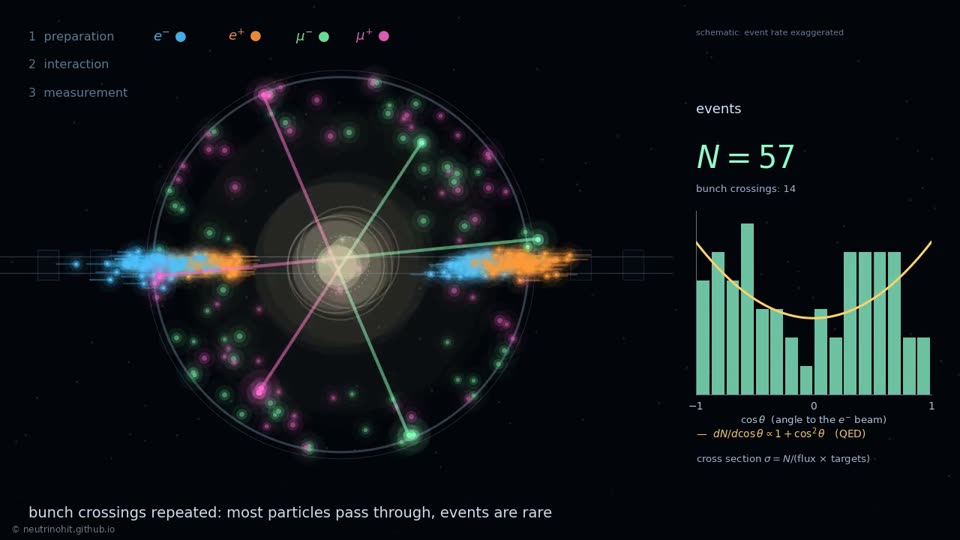
Three stages of a collider experiment: the beams are accelerated, interact in a small region (almost all particles fly through) and the muons are detected. From many events the angular distribution 1 + cos²θ builds up.
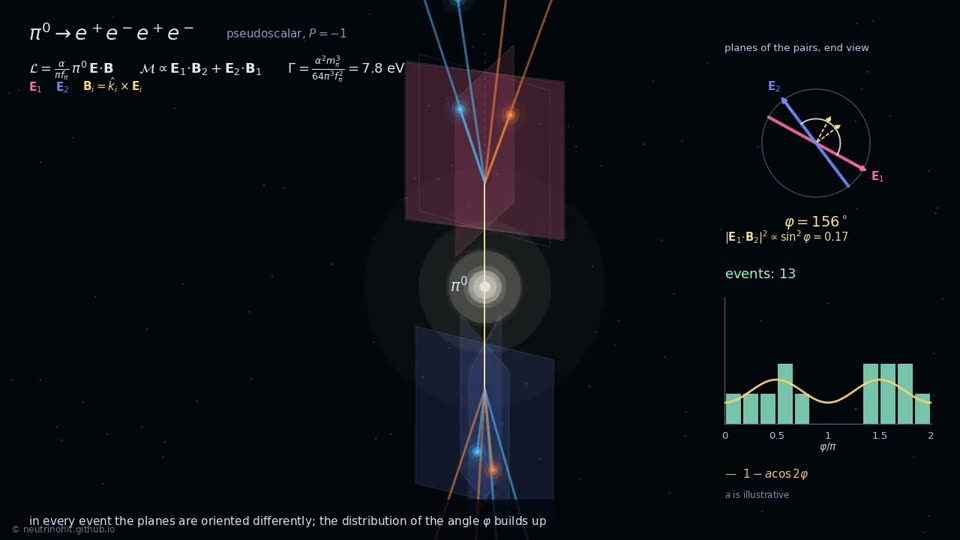
Two e⁺e⁻ pairs from virtual photons lie in planes containing the polarization (E) of their photon. For the pseudoscalar π⁰ the amplitude is ∝ E₁·B₂ + E₂·B₁ ∝ sin φ (the planes are perpendicular), for a scalar ∝ E₁·E₂ − B₁·B₂ ∝ cos φ (parallel); the distribution in the angle φ builds up. Two versions: Russian and English.
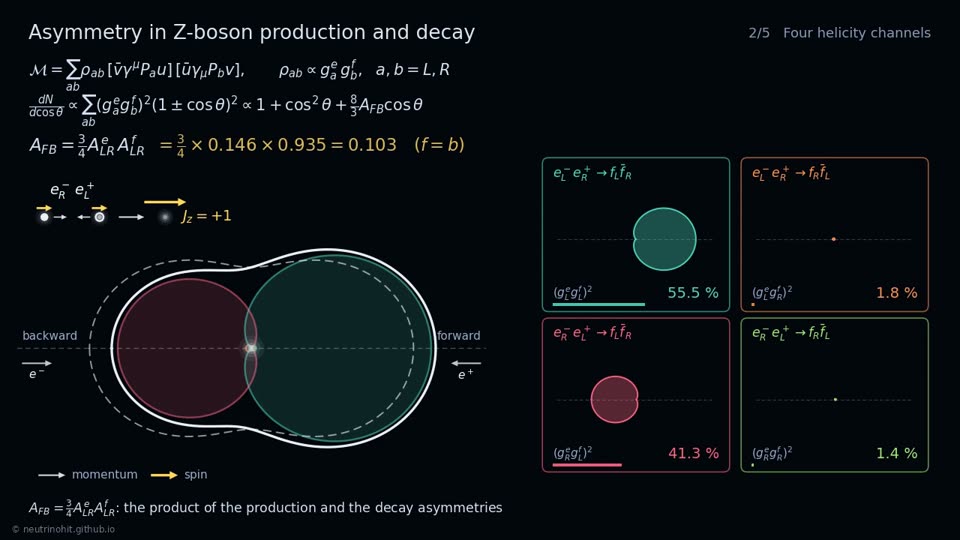
Four helicity channels e⁺e⁻ → Z → f f̄ with weights (g_a g_b)², the distributions (1 ± cosθ)² and their sum, the forward–backward asymmetry A_FB, Monte Carlo events and the dependence A_FB(√s) with γ–Z interference.
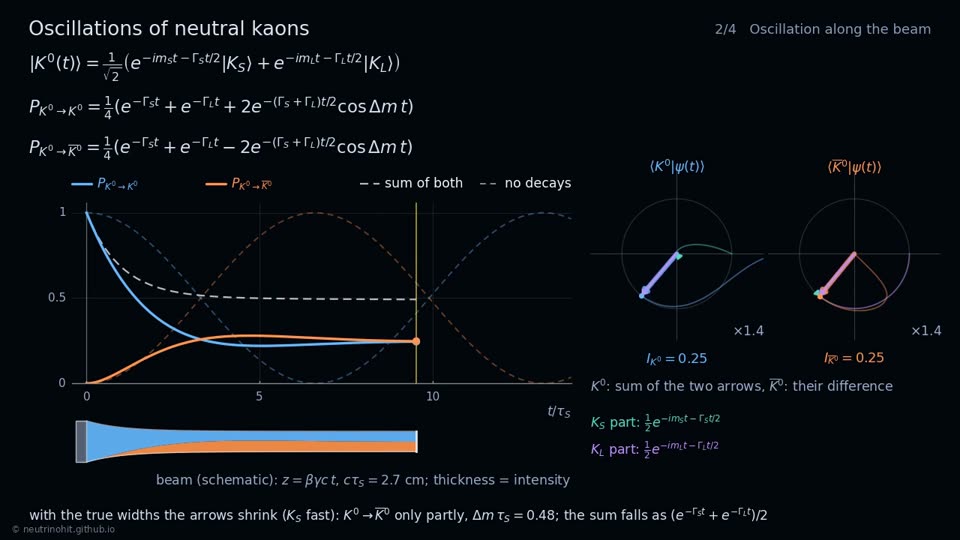
A K⁰ is produced in a strong reaction as a superposition of K_S and K_L; two-level evolution with H = M − iΓ/2 (integrated numerically), strangeness oscillations along the beam, the detector (K̄⁰N → Λπ) and the lepton charge, K_S regeneration.
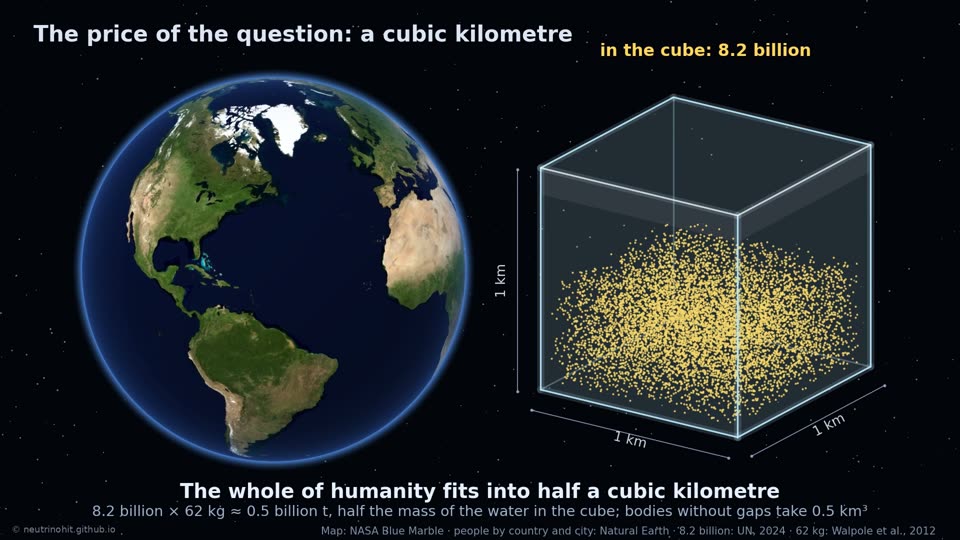
A neutrino telescope needs a target of a cubic kilometre. A rotating globe (NASA Blue Marble) is covered with dots where people live (Natural Earth countries and cities), one dot is a million people, 8200 dots are all of humanity (8.2 billion, UN 2024). A glass cube with a 1 km side appears next to it (not to scale with the planet), and all the dots are drawn into it at once. At 62 kg per person (Walpole et al., 2012) humanity weighs 0.51 billion tonnes, half the mass of the water in the cube, and the bodies without gaps fill half the cube. Then the camera dives into the cube: the dots turn into a crowd of people from all continents (shares by the population of Natural Earth countries; the appearance of the people is conventional).
Electromagnetic fields, wave packets, coupled oscillators and simple electronic circuits.
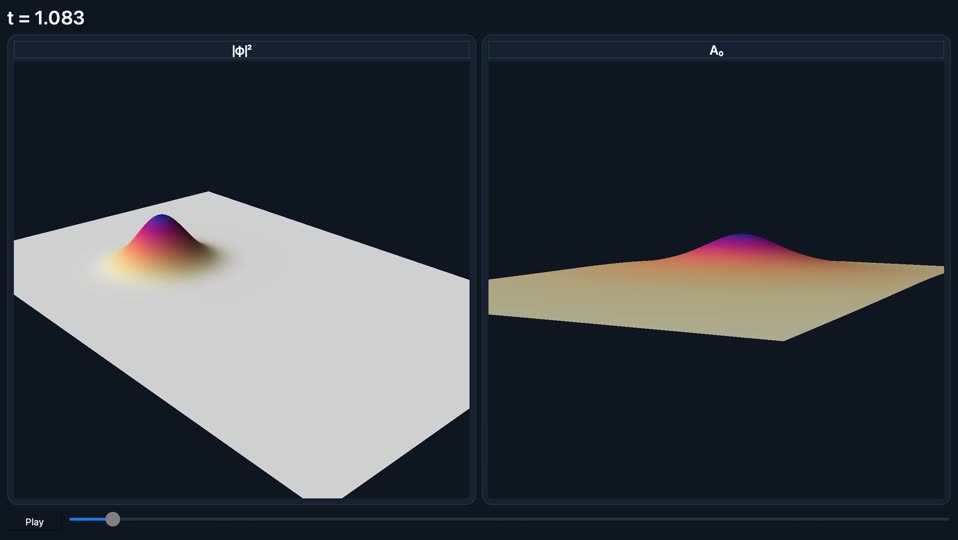
Attraction and repulsion of wave packets as the interference of the free wave and the interaction wave: the field of a packet, the eikonal phase, the shift of the momentum distribution.
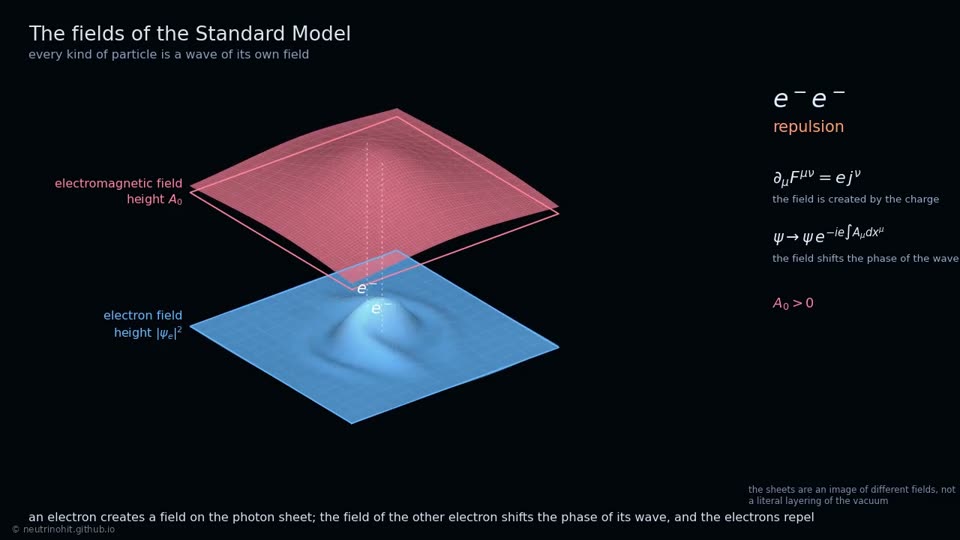
The 17 fields of the Standard Model as sheets of one stack; a particle is a wave packet on the sheet of its field; two fields close up: e⁻e⁻ (repulsion) and e⁻e⁺ (attraction) in the scalar QED model, then e⁻e⁺ ↔ γγ as energy flowing between the fields.
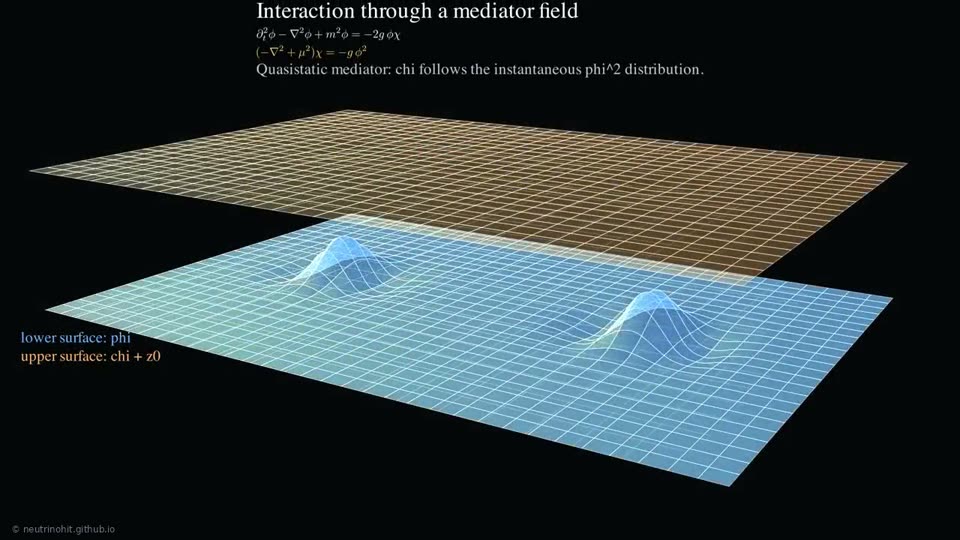
Two particles and the dynamic field through which their interaction shows up.
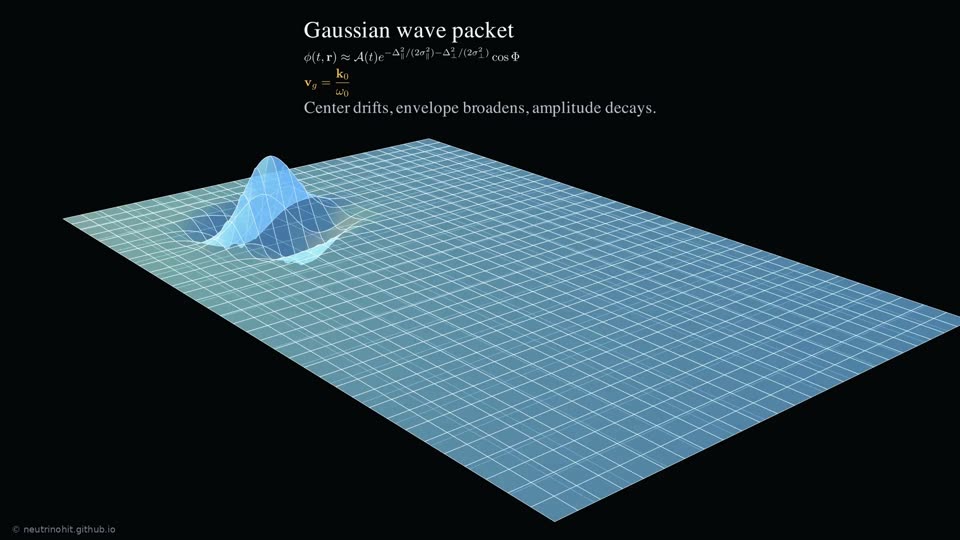
A single Gaussian packet and a pair of freely propagating packets.
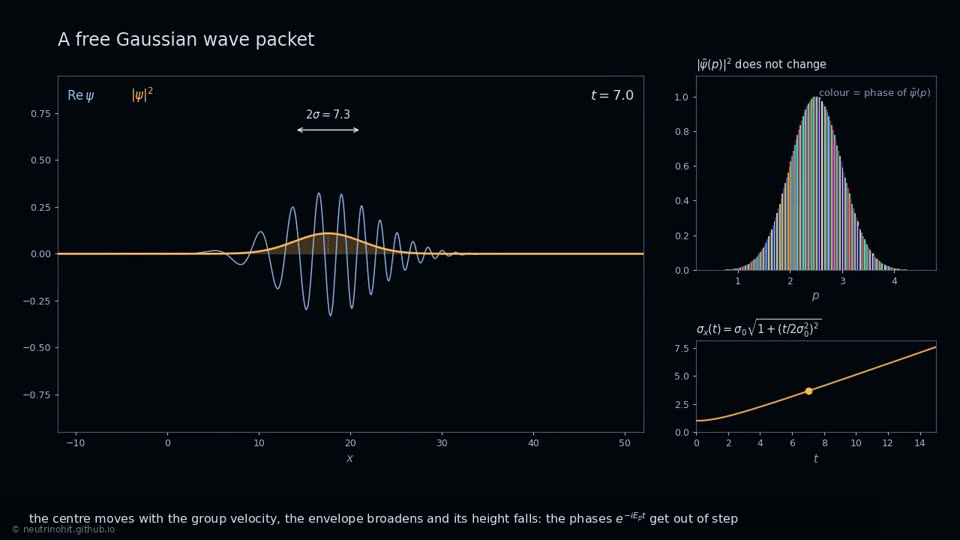
Exact evolution of the Gaussian packet of a free particle (ħ = m = 1): the centre moves with the group velocity, the width grows as σ₀√(1 + (t/2σ₀²)²), and |ψ̃(p)|² does not change; a narrow packet spreads faster than a wide one.
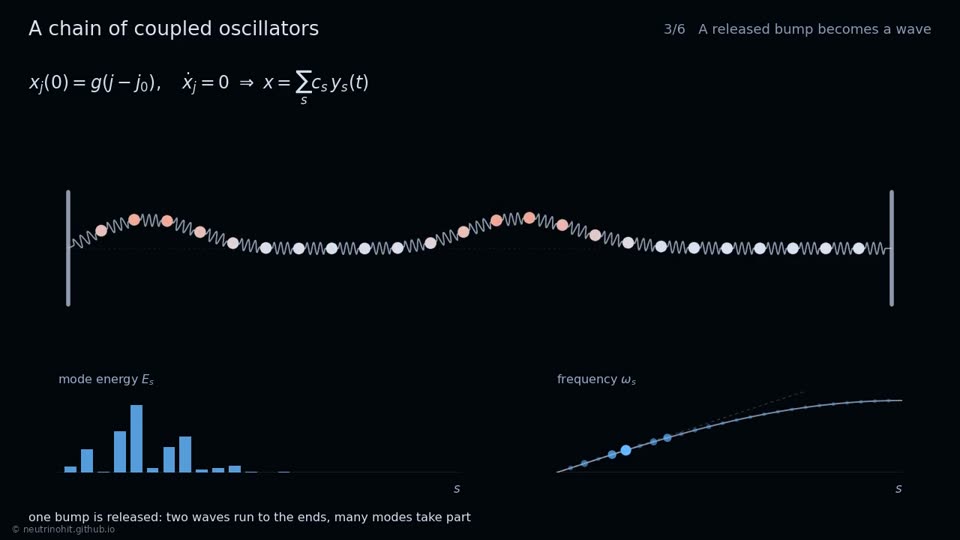
A chain of N masses: normal modes and dispersion, a wave from a released displacement, colliding waves in a linear chain (free particles) and with a cubic term (energy exchange between modes), the limit N → ∞ and the field.
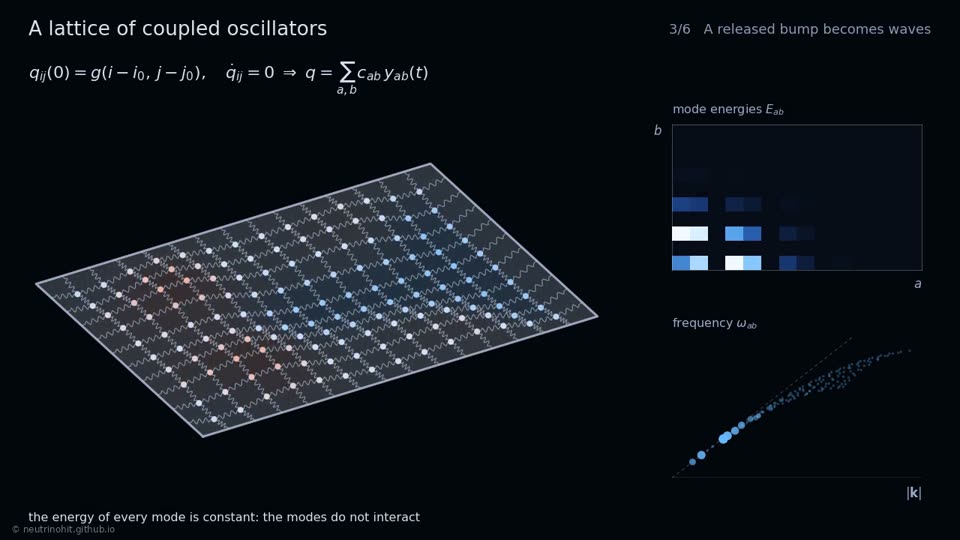
A lattice of 14×10 masses on springs: normal modes and the map of their energies, circular waves from a released displacement, colliding waves in a linear lattice and with anharmonic terms (energy redistributed between modes), the limit N → ∞ and the field.
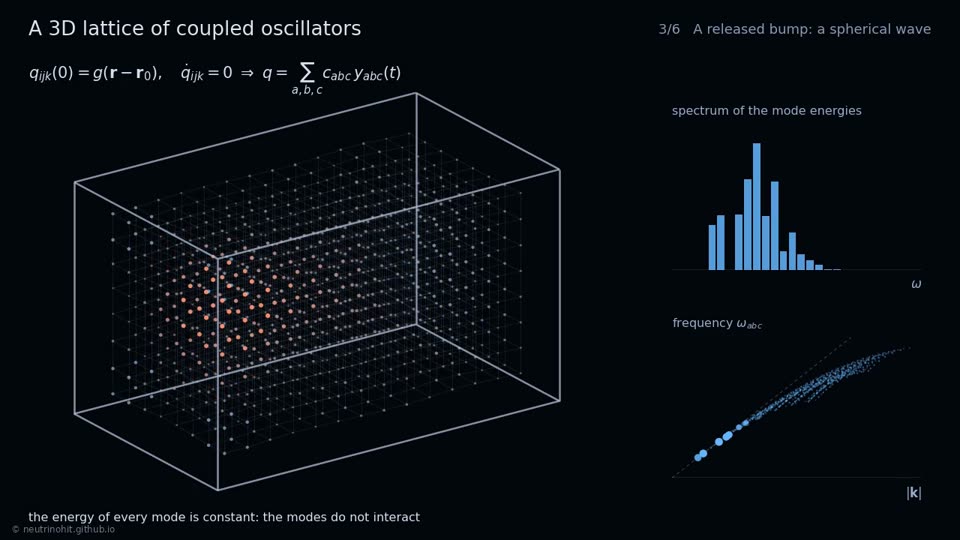
A box of 14×8×8 masses on springs: normal modes and the spectrum of their energies, a spherical wave from a released displacement, colliding waves in a linear lattice and with anharmonic terms (energy redistributed between modes), the limit N → ∞ and the field.
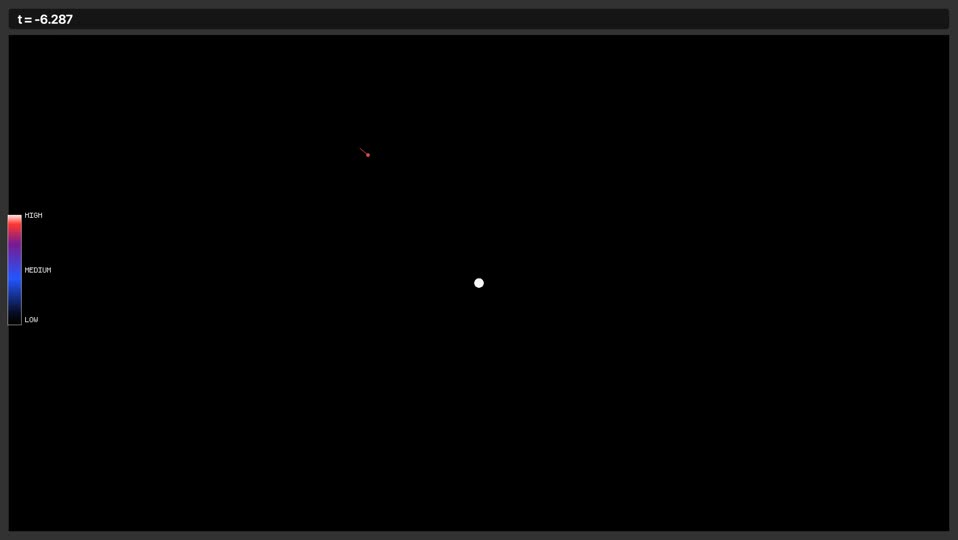
A numerical 3D visualization of the field of a moving charge.
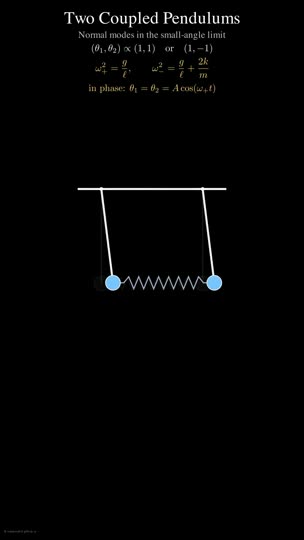
Energy transfer between two coupled pendulums.
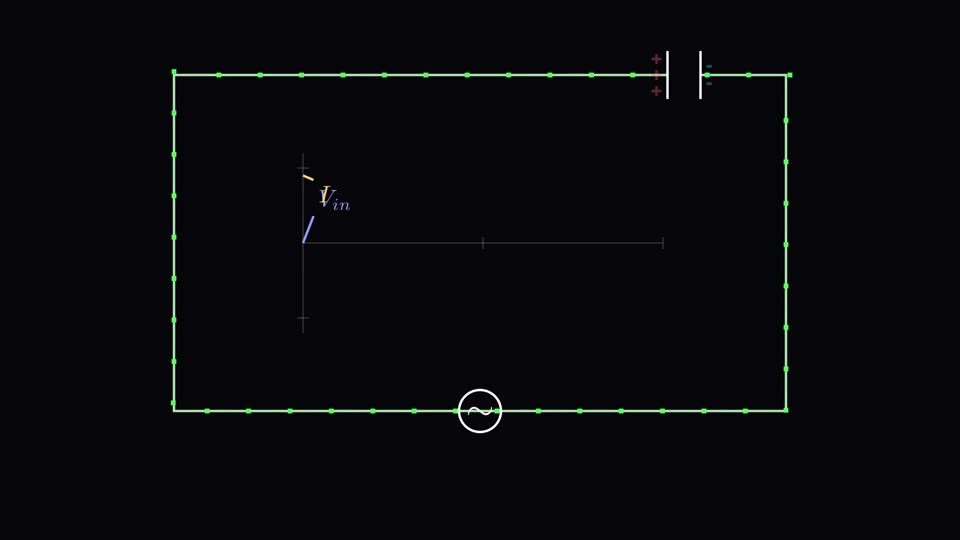
Phase relations and the charging of a capacitor in an AC circuit.
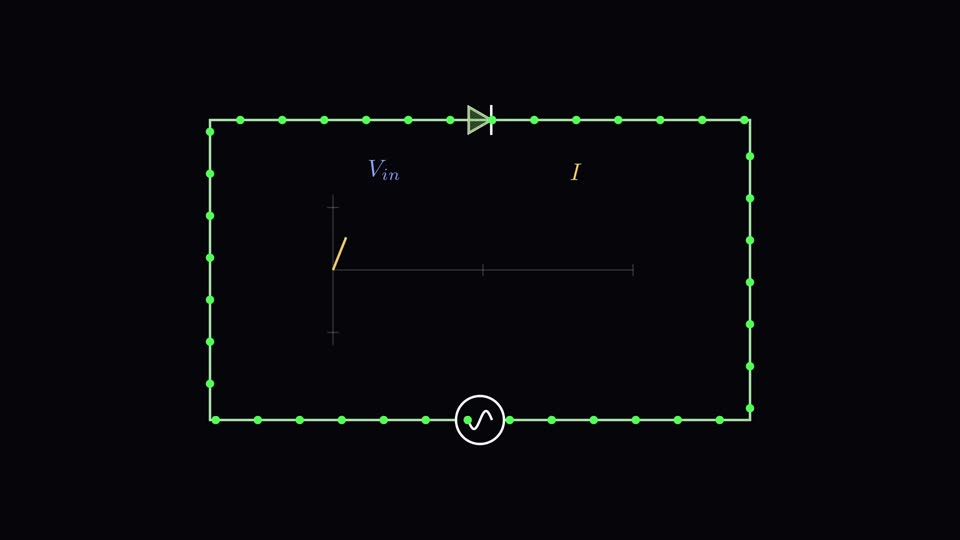
Half-wave rectification and the operation of a diode in an AC circuit.
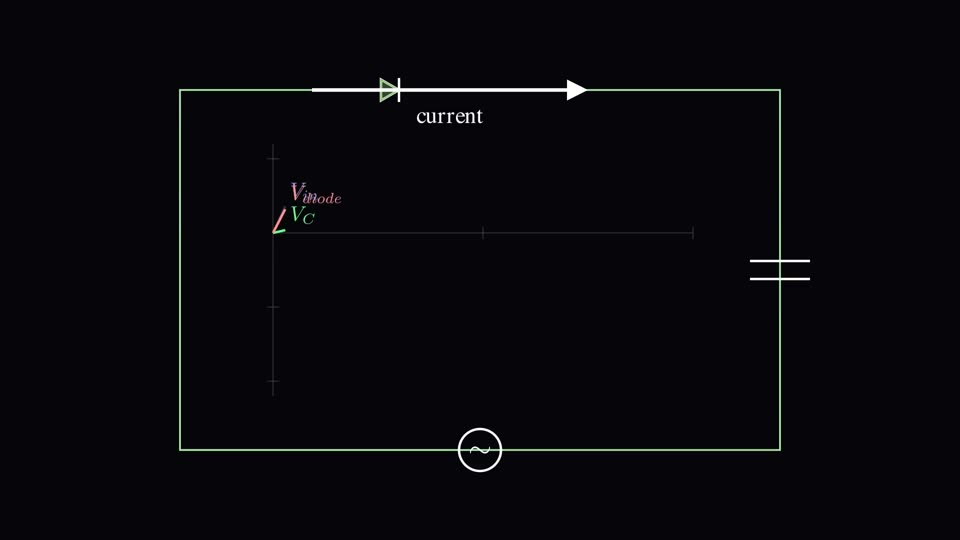
How a peak detector made of a diode and a capacitor works.
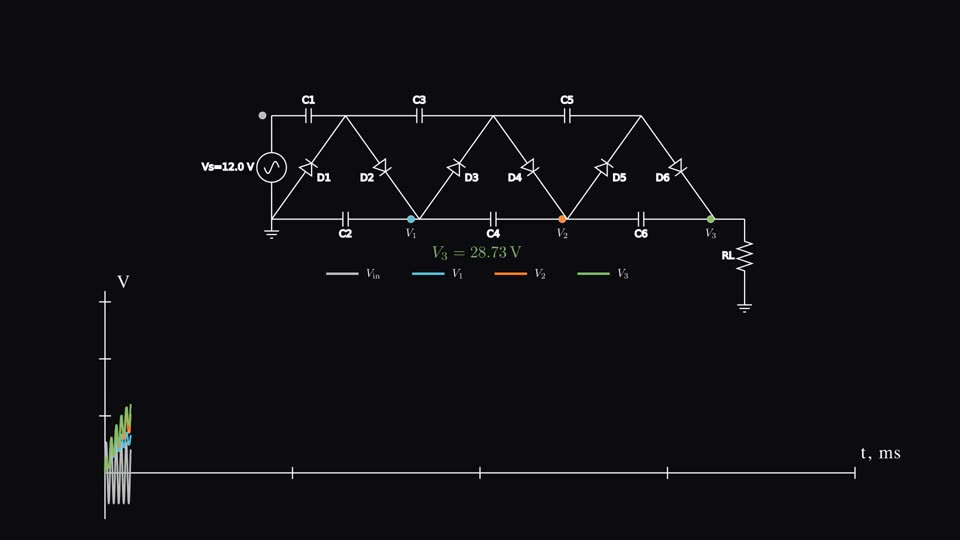
A voltage multiplier circuit and the successive charging of its stages.
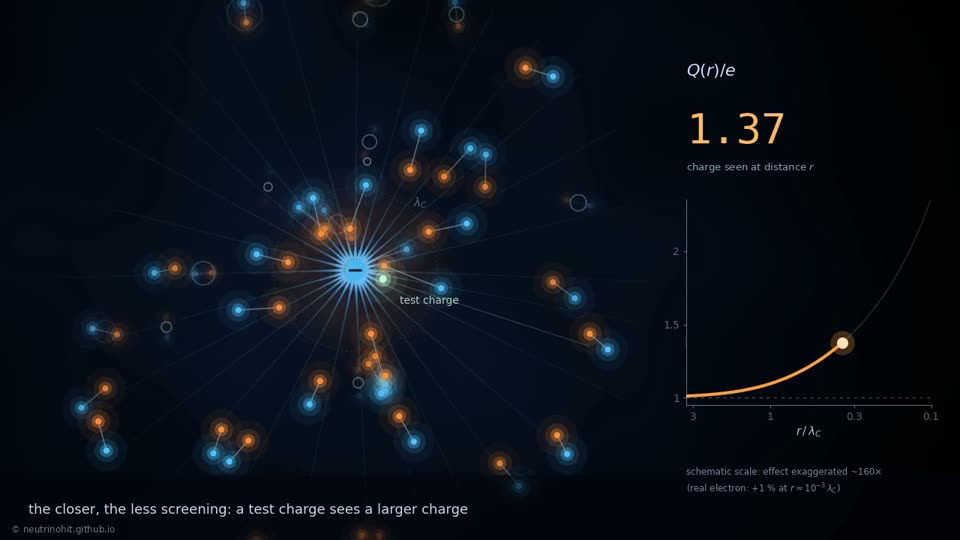
Virtual electron–positron pairs line up around an electron and screen its charge; a test charge flying in sees an ever larger charge. The scale of the effect is conventional.
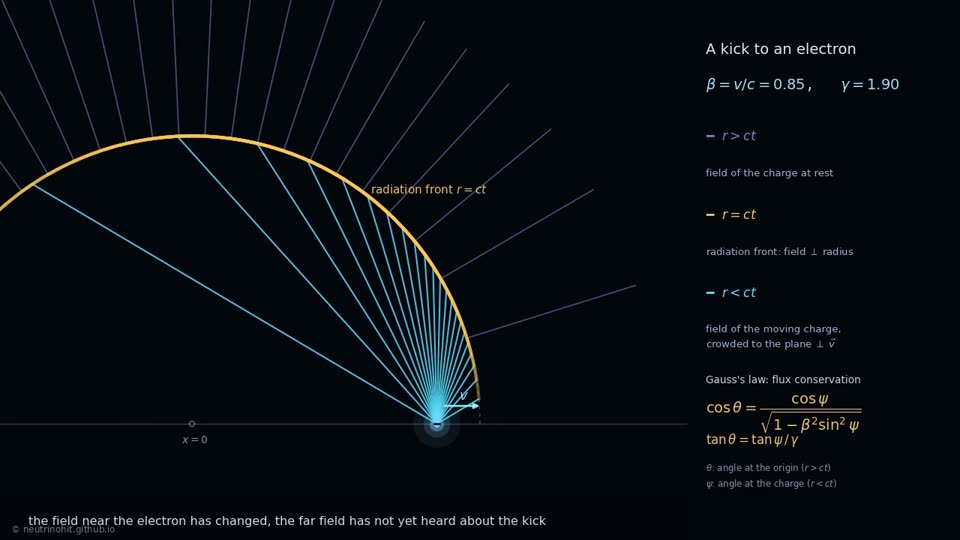
A charge suddenly gets a velocity: outside the sphere r = ct is the field of the charge at rest, inside it the field of the moving charge, and on the sphere the field lines are joined by arcs. The exact relativistic picture for β = 0.30 and 0.85.
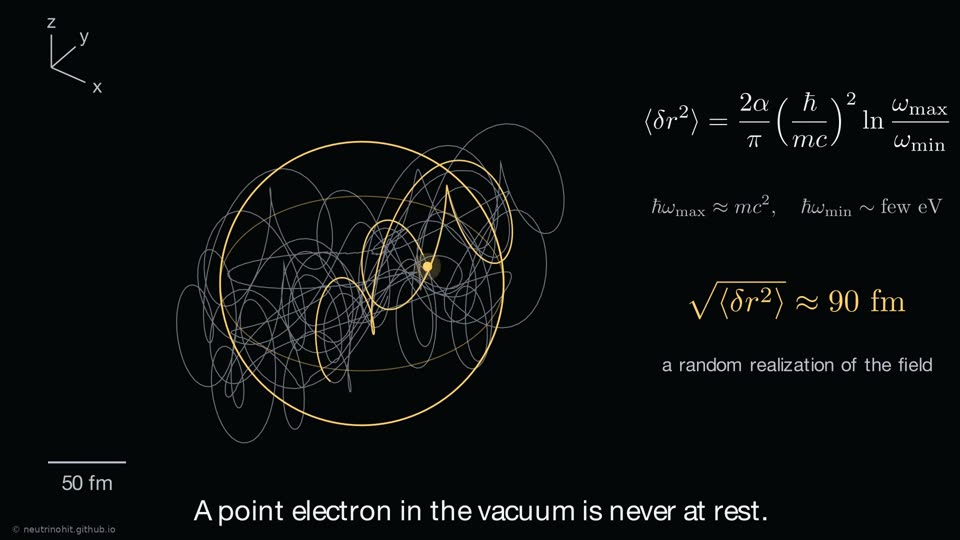
Zero-point fluctuations of the electric field: at each point the vector E goes round an ellipse at every frequency, ⟨E⟩ = 0, ⟨E²⟩ ≠ 0. The electron follows the ellipse with an amplitude ∝ E/ω²; each octave contributes equally, ⟨δr²⟩ = (2α/π)(ħ/mc)² ln 2, and the path fills a ball √⟨δr²⟩ ≈ 90 fm. Two versions: Russian and English.
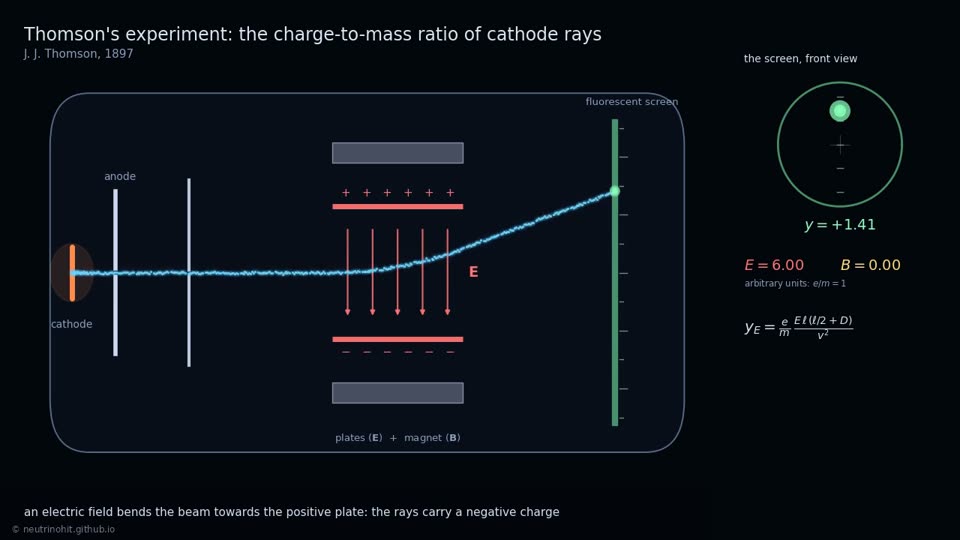
Cathode rays in crossed E and B: deflected up by the electric field, down by the magnetic field, the balance v = E/B and the ratio e/m from the deflection. The trajectories are computed numerically. Two versions: Russian and English.
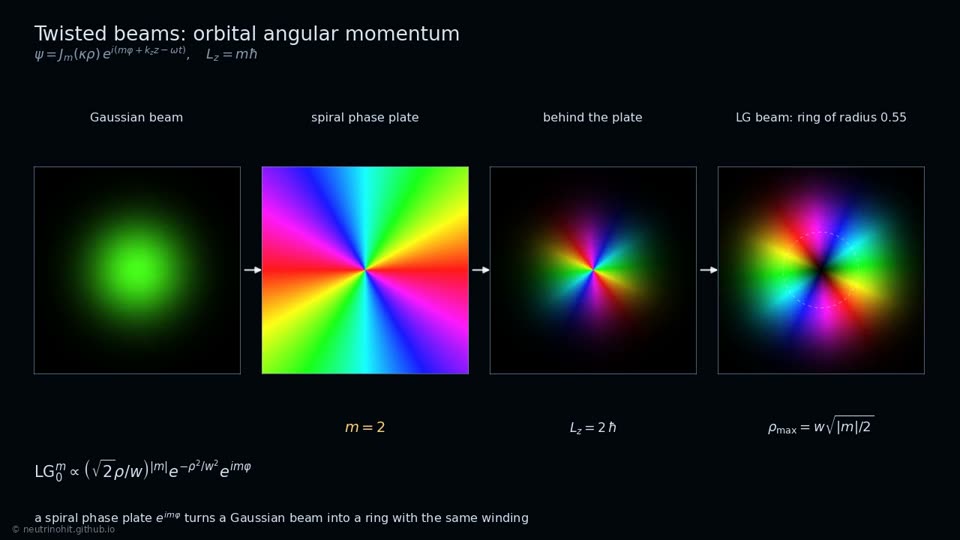
The phase makes m turns around the axis, L_z = mħ; helical wavefronts with m starts; making the beam with a spiral phase plate (a Gaussian beam → a Laguerre–Gaussian mode). Two versions: Russian and English.
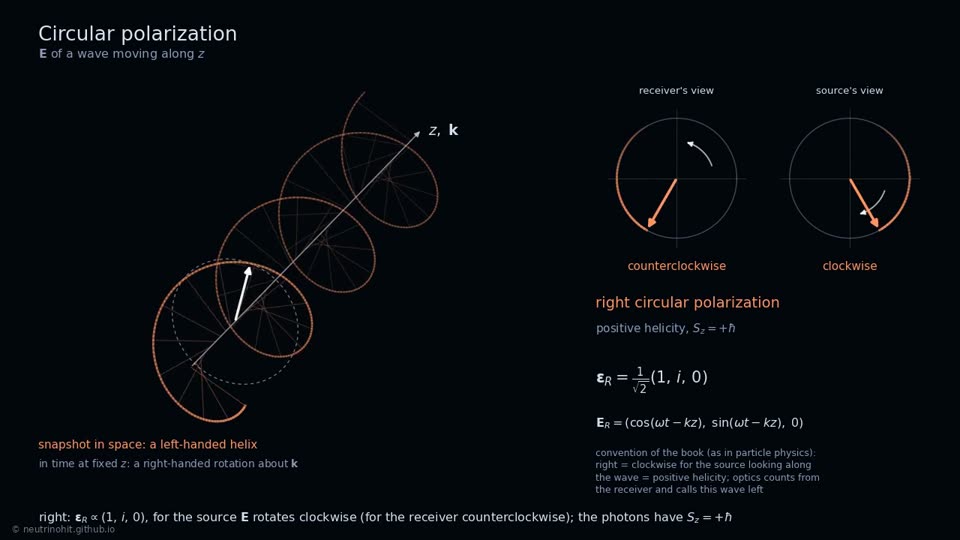
The rotation of E for the receiver and for the source, helicity S_z = ±ħ, an instantaneous snapshot in space (a left-handed screw) and the sum of ε_L and ε_R: linear, elliptical and circular polarizations. Two versions: Russian and English.
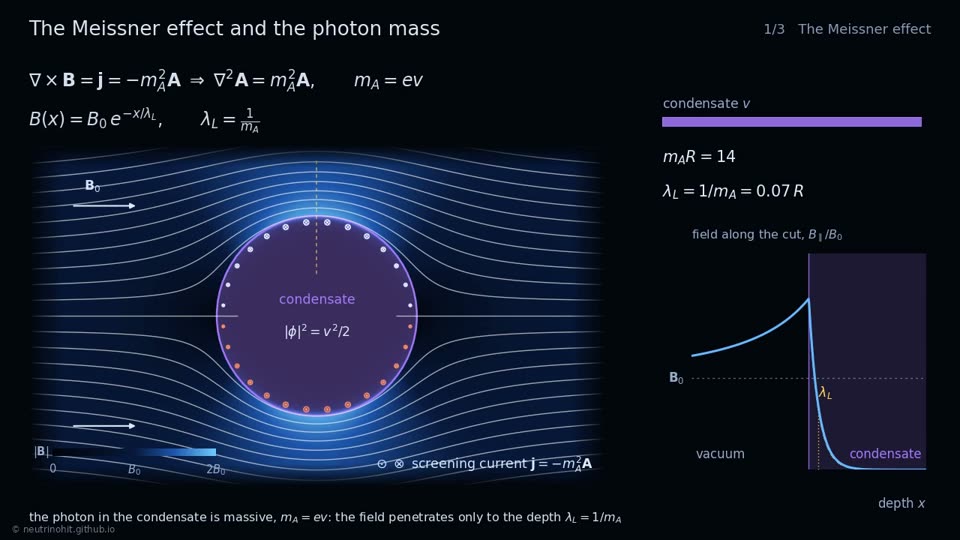
The Higgs condensate expels the magnetic field (the Meissner effect); a packet of an electromagnetic wave is reflected from the boundary of the condensate or passes with the group velocity k/ω < 1; the dispersion ω² = k² + m_A² and the count of polarizations 2 + 2 = 1 + 3.
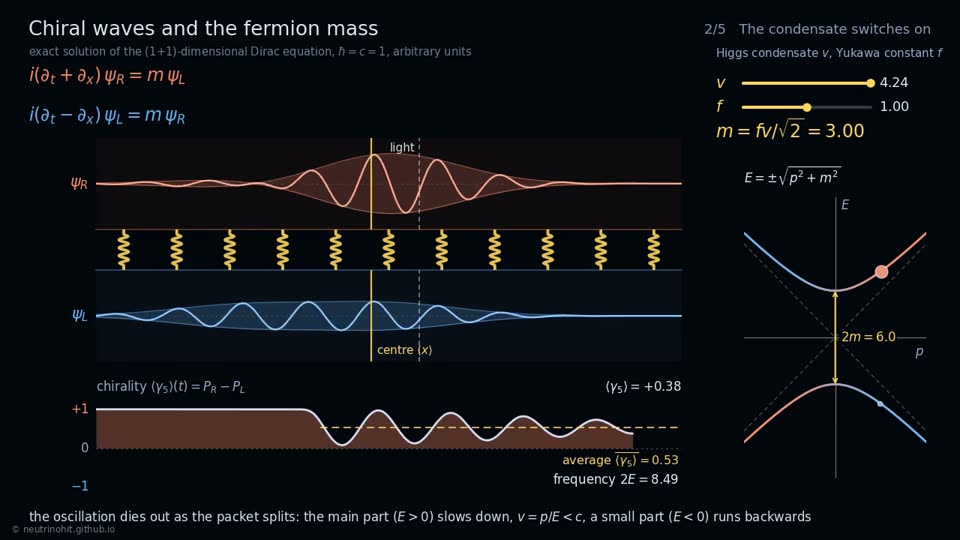
Two chiral waves of the Dirac equation in (1+1) dimensions: the mass is the coupling of ψ_R and ψ_L through the Higgs condensate; chirality oscillations with frequency 2E, the packet slows down to p/E, the mass term forbidden in SU(2) and the Yukawa coupling.
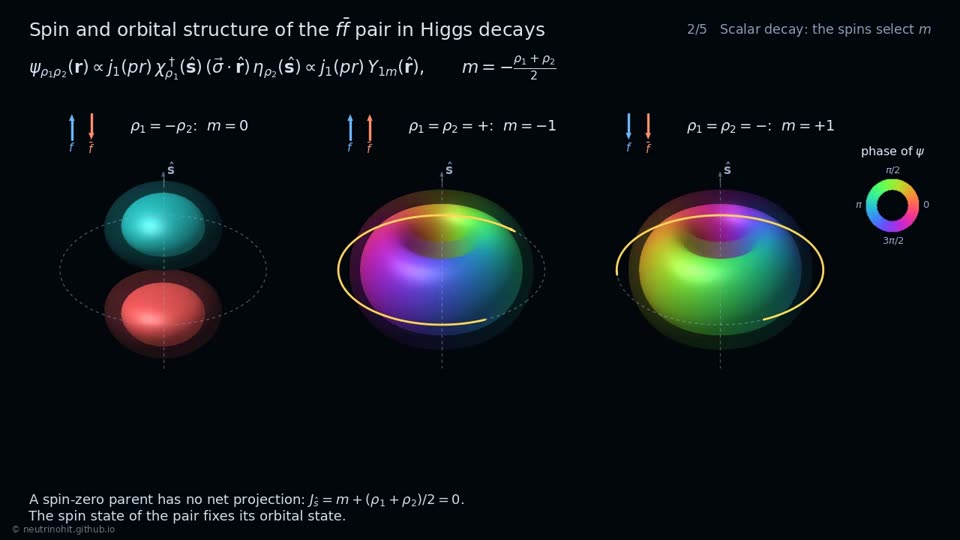
The wave function of the f f̄ pair in the relative coordinate: the P-wave of a scalar decay (a vortex, the orbital projection m is chosen by the spins), the S-wave of a pseudoscalar, the tilt of the cloud from scalar–pseudoscalar interference (CP oddness) and what remains for the detector.
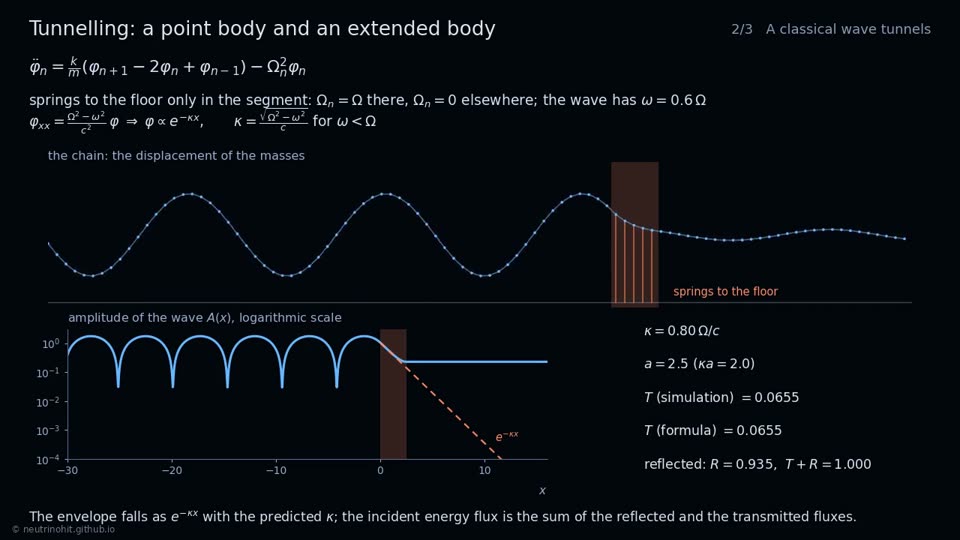
A ball, a train and a wave: an extended body feels an averaged barrier; a classical wave on a chain tunnels through a segment with T ≈ exp(−2κa) without quanta; for a matter wave the equation is the same, κ = √(2m(V−E))/ħ, and T falls exponentially with mass.
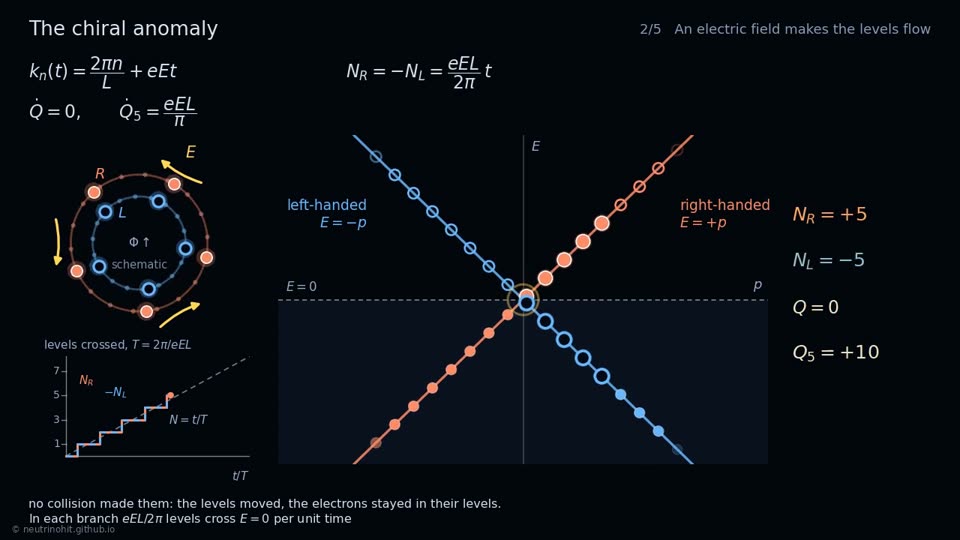
A massless fermion on a ring: an electric field shifts the levels, the levels cross E = 0 (the count gives dQ₅/dt = eEL/π); regularization and conservation of the vector current; Landau levels and e²E·B/2π²; the triangle and the decay π⁰ → γγ.
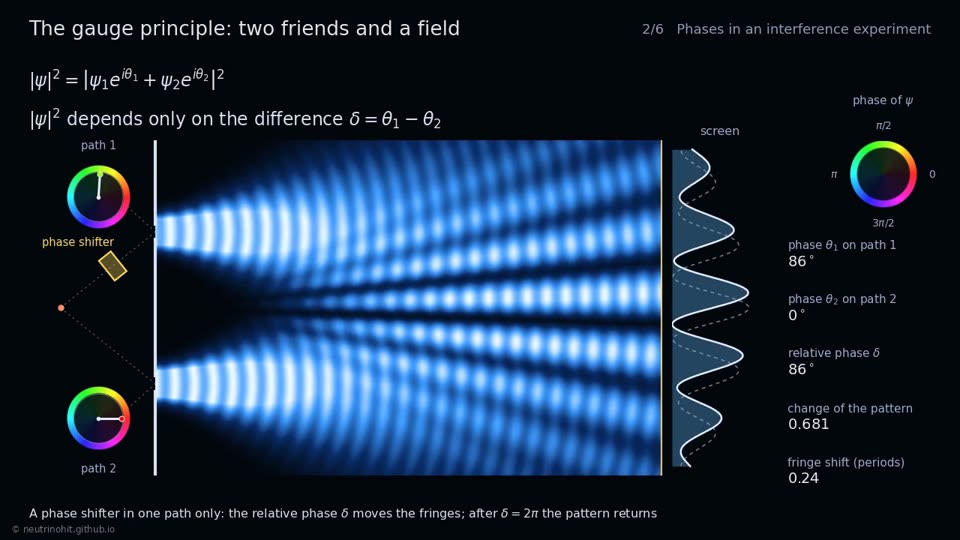
Two friends choose the phase of the wave function independently at every point: interference, a free packet and the covariant derivative; the compensating field A_μ, the field strength F and the gauge-invariant loop.
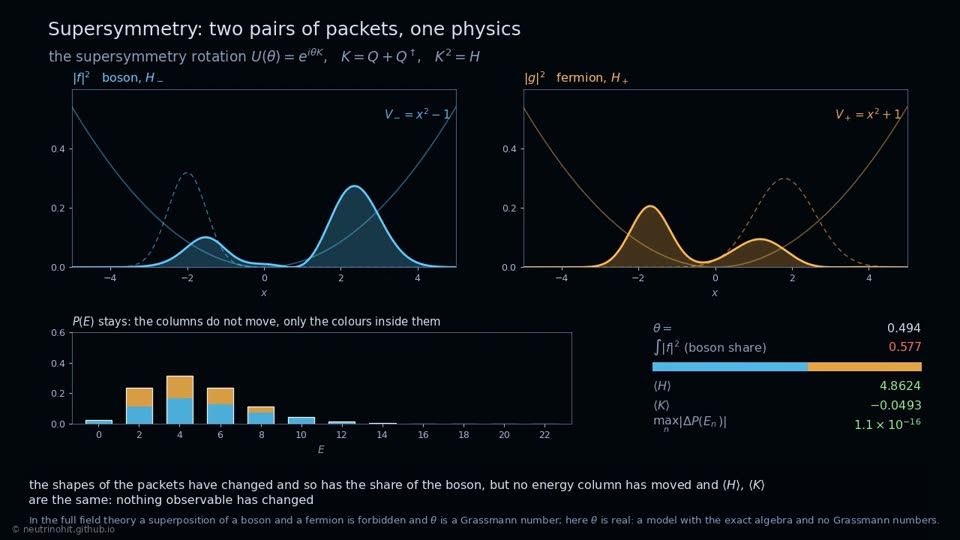
Supersymmetric quantum mechanics with W(x) = x (the oscillator), ħ = 2m = 1. A “boson” wave packet f and a “fermion” packet g of different shapes are turned by the supersymmetry rotation U(θ) = exp(iθK) into another pair of packets. The shapes and the boson share change (0.40 → 0.58 at θ = 0.5), but the energy distribution, ⟨H⟩, ⟨K⟩ and the whole time evolution do not: “rotate, then wait” and “wait, then rotate” coincide. At the end a soft breaking in the fermion sector splits the pairs of levels, and the two orders diverge. Everything is exact in the oscillator basis. A caveat: in the full field theory the parameter is a Grassmann number and a superposition of a boson and a fermion is forbidden; here the parameter is real.
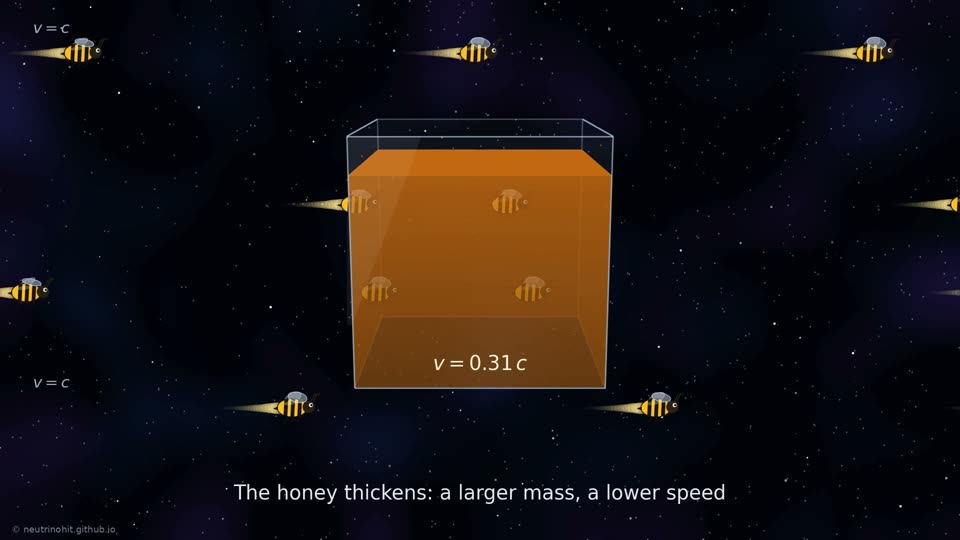
An image from the first chapter of the book. Bees fly through space at the speed of light. Honey pours into a transparent cube: its spreading is computed from the thin viscous film equation, and the volume is conserved exactly. In the honey the bees fly slower, v/c = √(1 − (mc²/E)²): 0.60c, and when the honey thickens, 0.31c; once out of the honey, they fly at the speed c again. A caveat: this is only an image: the Higgs field does not brake a particle like a viscous medium, it gives it a mass.
Animations for the book “Quantum Field Theory for Experimentalists and Beyond”: the relativistic image of a ball, the Rutherford experiment, a spinor and the Möbius strip.
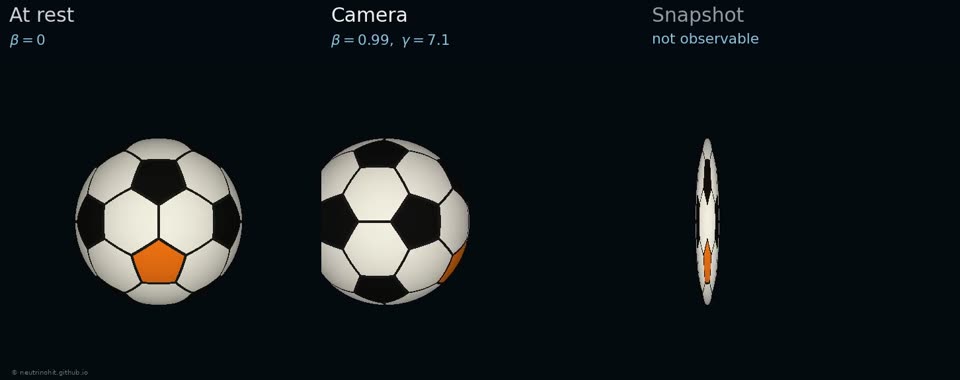
A football flies past a camera at 0.99 c. Ray tracing with retardation: the camera sees a round, rotated ball, while the instantaneous snapshot of the contracted ball cannot be observed.
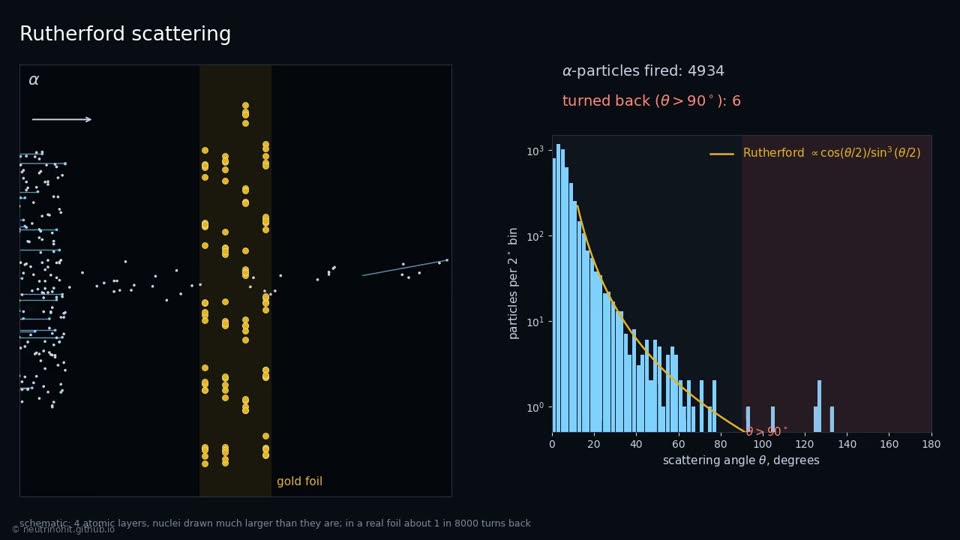
Alpha particles in the Coulomb field of the nuclei of a thin foil: the trajectories are computed numerically and the angular distribution is compared with the Rutherford formula.
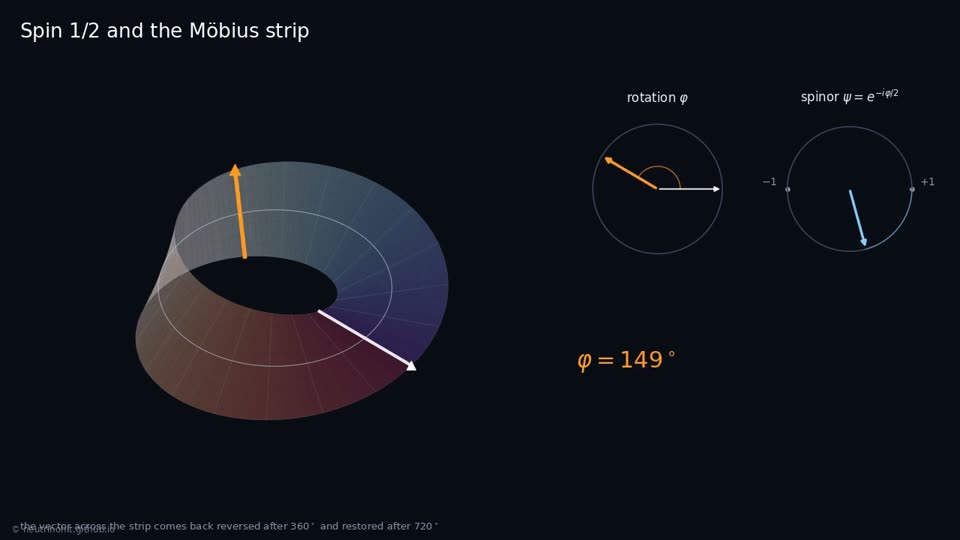
A rotation by 360° changes the sign of a spinor, a rotation by 720° brings it back: a vector on the Möbius strip and the component ψ = exp(−iφ/2).
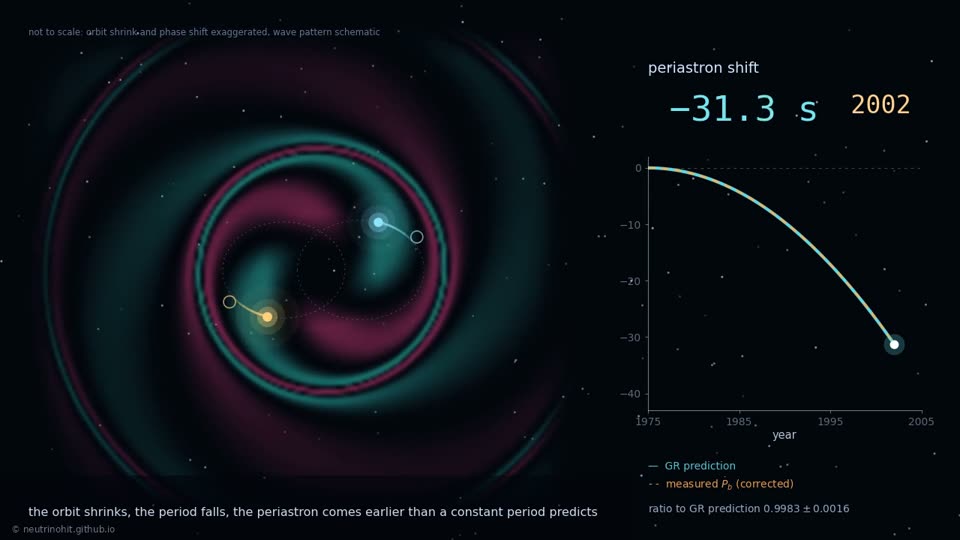
Two neutron stars on an eccentric orbit emit gravitational waves, the orbit shrinks and periastron comes ever earlier: the accumulated shift in general relativity and from the measured period derivative, 1975–2005.
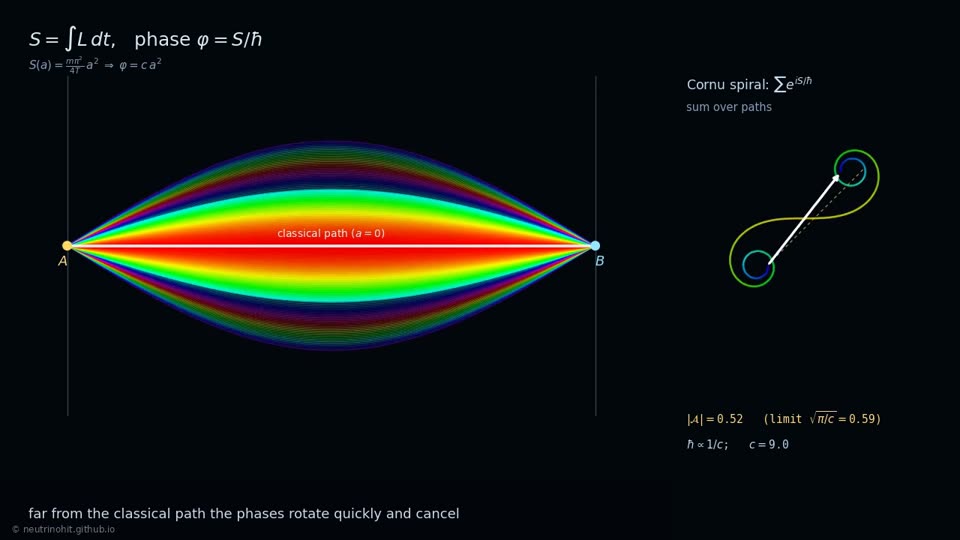
The amplitude as a sum over paths: screens with 3, 7 and 5 slits (105 paths), then all paths and the Cornu spiral, and the classical limit ħ → 0.
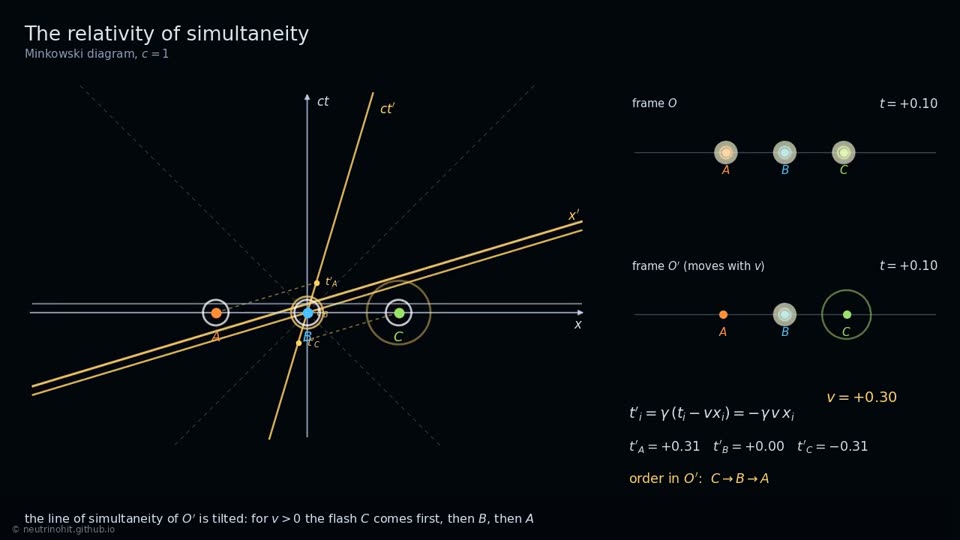
A Minkowski diagram: flashes A, B, C are simultaneous in O and come in the order C, B, A (v > 0) or A, B, C (v < 0) in O′; spacelike pairs change their order, timelike pairs never do. Two versions: Russian and English.
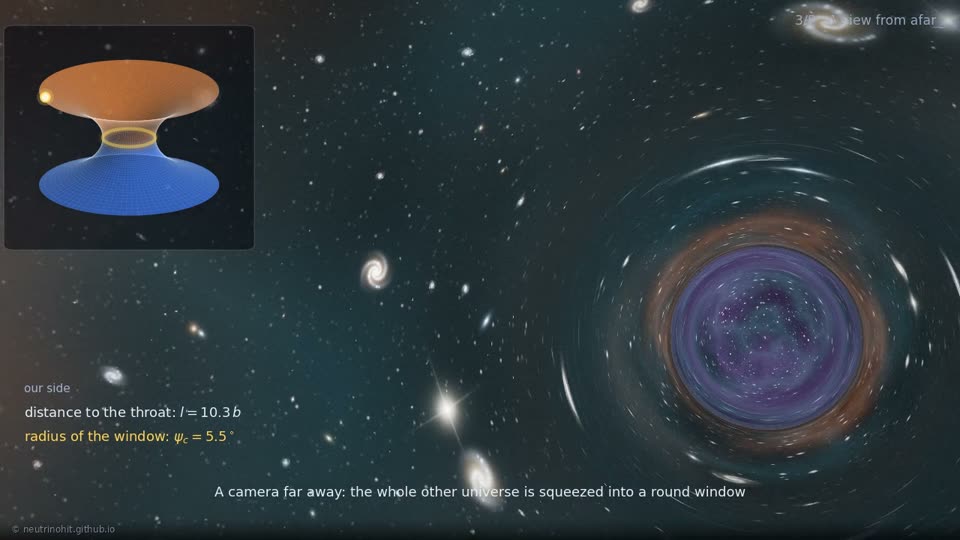
The Morris–Thorne wormhole as a solution of the Einstein equations, light rays on its surface and the view from a camera that flies around the wormhole, passes through the throat and sees the light of the galaxies of both universes.
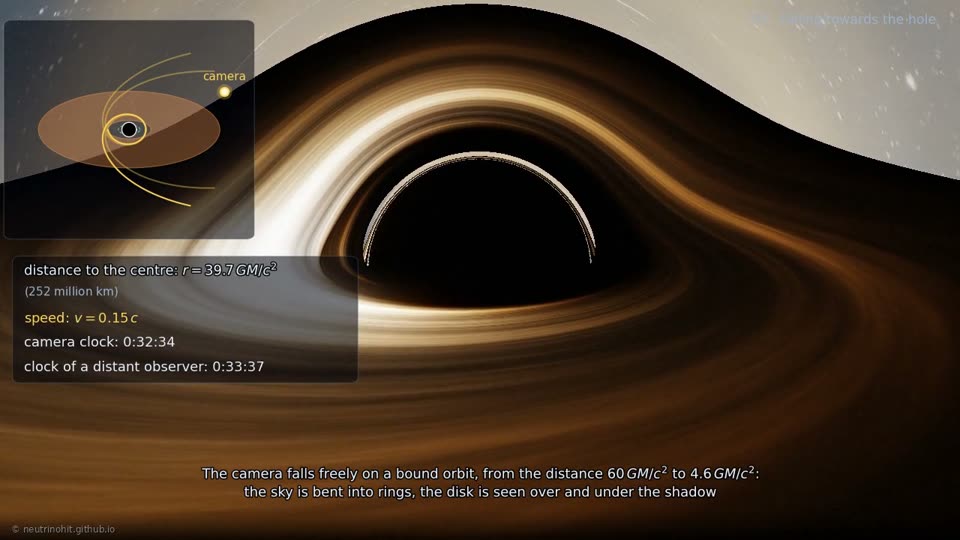
A camera falls freely on an orbit around a non-rotating black hole: light rays in the Schwarzschild metric, the shadow, the disk and its images, aberration and the frequency shift at a speed of 0.65c, the clocks of the camera and of a distant observer.
Fourier drawing, attractors, retrograde motion, spirals and complex powers.
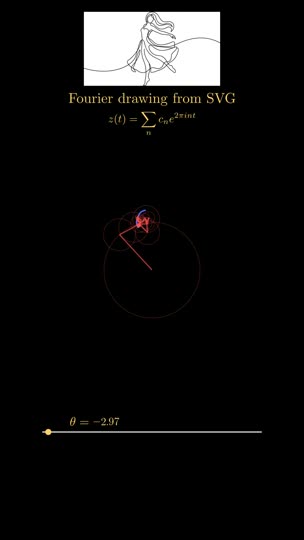
Contours approximated by epicycles and Fourier series.
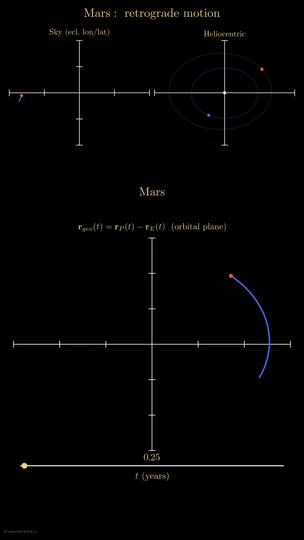
The geocentric picture and epicycles for the planets.
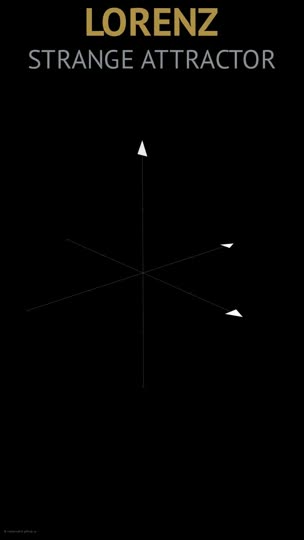
Classical dynamical systems in phase space.
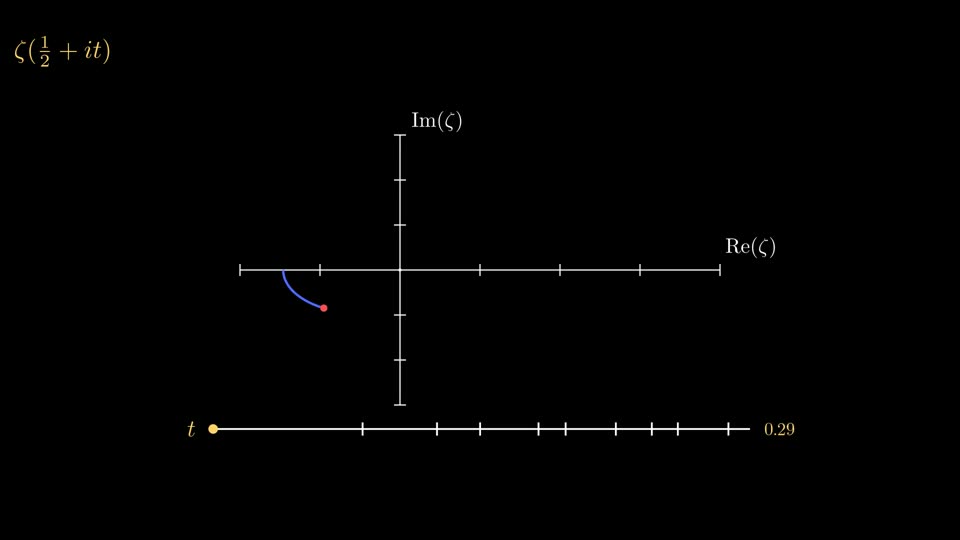
The path of the values of the zeta function in the complex plane.
The digits of π gathered into a short spiral visualization.
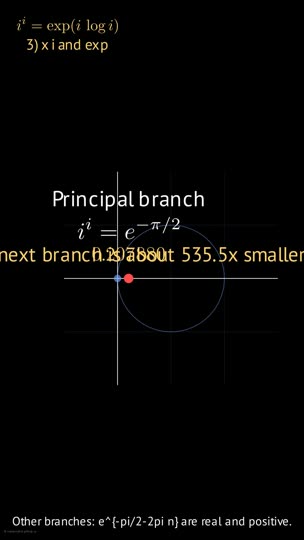
A visual story about the powers of the imaginary unit and motion in the complex plane.
How dipoles, quadrupoles and sextupoles steer and hold a particle beam.
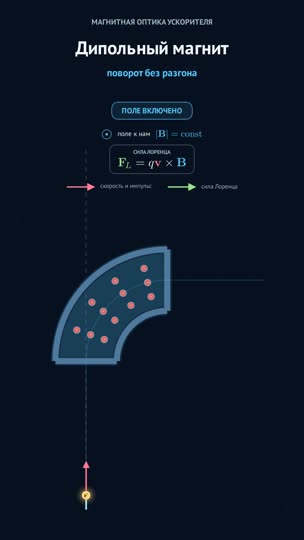
Why a magnet turns a particle but does not increase its energy.
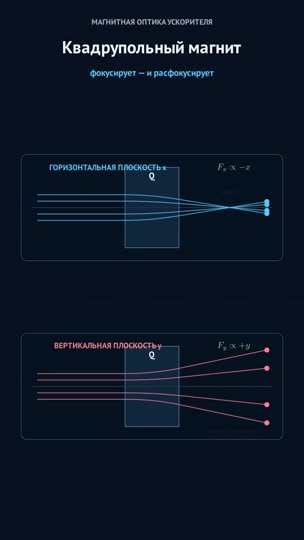
How alternating quadrupoles hold the beam in both planes at once.
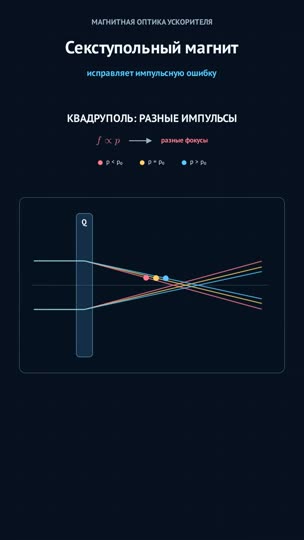
Why one quadrupole is not enough and how a sextupole corrects the momentum error.
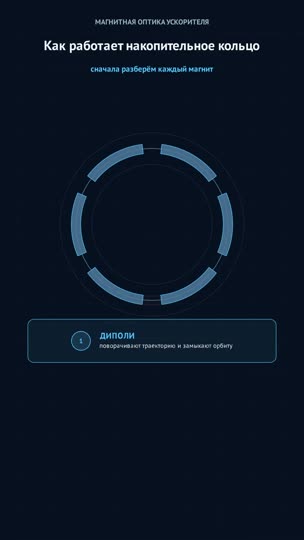
Dipoles, quadrupoles and sextupoles step by step, and then a full turn of the beam around the ring.
Short stand-alone animations and popular-science visual stories.
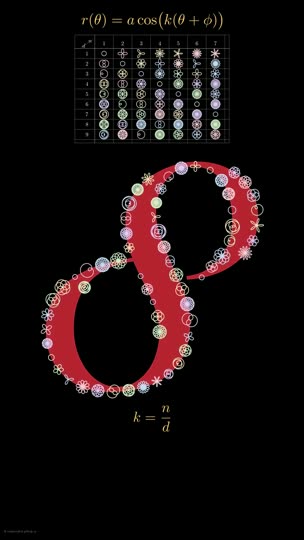
A parametric rose and a short festive film.
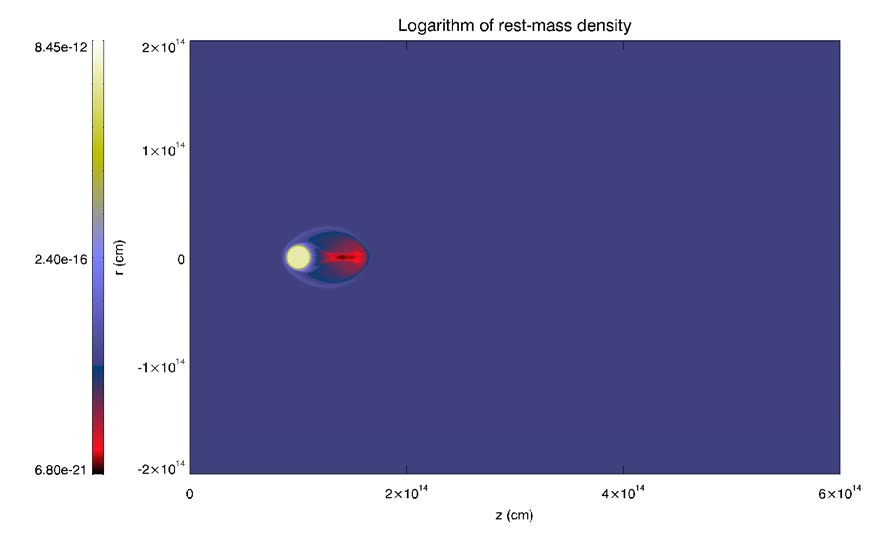
Astrophysical films; the animations were provided by M. V. Barkov.
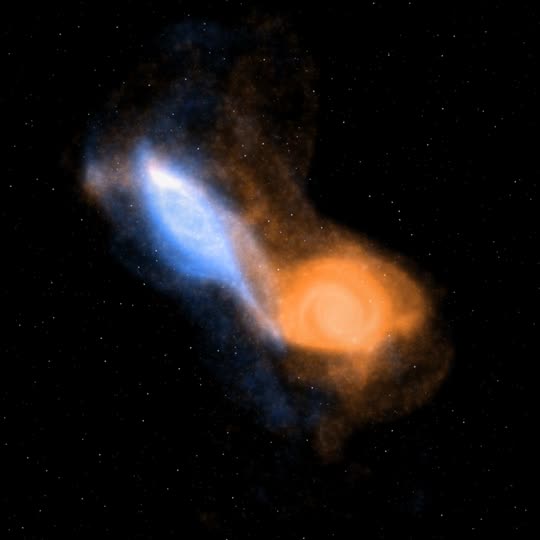
The collision of two disk galaxies in a restricted N-body problem with dynamical friction: tidal bridges and tails, then a rounded remnant. A calculation in the spirit of the 1972 paper by Alar and Juri Toomre.